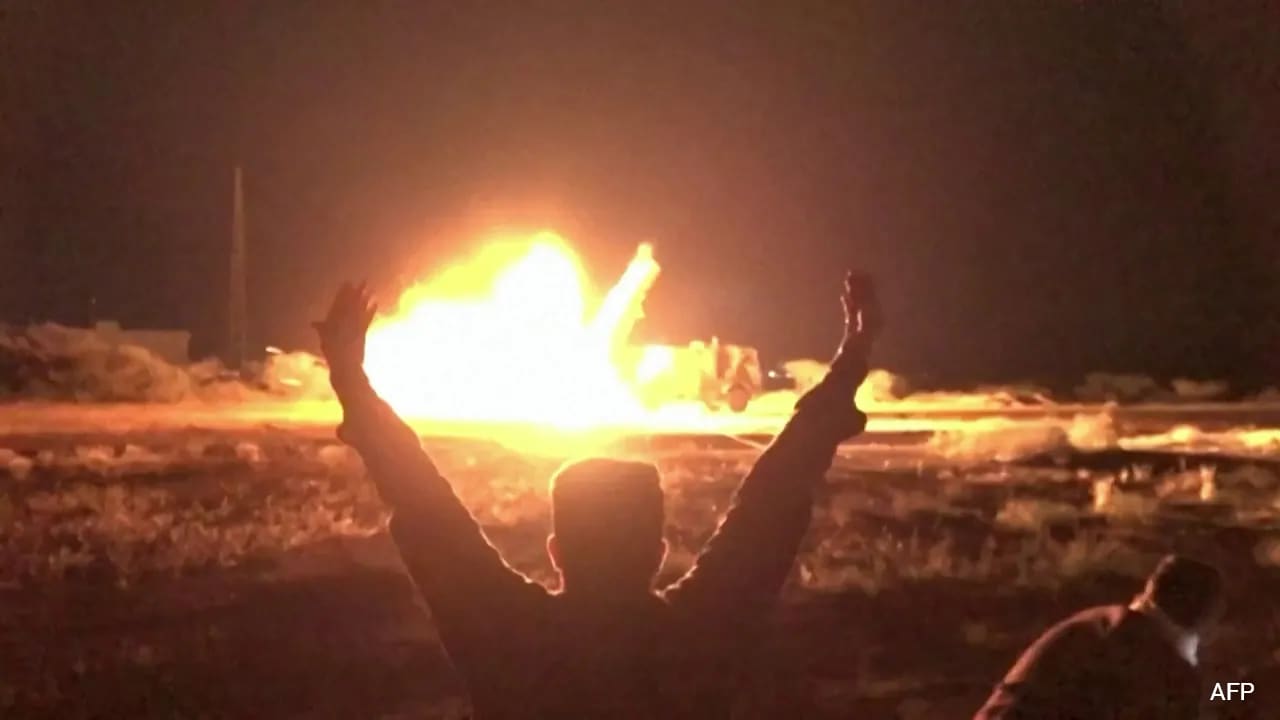
Behind this latest flare-up lies a collapsed peace effort.
Iran's health ministry said at least 50 people had been killed and more than 500 wounded in the latest wave of US strikes.
Here are 10-points on this big story:
- The US carried out its eighth consecutive night of strikes on Iran on Sunday, aiming to punish Tehran after American deaths in Jordan two days earlier. CENTCOM said the raids were designed to "swiftly punish Islamic Revolutionary Guard Corps forces who launched attacks against American service members in Jordan last night." Footage released by the military showed fighter jets and Tomahawk cruise missiles hitting coastal surveillance, air defence and missile storage sites, along with the under-construction Darkhovin nuclear power plant. Iran's Atomic Energy Organisation called the nuclear plant strike "an aggressive and brutal act contrary to international law."
- Iran responded within hours. Its army said it struck two US bases in Kuwait with drones, hitting an ammunition depot at Camp Udairi and Patriot radar systems at Ali Al Salem Air Base. Bahrain's military said it "confronted, intercepted, and destroyed a number of treacherous Iranian aerial attacks," accusing Tehran of targeting civilians. In Jordan, sirens sounded as Israeli and Jordanian forces intercepted an Iranian missile heading towards the port city of Aqaba, after the US embassy in Amman had warned of a "specific and credible threat" to the city's port and airport.
- Kuwait's electricity ministry said one of its power and desalination plants was attacked for a second consecutive day, sparking a fire. Around 90 per cent of Kuwait's drinking water comes from desalination, putting daily life at risk.
- An Israeli military official said on Sunday that Israel is preparing to receive more US refuelling aircraft, hinting at expansion of military operations against Iran. The official said the US had "decided to adjust its force posture in the region" and would "reinforce the existing fleet of aerial refuelling aircraft stationed in Israel with additional refuelling aircraft." Israel has not joined the latest wave of US attacks, though it has hosted dozens of refuelling aircraft.
- The latest escalation was triggered on Friday, when an Iranian strike on a base in Jordan killed two US service members. CENTCOM said they died as they "defended against Iranian ballistic missile and drone attacks." A third remains missing, and four others needed hospital treatment. This took the confirmed US military death count to 16 since the war began, with more than 430 wounded.
- Iran's Revolutionary Guards said four ships attempted to transit the Strait of Hormuz without their permission and two "had an accident and were stopped in place". The other two abandoned their journey, they said. The strait handles a fifth of the world's oil and gas trade in peacetime, and the US has separately redirected five ships and disabled one under its naval blockade over the past week.
- Iran's health ministry said at least 50 people had been killed and more than 500 wounded in the latest wave of US strikes. Overall, thousands have been killed and several million internally displaced in the conflict, mainly in Iran and in Lebanon, where a war between Israel and Iran-backed militant group Hezbollah was reignited.
- A day earlier, on Saturday, Iran's Supreme Leader Mojtaba Khamenei said the US would face an "unforgettable lesson" if the strikes continued. Khamenei, who has not been seen publicly since the war began, also dismissed a deal bearing US President Donald Trump's signature as "worthless and invalid". Iran's joint military command also issued a warning of its own, saying that US "covetousness, bullying, totalitarianism or brutality" would meet with a "devastating response."
- Behind this latest flare-up lies a collapsed peace effort. With both sides deadlocked over the Strait of Hormuz, the interim agreement fell apart entirely. An Iranian negotiator said Tehran was suspending its commitments to the deal, closing the door on a political settlement for now.
- The conflict traces back to 28 February, when the US and Israel launched the war with strikes on Iranian targets. Iran's then-supreme leader was killed in that opening attack, and his son, Mojtaba Khamenei, was injured.
Show full article


