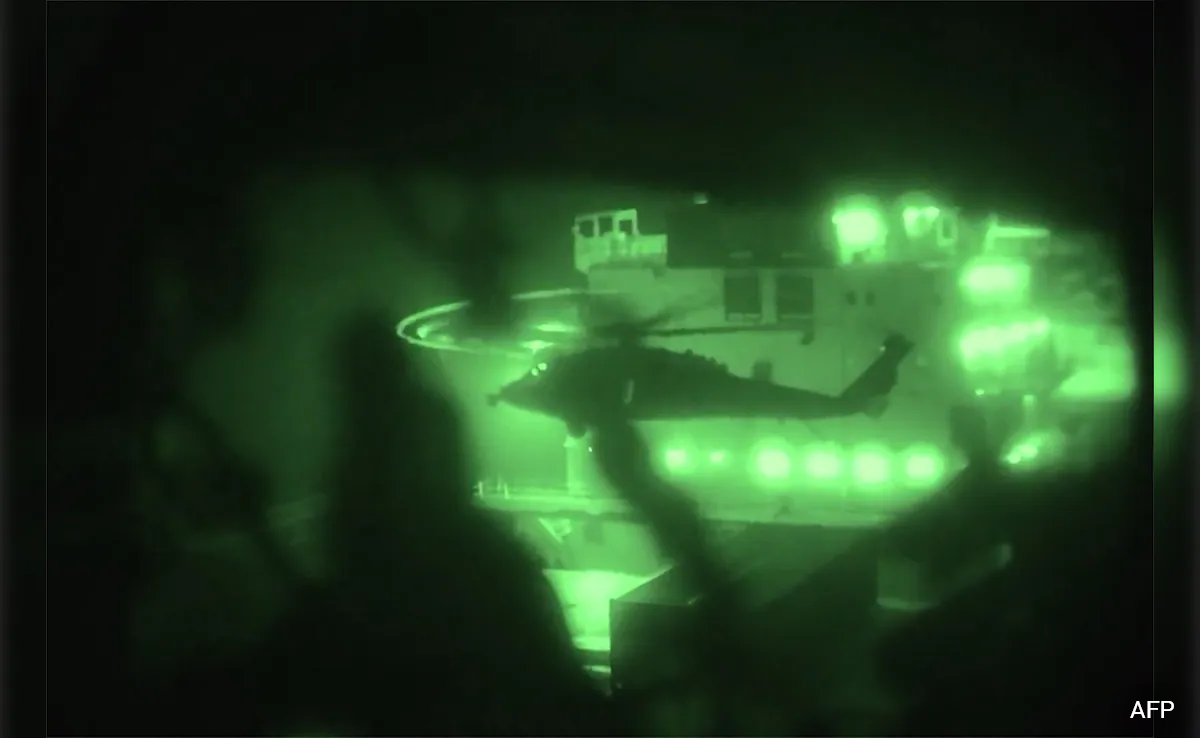
An image from the Arabian Sea says more than any speech. It shows the gap between US President Donald Trump's claims and the ground reality of America-Israel's unilateral war on Iran.
The picture shows US forces taking over an Iranian cargo ship after it was hit by the US Navy destroyer USS Spruance. Later, Marines from the USS Tripoli boarded the ship, the MV Touska, and seized it.
Trump said the ship was stopped because it didn't follow orders. He added the US was ready for peace talks with Iran. But within minutes, Iran pushed back.
The Islamic Revolutionary Guard Corps (IRGC) dismissed the idea of negotiations and warned of retaliation, calling the US action "armed piracy."
"We warn that the armed forces of the Islamic Republic of Iran will soon respond and retaliate against this armed piracy of the US military," said the IRGC spokesperson.
On the one hand, Washington signals diplomacy, while on the other hand, it carries out aggressive military action. That uncertainty is already hitting global trade.
Key routes such as the Strait of Hormuz and the Bab el-Mandeb, two of the world's most important oil and shipping routes, are under threat. Insurance companies are backing off, and without insurance, many ships cannot sail.
At the same time, Israel, a key US ally, is leading multiple wars - from Iran to the Gaza Strip, West Bank and Lebanon, along with threats from the Houthis in Yemen. There are also signs of strain in the US and Israeli militaries, with shortages of key weapons like long-range missiles and air defence systems.
Next, Trump will need approval from the US Congress to continue funding the war. The total cost is expected to be around $200 billion, but so far only about $40 billion has been approved. People in the US may soon face higher petrol and food prices, and inflation could rise above 4.5 percent.
Even with high-tech spying, including spy planes, drones and satellites, the US and Israel are still struggling to locate many of Iran's hidden weapons. Several drones and missile launchers are believed to be stored in caves and underground bunkers.
Add to that the fact that keeping the Strait of Hormuz open is not an easy task as the US Navy needs to deploy large forces to secure the route.
Doing that could weaken America's position in other regions, such as Europe, where tensions over Ukraine continue, and in Asia, including areas around Taiwan and the Sea of Japan.
Inside Iran, the situation remains tense as the US is not dealing with a single, unified country but with multiple power centers pulling in different directions, according to The Economist.
On the one hand are Iran's civilian leaders, looking to ease tensions; on the other are hardline forces such as the IRGC, holding significant military power and often taking a more aggressive stance.
Track Latest News Live on NDTV.com and get news updates from India and around the world


