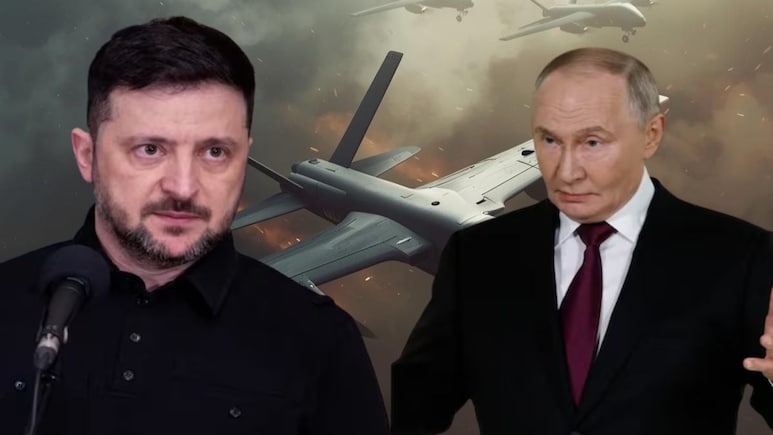
Ukraine has reportedly developed a silent air defence system capable of taking out Russian drones mid-air with almost no sound or visible trace.
The prototype system, known as Sunray, was recently demonstrated in the field, where it burned through a small UAV within seconds, causing it to fall from the sky, according to The Atlantic.
Narrating the scenario, The Atlantic reporter Simon Shuster said the laser system, known as a laser cannon, was placed on the roof of a pickup truck in an empty field. Then, from a few hundred yards away, an engineer launched a small drone. Soon after, the laser's cameras tracked the drone automatically.
The operator then shouted, "Fire," and immediately the drone caught fire midair. "Within seconds, the drone began to burn as if struck by invisible lightning, then fell to the ground in a fiery arc," said Shuster.
This was the first time Ukraine unveiled the Sunray laser weapon. Previously known as "Trident", the laser doesn't make any sound or visible beam. Colonel Vadym Sukharevsky, who leads Ukraine's Unmanned Systems Forces, said the Sunray can hit Russian aircraft up to 1.2 miles (around 2 km) away in the sky, reported the NY Post.
Sunray isn't the world's first laser weapon. The US Navy has its own laser system called Helios, developed by Lockheed Martin for $150 million and taking four years to build, compared to Sunray, which was built in just two years.
Sunray could be sold for a few hundred thousand dollars per unit, making it much cheaper than similar US-made laser weapons.
In January, Mykhailo Fedorov, Ukraine's defence minister, said, "The development of an 'anti-drone dome' is a matter of immediate necessity. It's not about the future. It's about survival today," reported The Kyiv Post.
Pavlo Yelizarov, recently appointed as commander of Kyiv's air-defense forces, pointed out that Ukrainian arms makers are personally invested in the fight against Russia, unlike American companies, which are mostly focusing on profit.
"Many American companies are driven by money. For them, it's a job. They do it. They get paid. We have another component at play: the need to survive," he said.
Track Latest News Live on NDTV.com and get news updates from India and around the world


