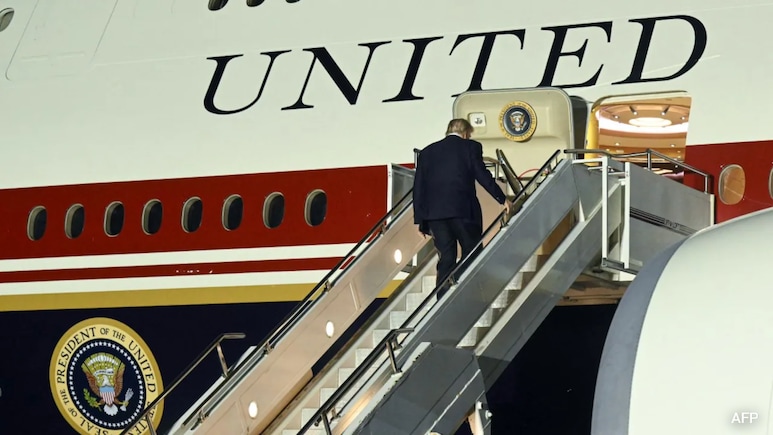
US President Donald Trump was secretly moved off Air Force One during a stop in Ankara, Turkey, last month after US officials believed Iran could target the presidential aircraft.
While Trump was taken to safety on another military plane, Air Force One continued its journey with Secretary of State Marco Rubio, Treasury Secretary Scott Bessent, senior White House aides Stephen Miller and Steven Cheung, along with reporters and other government personnel, reported The NY Times.
The people on Air Force One were not told that the plane was being used as a decoy. Journalists sitting at the back of the aircraft were instructed to keep their window shades closed during the flight. Trump later secretly rejoined Air Force One before landing to show him that he had been onboard throughout the journey.
Joe Lockhart, who served as White House press secretary to Clinton during his 2000 trip to Islamabad, said, "They just didn't seem to give a second thought to anybody but the president and the few people who were with him."
He recalled that when Clinton used the same trick, "We went out of our way to make sure the maximum number of people, especially civilians, were protected and not human shields. They didn't even think about it. And to me, that's the big difference."
A retired Navy rear admiral, who served as a senior White House, State Department and Pentagon spokesman, said the government had a responsibility not only to protect the president but also those travelling with him.
"And when the risk of that travel is knowable — as it certainly was in this case — they have an obligation to at least provide the broad contours of it so that travelers can make informed decisions," he said.
Former White House officials said such tactics can be necessary when the president faces a serious threat. Joseph W Hagin, who helped organise George W Bush's trips to war zones and later served as Trump's deputy White House chief of staff, said he would not second-guess the Ankara decision.
He said people who work at the White House or travel with the president accept a certain level of risk and that revealing the operation could have endangered Trump.
"I understand there is concern for those flying on what was assumed to be the primary aircraft, but when you go to work at the White House or travel with the president, you are accepting a not-insignificant degree of risk. Telling everyone what's up in an operation like this would have obviously jeopardized the president's safety," he said.
Trump defended the decision on Tuesday, saying he followed the advice of the Secret Service. He also rejected the suggestion that others had been placed at greater risk. "I think actually the plane that I flew on was at greater risk because that would be the plane I think that they would be more likely to go for," he said.
Trump's decision also differs from a similar operation carried out by former President Bill Clinton during a 2000 visit to Pakistan.
Clinton switched planes during that trip because of concerns about terrorist attacks. His team informed at least one journalist in advance and later made the details public after Clinton was safely out of Pakistan. The Trump administration did not disclose the Ankara operation. It became public only after The Washington Post first reported the secret plane switch.
Track Latest News Live on NDTV.com and get news updates from India and around the world


