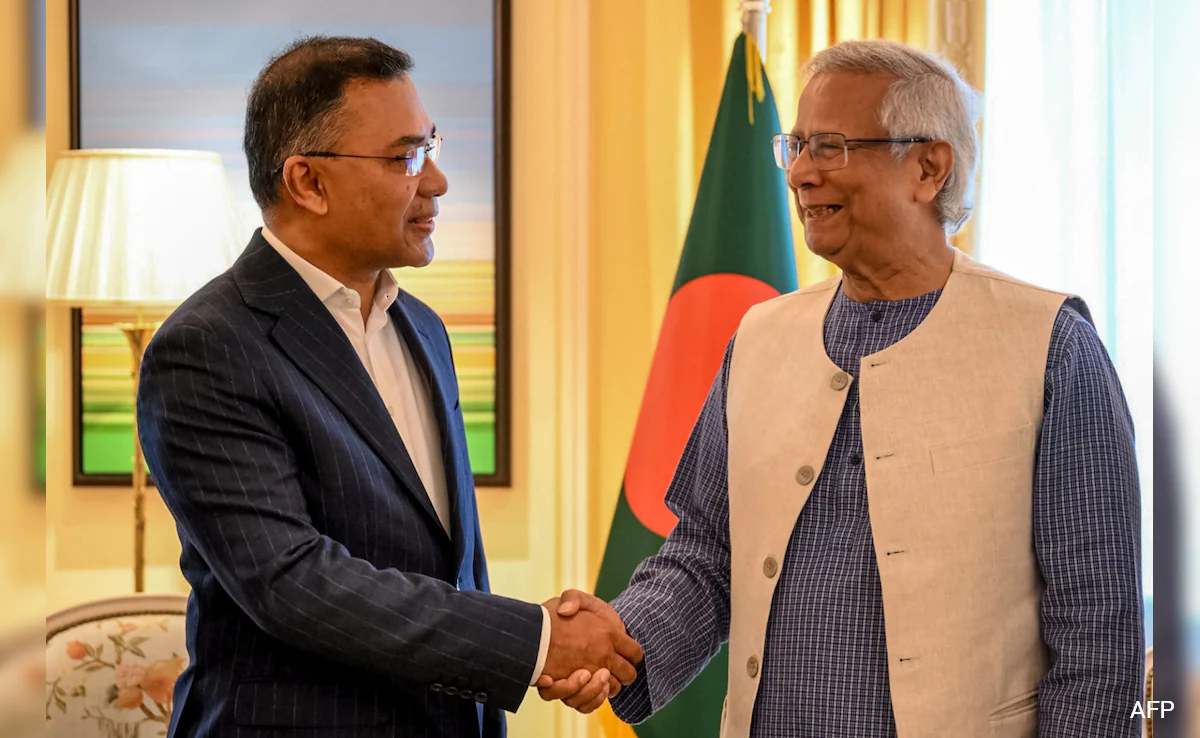
As supporters of the Bangladesh Nationalist Party (BNP) celebrate the return of Tarique Rahman to the country after 17 years, attention has shifted to the policies the party is likely to pursue under his leadership. The BNP is widely seen as the frontrunner in the upcoming elections. If the party secures victory, Rahman is expected to assume the country's top political role, facing the formidable task of steering Bangladesh through a period of political, economic, and institutional strain.
Rahman has, through a series of speeches and public statements, outlined how he plans to govern. The BNP has announced plans to mobilise as many as five million supporters to welcome him home. Rahman is scheduled to complete his voter registration and National Identity Card (NID) formalities on December 27, a procedural step that carries both administrative and symbolic weight.
Rahman Signals "Bangladesh First" Foreign Policy
Rahman has clearly articulated the foreign policy direction he envisages under a BNP-led government. Speaking in May, while stressing the need for elections and institutional reforms, Rahman questioned the legitimacy of Muhammad Yunus to take long-term foreign policy decisions without an electoral mandate.
Outlining his party's worldview, Rahman said Bangladesh's national interest would take precedence over all external considerations. He made it explicit that Dhaka would not align itself closely with either Rawalpindi or New Delhi. "Not Dilli, not Pindi - Bangladesh before everything," he declared at a large rally in Dhaka's Nayapaltan area, urging supporters to repeat the slogan.
This position marks a clear departure from the trajectory adopted by the current interim leadership. Yunus has charted a markedly different foreign policy course from that of former prime minister Sheikh Hasina, who had built close ties with India while balancing Bangladesh's engagement with China and maintaining distance from Pakistan. By contrast, Yunus has advocated closer engagement with Islamabad, a shift that has come at the cost of what many describe as a historically close India-Bangladesh relationship.
Restoring Law And Order
Law and order feature prominently in Rahman's public messaging. He has cautioned BNP leaders and supporters to remain vigilant, warning that the period ahead will be challenging. Rahman has said that signs of anarchy are emerging in different parts of the country, with certain groups attempting to foment disorder. "Everyone must stay alert," he said.
Referring to his family's political legacy, Rahman invoked the role of his parents in what he described as moments of national rescue and reform. He said BNP founder and former president Ziaur Rahman had pulled the country back from the brink of collapse, while BNP chairperson Khaleda Zia led Bangladesh out of autocracy in 1991 and placed it on a path toward development.
Rahman has also taken a sharp line against radical political forces. Speaking at the inauguration of the BNP's six-day "Plan to Build the Country" programme, he criticised groups such as Jamaat-e-Islami Bangladesh, accusing them of having a violent and divisive past.
"Those who are now asking people for support - the people of this country have already seen them in 1971. They not only killed lakhs of people, but their collaborators also violated countless mothers and sisters. We must never forget this," Rahman said, recalling Jamaat's role during the 1971 Liberation War.
Security For Minorities, Commitment To Democracy
Rahman has repeatedly emphasised the protection of minorities as a core principle of BNP policy. During this year's Durga Puja celebrations, he appealed for communal harmony, saying, "May all Hindus across the country be able to celebrate the festival with enthusiasm and joy, with safety and security. I urge all Bangladeshis, regardless of religion, to spread the message of harmony and goodwill."
He underlined a distinction between personal faith and the responsibilities of the state. "Our party, the BNP, and I believe that religion is for the individual, but the state is for everyone. Religion is for the individual, but the right to security is for everyone," Rahman said.
On democracy, Rahman has framed his political ambitions in the language of institutional renewal. "As a proud son and a committed activist of the Bangladesh Nationalist Party, I draw inspiration from my father's legacy, which unifies our nation in reclaiming the spirit of independence and striving for a democratic future for all Bangladeshis," he said.
Fighting Corruption High On Agenda
Anti-corruption reforms are another central pillar of Rahman's stated agenda. In a post on social media platform X, he acknowledged the scale of the challenge ahead. "Fighting corruption will be an uphill battle after years of systemic abuse. But Bangladesh's own history proves progress is possible. With commitment, discipline, and public support, meaningful reform can return. If entrusted by the people, BNP is prepared to lead that charge, once again," he wrote.
Rahman said the BNP intends to pursue institutional independence, greater transparency and accountability, judicial and law-enforcement reform, deregulation, expanded e-governance, and stronger whistleblower protections to ensure wrongdoing can be reported safely. He has also called for tougher financial oversight, including independent audits, digitised expenditure trails, and more robust parliamentary scrutiny of budgets.
Bringing More Women Into The Workforce
Increasing women's participation in the economy is another area where Rahman has outlined specific policy proposals. He said the BNP's objective is to build a modern, people-centred Bangladesh in which women are not forced to choose between family responsibilities and professional aspirations.
Citing data from the 2024 Bangladesh Bureau of Statistics Labour Force Survey, Rahman noted that only 43 per cent of women participate in the labour market, compared with 80 per cent of men. "That gap is a warning that we are leaving more than half of our nation's talent behind," he said.
To address this, the BNP is considering a nationwide childcare initiative as part of its economic growth strategy. Proposed measures include daycare centres in all public universities, a phased rollout of daycare facilities in government offices, mandatory childcare provisions in large private institutions and factories, tax incentives and corporate social responsibility credits for employers who provide childcare, and training and certification standards for caregivers under the Ministry of Women and Children's Affairs.
Together, these policy signals offer the clearest indication yet of how Tarique Rahman envisions Bangladesh's political, economic, and diplomatic direction should he and the BNP return to power.
Track Latest News Live on NDTV.com and get news updates from India and around the world


