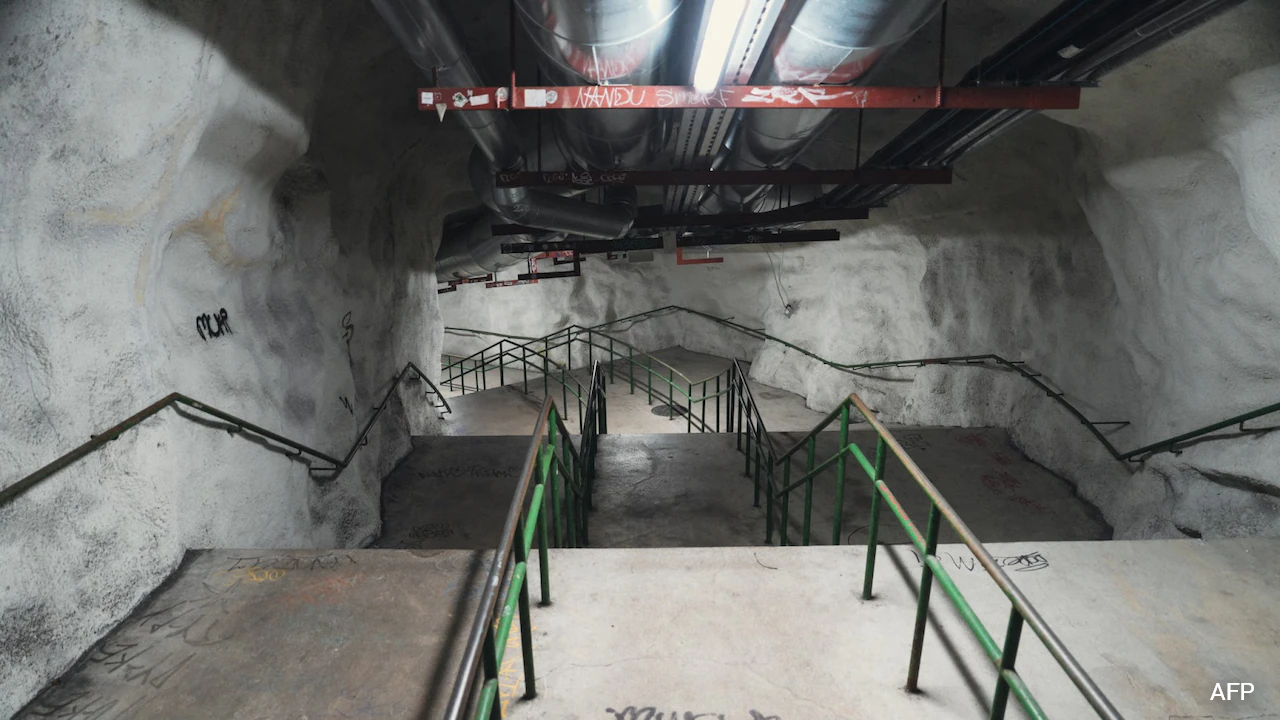
Russia's war in Ukraine has pushed European capitals to rethink how prepared they really are for conflict. Few nations, however, are as ready as Finland. Beneath the streets of Helsinki lies a hidden underground city built to shelter almost a million people, a scale of preparation that dates back decades and has only grown more relevant since the war began.
According to The Sunday Times, Finland's capital sits above a network of 5,500 shelters. Helsinki has a population of more than 675,000, meaning there is shelter space for everyone, and more.
A Country That Never Stopped Preparing
Finland's caution is rooted in geography and history. Helsinki lies fewer than 200 miles from St Petersburg, and the country shares an 830-mile border with Russia, the longest that any NATO member has with Moscow.
While much of Europe scaled back defence preparations after the Soviet Union collapsed in 1991, Finland kept building. Jukka-Pekka Schroderus of the City Rescue Department, which is responsible for keeping Helsinki's residents safe, told the paper: "We started building them [bunkers] in 1939 and never stopped. Under this city is a big cheese full of holes."
This shelter network sits within a wider defence system known as Comprehensive Security. It includes compulsory military service for men from the age of 18, which remains optional for women, along with three-week defence courses for professionals such as editors and chief executives, and weekend sessions teaching women how to run field kitchens, cook without power, and identify drones. Construction firms are kept on six-hour standby in case fortifications need to be built quickly.
Playground That Doubles As A Bomb Shelter
There's something called a Play Cave inside the Finnish capital, a soft-play centre beneath Hakaniemi Market Square, where children climb frames and jump on trampolines.
It looks like an ordinary indoor playground, except for a small blue triangle on an orange background near the lift. A symbol that marks the site as a nuclear-proof shelter, one that can hold up to 6,000 people in an emergency.
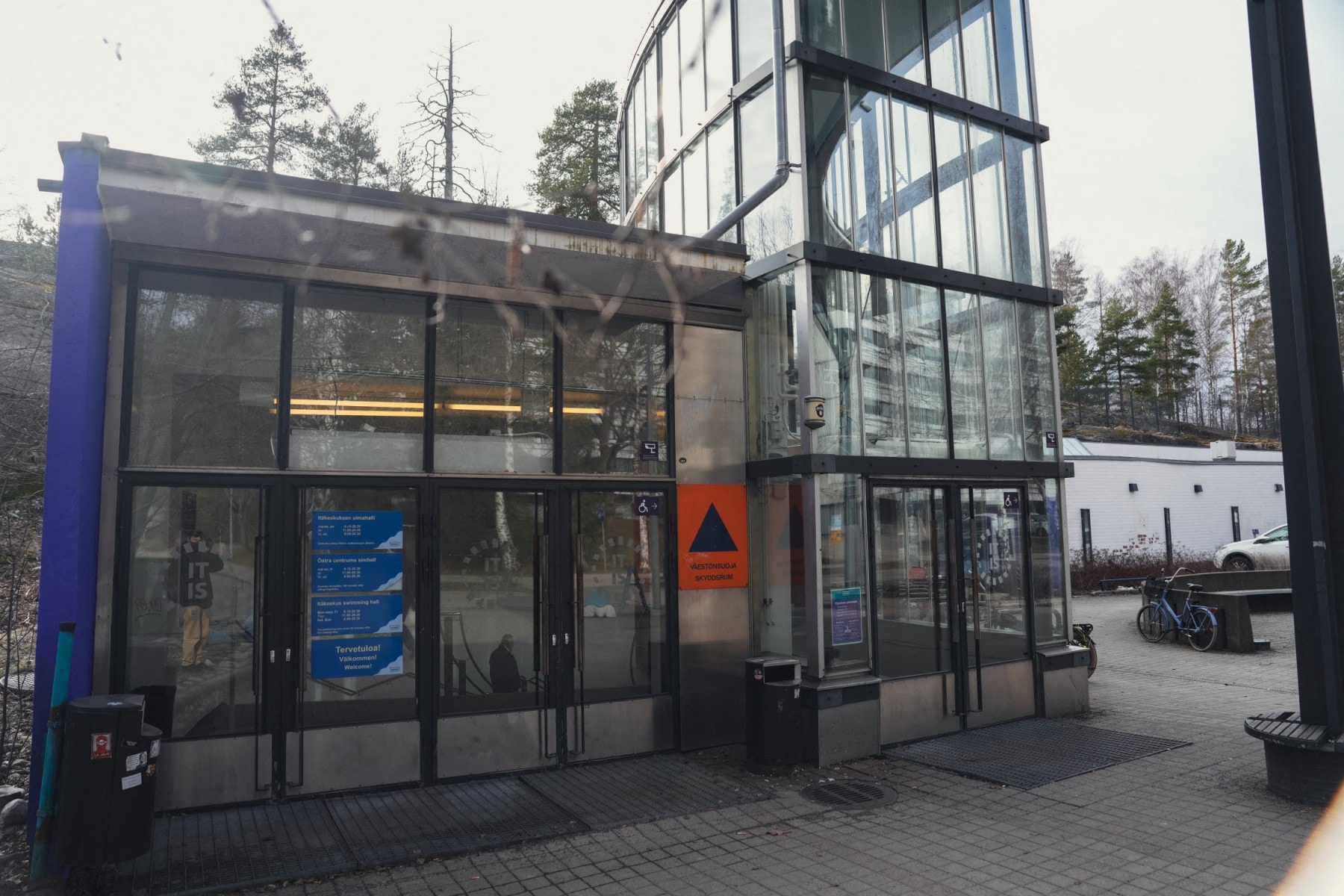
The entrance of the Itakeskus underground swimming pool is pictured on March 27, 2025 in Helsinki, Finland. Swimming pools, playgrounds, and even amusement parks: Finland's underground facilities, which can serve as bomb shelters, are inspiring many of the Nordic country's allies as Europe seeks to strengthen its war preparedness.
Photo Credit: AFP
"This is the idea of dual use. They are built by the city for emergencies but then rented out. It's good they are used so we know everything works, but also very important for us that kids are playing here, so in times of crisis they are already very familiar with the place," Schroderus said.
Under Finnish law, any new office or residential building above a certain size must include a bunker. The largest in Helsinki can hold 11,500 people at once. Beyond soft play areas, these shelters also double as swimming pools, saunas, go-kart tracks, skate parks, churches, archery ranges, and even rehearsal rooms for heavy metal bands.
One of the city's biggest shelters is a 15,000 square metre space carved into bedrock 20 metres below ground.
Entry is through two sets of heavy blue steel blast doors. The first is built to absorb the force of an explosion, the second to seal out chemical, biological and radioactive contamination.
Markings on the floor show where portable toilets and sinks would be installed during an emergency, and a metal cage nearby holds 2,000 folding beds ready to be set up across the shelter, with separate zones planned for the elderly, families, and higher risk groups such as drug users.
Life Underground Would Run Like A Submarine
Even with 2,000 beds, that is only enough for a third of the shelter's 6,000 capacity. Schroderus explained the logic behind this. "The idea is we are like a submarine where at any one time a third of people are resting, a third doing activities and a third on duty, cleaning," he said.
A control room nearby holds a detailed chart mapping out responsibilities for the 100 emergency staff and 200 volunteers who would keep the shelter running. Storage areas are stocked with toilet rolls, torches, masks, helmets, gloves, rubber boots, pumps and filters. The shelter has its own power supply and large water tanks, since once it seals shut, nothing comes in from outside.
Each person sheltering would receive 50 litres of water, but no food is provided. Finns are instead encouraged to keep a 72-hour survival kit at home, containing food, medicine and portable power banks, ready to bring with them if needed.
A Model The World Now Wants To Copy
For years, Finland's approach was viewed by outsiders as excessive. That changed after Russia invaded Ukraine in 2022 and the continued bombing of civilian areas, which made bunkers feel far less old-fashioned. The war in Iran has only reinforced that shift.
Officials and delegations from around the world are now travelling to Helsinki to study its underground network firsthand, including British defence officials, Ukrainian President Volodymyr Zelensky, and representatives from Saudi Arabia. "We've been contacted by Gulf countries and Israel and asked to advise others," Schroderus said. "We are happy to share our information, apart from a few classified things, but are also always updating by collecting ourselves from Ukraine, Switzerland and the Middle East."
Track Latest News Live on NDTV.com and get news updates from India and around the world


