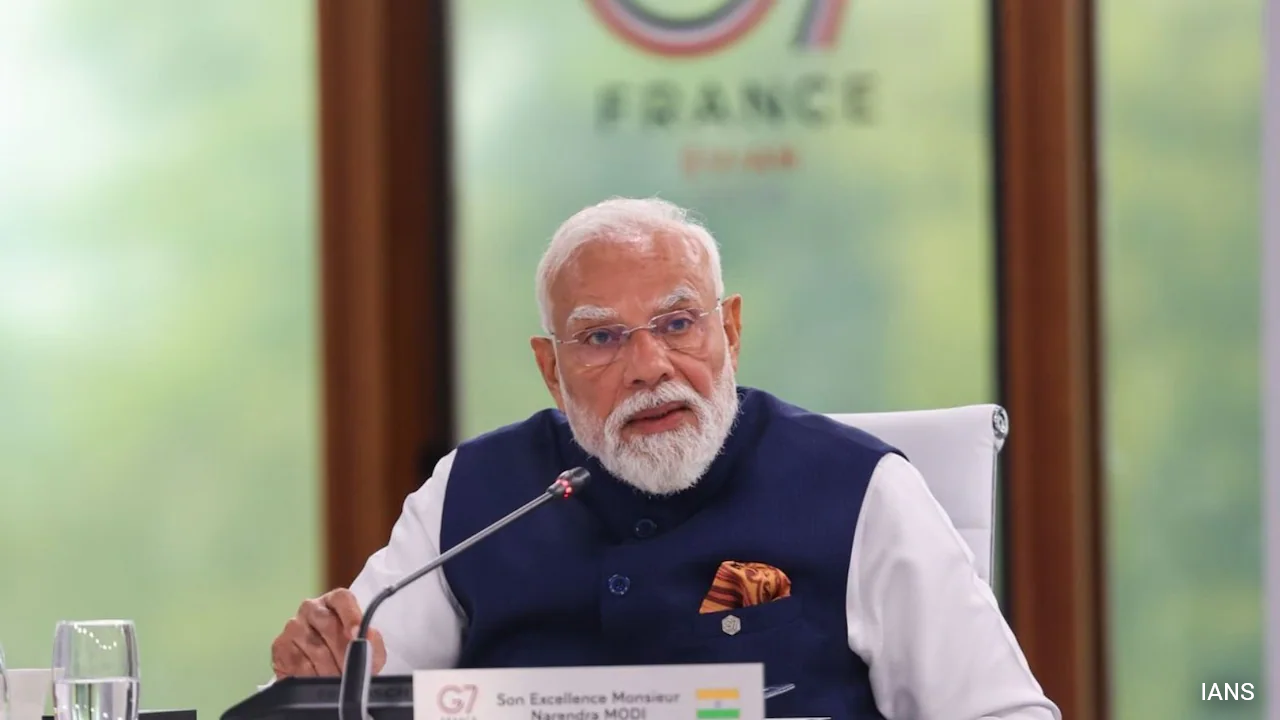
Prime Minister Narendra Modi on Tuesday told world leaders at the G7 Summit that the misuse of trade and technology for narrow national interests has created a "trust deficit" in global affairs, calling for a new era of international solidarity built on transparency rather than transactional ties.
Addressing the Outreach Session themed "Forging New Partnerships and Rebuilding International Solidarity" at the summit in France's Evian, PM Modi said energy, food, health, cyber and economic security have become so interconnected that building partnerships across nations is no longer optional but a necessity for global progress and prosperity, according to a statement issued by India's Ministry of External Affairs.
Drawing on lessons from the COVID-19 pandemic, he urged nations to prioritise trust and transparency while forging international alliances at a time when uncertainty has allowed trade and technology to be weaponised for narrow gains.
PM Modi positioned India as a model for inclusive global engagement, pointing to initiatives such as the International Solar Alliance, the Coalition for Disaster Resilient Infrastructure, the Global Biofuel Alliance, Mission LiFE and the "Ek Ped Maa Ke Naam" (Plant for Mother) tree-planting campaign as evidence of a "humanity first" approach that he said has guided India's outreach efforts. He added that this same philosophy has driven India to act as a first responder during disasters abroad, citing assistance rendered after a cyclone in Sri Lanka, an earthquake in Afghanistan, floods in Mozambique and a hurricane in Jamaica.
On domestic governance, the Prime Minister linked India's development strategy to the principle of "Sarv Jan Hitaye, Sarv Jan Sukhaye" - welfare and happiness for all - crediting it with gains in financial inclusion, digital identity systems, health security, technology-led empowerment and women-led development.
The centerpiece of Modi's intervention was a call to reshape the very architecture of international cooperation. He argued that global partnerships must move beyond the traditional donor-recipient framework toward one rooted in solidarity and equal ownership among nations. He further said that lack of respect for international law remains the single biggest hurdle to building such solidarity and needs to be addressed as a priority, while stressing that dialogue and diplomacy - rather than coercion - must anchor global efforts to secure peace and stability.
The Outreach Session brought together G7 leaders and invited partner nations as part of broader efforts to widen consultations beyond the bloc's core membership, amid deepening geopolitical fragmentation, supply chain disruptions and contested claims over critical technologies. Modi's remarks come against a backdrop of intensifying global debate over trade barriers, export controls on critical minerals and semiconductors, and the governance of artificial intelligence - areas where New Delhi has sought to position itself as a bridge between developed and developing economies.
This marks Modi's latest appearance at a G7 outreach platform, where India has been a regular invitee in recent years despite not being a member of the grouping. The Ministry of External Affairs said the full text of the Prime Minister's remarks would be made available separately.
Track Latest News Live on NDTV.com and get news updates from India and around the world


