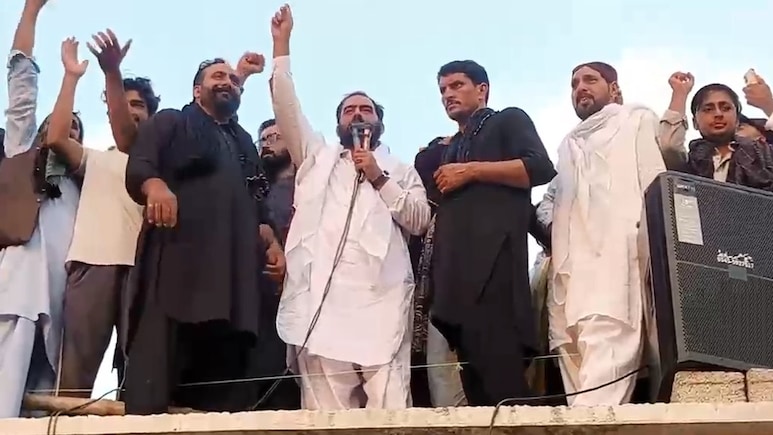
- Jammu and Kashmir Joint Awami Action Committee issued a 48-hour ultimatum to Islamabad
- JAAC demands abolition of 12 refugee legislative seats in PoK elections
- PoK Supreme Court ruled that reserved refugee seats remain constitutionally protected
Tensions are once again mounting in Pakistan-occupied Jammu and Kashmir (PoK). The Jammu Kashmir Joint Awami Action Committee (JAAC) has issued a 48-hour ultimatum to the government in Islamabad, warning of a "grand and final" phase of protests if its 38-point charter of demands is not addressed.
The immediate flashpoint is the regional elections scheduled for July 27. With nominations set to begin on June 9, the JAAC has announced a massive protest march to Muzaffarabad, signalling what could become one of the biggest political confrontations the region has witnessed in recent years.
The 'Refugee Seat' Controversy
At the centre of the protests is the demand to abolish 12 legislative assembly seats reserved for Kashmiri refugees settled in Pakistan.
The JAAC argues that these seats allow Islamabad to retain disproportionate influence over PoK's politics. According to journalist Luv Puri, the 12 refugee seats represent around 4.36 lakh registered voters in Pakistan, while the remaining 33 directly elected seats represent nearly 33 lakh voters living in PoK. Critics argue that this gives refugee constituencies significantly greater electoral weight than those representing residents of the region.
Adding another layer to the controversy, the PoK Supreme Court ruled on June 7 that the 12 reserved seats are constitutionally protected and cannot be abolished through an executive order, requiring a constitutional amendment instead.
The 38-Point Charter
While the refugee-seat issue has become the immediate trigger, the JAAC's charter reflects far deeper economic frustrations.
Apart from seeking the abolition of the 12 reserved seats, the group has demanded a complete renegotiation of hydropower projects, higher subsidies on essential commodities such as flour to cushion soaring inflation, and lower electricity tariffs, arguing that residents should not have to pay high electricity prices generated in their own region.
The demands reflect growing resentment over what many residents see as political marginalisation coupled with economic neglect.
The Rise Of The Awami Action Committee
Formed in 2023, the JAAC has rapidly emerged as the most influential civil rights platform in PoK. The organisation first came to prominence during the widespread protests of May 2024, when sit-ins, shutter-down strikes and wheel-jam protests brought large parts of the region to a standstill. The agitation was triggered by soaring inflation and demands for subsidies comparable to those available in other Pakistan-administered regions such as Gilgit-Baltistan.
Since then, the organisation has repeatedly mobilised large protests, including another major agitation in September 2025.
How Autonomous Is PoK?
Pakistan describes the region as "Azad" (Free) Kashmir, but its constitutional and administrative structure presents a more complex picture.
Technically, PoK does not form part of Pakistan under Article 1 of the Pakistani Constitution, which lists the country's provinces. As a result, the region has no representation in Pakistan's national parliament.
On paper, PoK has its own President, Prime Minister, Supreme Court and elected Assembly. However, substantial authority continues to rest with institutions controlled by Islamabad, particularly the Kashmir Council headed by the Prime Minister of Pakistan.
The PoK Constitution also bars any individual or political party from opposing the region's accession to Pakistan. Election candidates are required to sign a declaration supporting accession before they can contest polls.
Rich In Resources, Poor In Returns
PoK is rich in forests, minerals including graphite, marble and gemstones, and, above all, water. Nearly 70 per cent of the irrigation water used by Pakistan's agricultural heartland in Punjab and Sindh flows through the Indus river system originating in PoK. Hydropower projects in the region also generate an estimated 10 to 15 per cent of Pakistan's electricity.
Despite this, residents have long alleged that the region receives little economic benefit from its natural wealth, with revenues flowing largely to mainland Pakistan while local infrastructure and public services remain underdeveloped.
Life On The Ground
Economic hardship remains one of the biggest grievances among residents. According to a 2025 study published in Nature, nearly 66 per cent of the population depends on farming and livestock, yet 57.1 per cent face food insecurity. Around 29 per cent of residents are undernourished, significantly higher than Pakistan's national average of 19.9 per cent. In the mountainous regions, food insecurity reportedly affects as many as 90 per cent of households.
Healthcare indicators also remain concerning. According to Pakistan's Voluntary National Review Report, 39 per cent of children under five are stunted, while the maternal mortality ratio stands at 104 deaths per 100,000 live births.
A Worsening Security Situation
The political unrest has unfolded against an increasingly fragile security backdrop. Political activist Amjad Mirza has alleged that the recent crackdown has led to mass detentions across the region, claiming that more than 600 activists have been arrested and over 100 protesters killed.
At the same time, security challenges have intensified across Pakistan-administered Kashmir. A May 2026 report by the European Union Agency for Asylum documented 39 security incidents, including armed clashes and explosions, resulting in 56 fatalities across AJK and Gilgit-Baltistan between November 2024 and April 2026.
The broader picture is equally troubling. According to the Pakistan Institute for Conflict and Security Studies, Pakistan witnessed 1,045 terror incidents and 1,139 deaths in 2025, the highest fatality levels in a decade, driven largely by the resurgence of the Tehreek-i-Taliban Pakistan (TTP).
India's Position
India's position on the status of PoK has remained consistent.
Following Independence, Maharaja Hari Singh signed the Instrument of Accession on October 26, 1947, legally acceding the erstwhile princely state of Jammu and Kashmir to India, a process identical to that followed by more than 560 princely states.
However, Pakistan sent in tribal invaders, followed by its regular army, sparking a war. On February 22, 1994, both Houses of Parliament unanimously passed a resolution declaring that the entire erstwhile state of Jammu and Kashmir is an integral part of India and demanding that Pakistan vacate the territories under its occupation.
As regional elections approach and the JAAC threatens a "grand and final" phase of protests, PoK appears headed towards another period of political confrontation.
Track Latest News Live on NDTV.com and get news updates from India and around the world


