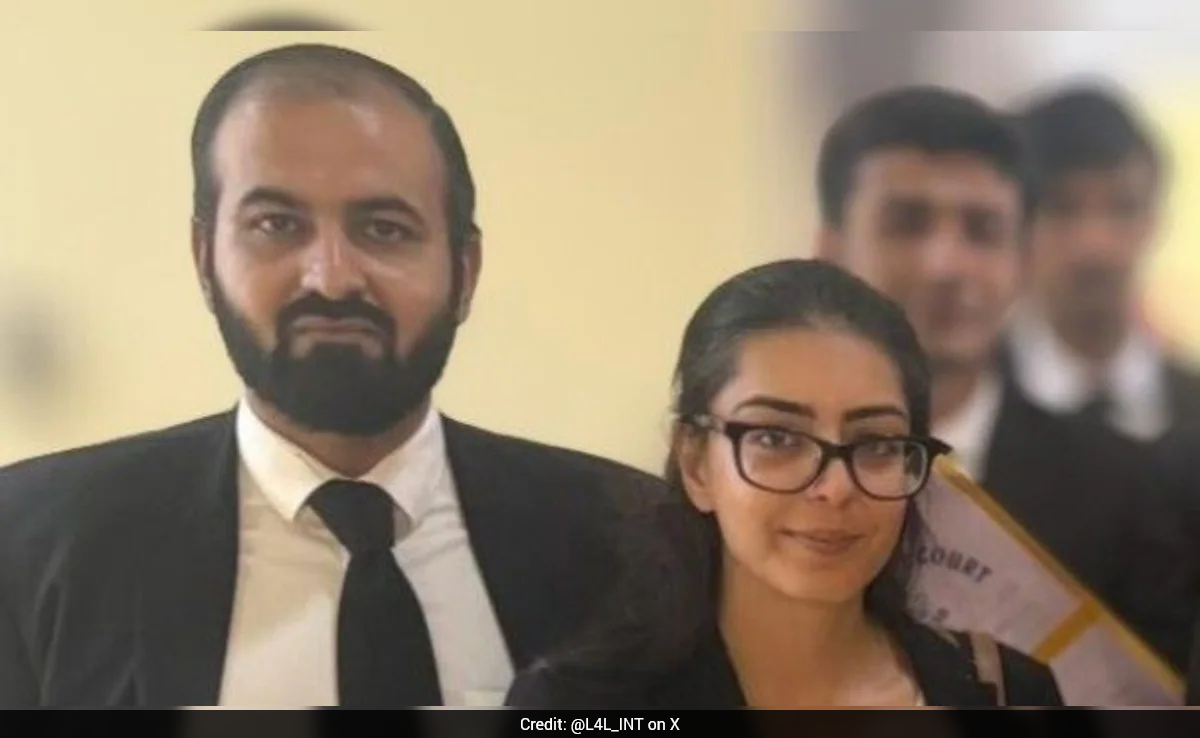
- Former Pakistani minister Shireen Mazari accuses Islamabad of weaponising courts to silence dissent
- Mazari's daughter and son-in-law face cybercrime charges for tweeting "enforced disappearance"
- Term "enforced disappearance" used by Pakistan's Supreme Court and politicians, highlighting contradiction
A former Pakistani minister has accused Islamabad of weaponising courts to silence dissent against the state. Shireen Mazari, a defence and security analyst who served as Pakistan's Minister for Human Rights in Imran Khan's cabinet from 2018 to 2022, highlighted the trial of her daughter Imaan Zainab Mazari-Hazir and her husband Hadi Ali Chattha, who are being charged under cybercrime laws for using the term "enforced disappearance" in a tweet.
Mazari-Hazir and Chattha are human rights lawyers. Mazari noted that their trial proceedings reflect yet another instance of Pakistani authorities weaponising the law to "silence human rights defenders, lawyers, journalists, and all those who question or criticise the policies and actions of the state and its institutions."
Mazari's article comes days after Pakistan's military establishment allegedly ordered the removal of an article by a young Pakistani academic on how the country's younger generation was done taking orders from old guards. The op-ed, titled 'It is Over' by Zorain Nizamani, a Pakistani PhD student based in the United States, was originally published in a prominent Pakistani daily, The Express Tribune, on 1 January. However, it was taken down a few hours later, reportedly under pressure from Pakistan's army.
What Shireen Mazari Said
In an op-ed, tiled 'How My Daughter's Trial Exposes Pakistan's Assault on Human Rights', published in Dissent Today, the former Pakistani minister noted that her daughter's trial exemplifies how Pakistan's justice system is being misused to criminalise dissent and silence human rights defenders.
"Their case has come to symbolise a much larger and more troubling reality in today's Pakistan – the criminalisation of language, legal concepts, and dissent itself. Their trial is a stark illustration of how the justice system is being misused to silence voices that challenge state narratives," she said.
Mazari noted that in her daughter's cybercrime case, the credibility of the prosecution has come under serious scrutiny after a supposed National Cyber Crime Agency (NCCIA) official witness failed to produce a valid identification card during cross-examination. Moreover, the witness controversially claimed that tweeting the phrase "enforced disappearance" amounts to spreading a terrorist narrative, exposing the questionable foundation of both the First Information Report (FIR) and the ongoing trial.
"The absurdity deepens when it is pointed out that the very same term has been used repeatedly by Pakistan's Supreme Court, the Islamabad High Court, and other high courts; by politicians, including the current chief minister of Punjab, Maryam Nawaz Sharif; and that Pakistan itself has an official Commission of Inquiry on Enforced Disappearances," she noted.
"This contradiction lays bare not only the falsehood underpinning the prosecution but also its mala fide intent. It shows how, in today's Pakistan, words are being weaponised – stripped of their legal meaning and context – to silence human rights defenders, lawyers, journalists, and all those who question or criticise the policies and actions of the state and its institutions," she added.
The Pakistani politician stressed that the term "enforced disappearance" is not a political slogan. It is a well-established concept in international law and international relations, particularly since the aftermath of the Second World War.
"Against this backdrop, how can the government of Pakistan justify filing a cybercrime case against an individual simply for using the term "enforced disappearance", accusing them of furthering a terrorist narrative?" she asked.
What's The Case
Pakistan's National Cybercrime Investigation Agency (NCIA) registered a case against Mazari and Chattha on August 22, accusing them of using social media to "incite linguistic divisions" and portray the armed forces as "involved in terrorism".
The FIR, citing tweets from 2021 to 2025, targeted their criticism of enforced disappearances, extrajudicial killings, and military operations in Balochistan and Khyber Pakhtunkhwa. They were charged under the Prevention of Electronic Crimes Act (PECA) 2016, which carries a maximum sentence of up to 14 years in prison.
Following their indictment on October 30, proceedings reportedly moved at "unprecedented speed."
Recently, in a joint appeal, prominent international legal organisations have condemned what they described as Pakistan's "persistent judicial harassment" of Mazari-Hazir and Chattha, urging authorities to immediately drop all charges and ensure the protection of lawyers' rights, as reported by The Balochistan Post.
According to the report, lawyers alleged that the case seeks to punish the couple for their lawful criticism of Pakistan's security establishment and their advocacy for victims of state violence.
Track Latest News Live on NDTV.com and get news updates from India and around the world


