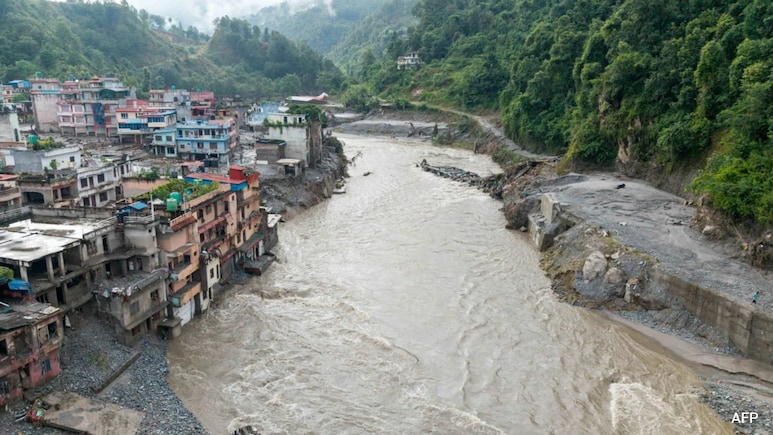
Nepal witnessed catastrophic events on August 26, 2026, especially in the Rasuwa district and the Tibet border region. The tragedy showed how fast high-altitude ice loss transforms into a huge humanitarian disaster.
Nepal sits at the intersection of two massive planetary forces: the ongoing subduction of the Indian tectonic plate colliding with the Eurasian plate at around 20 mm per year, and accelerating atmospheric warming above its high peaks. This unique geological setup makes Nepal's mountain basins exceptionally volatile when glacial environments destabilise.
Following the catastrophic event that inflicted widespread destruction, an analysis conducted by the US Geological Survey (USGS) confirmed that a high-altitude glacial collapse along the border generated a seismic signal equivalent to a 5.2-magnitude event at 8:37 am local time.
Research teams at the International Centre for Integrated Mountain Development (ICIMOD) and Kathmandu University reported that a massive ice-rock avalanche rolled off a cliff at an altitude of nearly 5,200 metres into the Lhende Khola catchment, temporarily damming the river before breaching. The sudden surge swept through the Bhote Koshi and Trishuli river systems - wiping out settlements like Timure and Syabrubesi, claiming hundreds of lives, leaving many missing, and heavily damaging downstream hydropower infrastructure.
High-Altitude Instability
In fragile mountain ecosystems, atmospheric warming acts as an environmental accelerator.
Elevation-Dependent Warming (EDW): High-altitude mountain summits warm significantly faster than low-lying plains due to localized thermal radiation feedback and shrinking snow reflectivity.
Shifting Precipitation Regimes: The atmospheric freezing line is migrating upward. Precipitation that historically fell as dense snow now increasingly arrives as liquid rain at extreme elevations, accelerating thermal ice melt.
Structural Mass Deficits: As surface ice melts rapidly, surrounding valley walls lose the support earlier provided by dense ice sheets, destabilising steep rock faces.
Explaining the mechanics behind the rapid structural decay, Dr Manish Mehta, senior glaciologist and Scientist 'E' at the Wadia Institute of Himalayan Geology (WIHG), details how glacier retreat turns into downstream disaster: "We know that glaciers worldwide, including those in the Himalayas, are retreating, leaving behind vast quantities of debris or loose 'moraine' material - this debris is highly unstable. Rising temperatures are altering precipitation patterns, with snowfall zones shrinking and rainfall zones expanding, leading to significant rainfall in high-altitude areas. Consequently, the loose moraine shifts downslope, resulting in the formation of lakes at lower elevations. Eventually, the buildup of hydrostatic pressure causes these lakes to breach, wreaking havoc on the areas below."
When glaciers recede, they expose massive, unanchored deposits of rock, silt, and gravel known as moraines. At the time of heavy high-altitude rainstorms, meltwater and rainwater pool behind these natural debris barriers, forming expanding proglacial lakes. A proglacial lake a is water body formed in front of a melting or retreating glacier, trapped either by an ice dam or by a wall of debris
As pressure builds up against the moraine walls, sudden structural failure can trigger a catastrophic Glacial Lake Outburst Flood (GLOF) or a water-sodden debris flow.
High-Vulnerability Zones
Explaining the geographical threshold where these mountain hazards intensify, Mehta highlights, "Currently, areas in the Himalayas situated above an altitude of 2,800 metere are at the greatest risk; these areas were formed by retreating glaciers, which left behind vast quantities of loose debris - material that significantly intensifies erosion during floods."
Experts compare events like the Nepal deluge to previous regional disasters such as the 2013 Kedarnath tragedy and the 2021 Raini flash flood in Uttarakhand. At altitudes above 2,800 metres, unanchored moraine acts as a force multiplier.
Experts argue that floodwaters carve through loose moraine deposits, loading the flow with boulders and mud. This converts clear water surges into high-density, highly destructive debris torrents. Landslides from unstable moraine slopes choke narrow river gorges, creating temporary debris dams that breach rapidly and unleash secondary surge waves downstream.
As Himalayan glaciers continue to lose mass, millions of tons of unstable moraine above 2,800 metres remain extremely vulnerable, making real-time early-warning systems across borders essential to protecting mountain communities downstream.
Track Latest News Live on NDTV.com and get news updates from India and around the world


