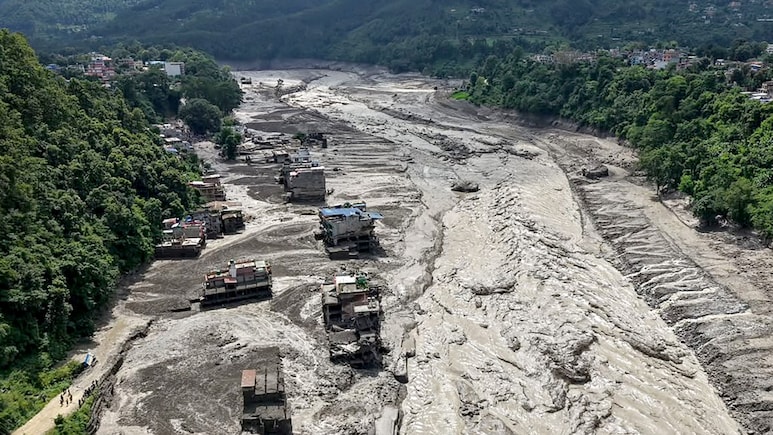
After massive flash flood that originated in Tibet and caused devastation in Nepal and China, claiming 172 lives, questions are being raised about whether early warnings from China could have helped prevent loss of lives in one of the worst natural disasters to hit Nepal.
The Chinese side has now responded to these questions saying the claims that Beijing did not issue an early warning to the Nepali side, resulting in significant casualties on the Nepali side, are fake.
Voices in Nepal have questioned that even when the border facilities at the Rasuwagadhi-Gyirong crossing and Gyirong port were hit, warnings could have been issued to save lives downstream.
"Nepal has been addressing the legitimate security concerns of our neighbours. However, it must be said with sadness that our northern neighbour has significantly undermined us. By failing to provide early warning of such a massive disaster, we suffered immense loss of human life," Nepali Journalist with Naya Patrika, a Nepali daily, posted on X.
Nepal has been addressing the legitimate security concerns of our neighbors. However, it must be said with sadness that our northern neighbor has significantly undermined us. By failing to provide early warning of such a massive disaster, we suffered immense loss of human life.
— Parshuram Kaphle 🇳🇵 (@journoprk) August 26, 2026
"We have continually faced crises originating from their territory, while we continue to address all their concerns, necessary or unnecessary. Why must Nepal alone pay the price of one-sided love?" he added.
We have continually faced crises originating from their territory, while we continue to address all their concerns, necessary or unnecessary. Why must Nepal alone pay the price of one-sided love?
— Parshuram Kaphle 🇳🇵 (@journoprk) August 26, 2026
"I thought Chinese have better monitoring systems for GLOF (Glacial Lake Outburst Flood) in border region, but it seems not. They have also suffered heavy losses of life and properties," said Dr Govind Raj Pokharel, Former Vice Chair of National Planning Commission of Nepal and Former CEO National Reconstruct in a post on social media platform X.
"I think Nepal China must have strong monitoring and early warning systems in border areas regarding GLOF and flood."
I thought Chinese have better monitoring systems for GLOF in border region, but it seems not. They have also suffered heavy losses of life and properties. I think Nepal China must have strong monitoring and early warning systems in border areas regarding GLOF and flood @XHNews
— Govind Raj Pokharel🇳🇵 (@grpokharel) August 26, 2026
Dr Govind Raj Pokharel, who led Nepal's reconstruction effort after Nepal earthquake of 2015 told NDTV, "I was expecting that because of the advanced satellite systems and technology they could have at least noticed an image or something like that. And they could have relayed the information to the Nepali side, but they could not notice that also. In our side, it was the lower side, but it was beyond our expectation, because it was, there was no rain etc. So, people downstream did not expect something like this. Policemen who were warning people not to go to the riverside were also swept away because they themselves could not estimate the level of flood."
Dr Pokharel believes early warning signals were either not effective or either not working.
"Because the current was so fast upto Nuwakot that they did not expect this level of flood. Rasuwa district is where we lost people including hydropower workers, policemen and locals. And Chinese also have lost many people as you can see. There was no early warning system and even if it was there, it was beyond their capacity to warn the local people," Dr Pokharel added.
The debris mixed with huge volume of water caused major damage downstream in Rasuwa district, according to experts.
"We need to have better coordination with China when it comes to disasters like GLOF, flood or earthquake...This border is very sensitive with climate change. There was an agreement or an understanding that they will share information regarding GLOF and other such disasters," Dr Pokharel said.
China has now reacted to these legitimate concerns. A statement from Chinese Embassy in Nepal said, "Fake: The collapse of the geological disaster dam on the Chinese side caused major losses to the Nepali side."
"An earthquake or earthquake like glacier collapse occurred on the Nepali side on the morning of August 26, 2026, triggering huge mudslides, which caused significant casualties and left people missing on both the Nepali and Chinese sides of the Gyirong- Rasuwagadhi border region," the statement added.
"Accusation helps nothing, cooperation saves lives," the statement reiterated.
What Triggered Flash Floods In Nepal
An avalanche of ice and rock, likely a result of glacial lake outburst, triggered massive flash floods that tore through parts of Nepal, killing at least 172 people and causing extensive damage to villages and infrastructure. The number of casualties is expected to rise sharply and experts say it will take time to account for the number of deaths as complete settlements have been washed away.
Climate experts at the Kathmandu-based International Centre for Integrated Mountain Development (ICIMOD) say an avalanche from a glacier in all probability caused Wednesday's flash flood.
Nepal's disaster authority (NDRRMA) has described that a chunk of snow and rock broke off near the glacier zone on the Nepal-China border, about 20km northeast of the Rasuwagadhi border crossing.
That avalanche either fell into a glacial lake or blocked the river channel, and the resulting surge, carrying glacial ice, meltwater and debris -- "glacier-inclusive flood" -- swept down the Lhende Khola into the Bhote Koshi river.
An earthquake was also reported earlier but the United States Geological Survey's latest analysis suggests there was no earthquake, raising questions about what caused the landslide itself.
Earlier reports were examining reports of an earthquake around at 8:37 am, with the epicentre located around 47 kilometres north of Gosainkunda, as a possible cause for a huge outflow of water and debris.
Nepal's Department of Hydrology and Meteorology is also investigating whether a glacial lake outburst may have caused the flash flood.
In August last year, the same regions saw similar flash floods when a glacial lake in Tibet overflowed because of high temperatures. Nine people were killed, and critical infrastructure, including a bridge connecting Nepal and China, at the Gyirong Port, was damaged.
Chinese state-controlled media, People's Daily said a mudslide struck near Gyirong Port in southwest China's Xizang Autonomous Region on Wednesday, with people feared missing.
The disaster has cut off roads leading to the port on the Chinese side, as well as communications and power supplies, according to the emergency management bureau of Gyirong County in Xigaze City. Gyirong Port is a major land port connecting China and Nepal.
Track Latest News Live on NDTV.com and get news updates from India and around the world


