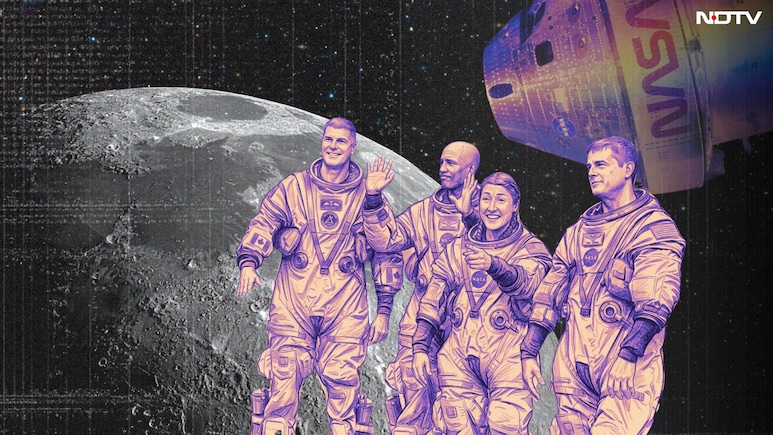
NASA astronauts Reid Wiseman, Victor Glover and Christina Koch, alongside Canadian Space Agency astronaut Jeremy Hansen, are poised to travel farther from Earth than any human has ever travelled since the Apollo era. Riding aboard the Orion spacecraft, Integrity, the crew is set to break the long-standing distance record set during Apollo 13 in 1970 as Artemis II carries humans deeper into space than ever before.
Mission Control teams in Houston recently executed a precise outbound correction burn, a short but crucial engine firing that refined Orion's trajectory and placed the spacecraft on a carefully planned path toward the Moon.
The burn, lasting just 17.5 seconds, ensured that Artemis II remains on a "free-return" trajectory. This orbital design allows the spacecraft to loop around the Moon and naturally return toward Earth without the need for major propulsion manoeuvres. It is a trajectory that has been tested many times before in human and robotic exploration and is regarded as inherently safe and stable.
For the Artemis II crew, the journey is as much about preparation and systems validation as it is about historic milestones. Early in their workday, all four astronauts completed a full, end-to-end test of the Orion Crew Survival System (OCSS) suits.
The crew donned and pressurised the suits, carried out leak checks, simulated seat ingress and egress, and evaluated their mobility alongside their ability to eat and drink while suited. These suits are designed to protect astronauts during the most dynamic phases of flight and provide life support in the unlikely event of cabin depressurisation or during survival operations after splashdown.
As Orion approaches the Moon, the mission will reach the anticipated lunar flyby of the far side of the Moon. When the spacecraft slips behind the Moon, Earth will be completely blocked from view, cutting all communications.
For approximately 40 minutes, the Moon will stand between Orion and Earth, creating a total communications blackout. During this period, there will be no voice, telemetry or video contact with NASA's Mission Control.
NASA has stressed that this is not a risky situation. Communications blackouts during lunar flybys are well understood and have occurred during earlier missions. Artemis II is following a free-return trajectory and will emerge from behind the Moon naturally. The blackout is a predictable consequence of physics rather than a system failure.
The astronauts will be busy executing a series of pre-planned activities during this silent stretch. Chief among them is observing the Moon's far side, the hemisphere that is permanently turned away from Earth and never visible from the ground. Though often mistaken as the "Dark Side", it remains lit by the Sun. Using human eyes rather than robotic cameras, the Artemis II crew will closely observe the rugged, heavily cratered terrain, capturing observations that add a uniquely human perspective to lunar exploration.
History offers powerful parallels to this moment. During Apollo 11, Michael Collins remained alone in lunar orbit as Neil Armstrong and Buzz Aldrin descended to the surface. Each time he passed behind the Moon, Collins experienced the same communications blackout, relying on training and the reliability of his spacecraft. Artemis II echoes that experience, though this time four astronauts will share the moment together.
There is also an Indian parallel that resonates strongly. In 2014, when ISRO's Mars Orbiter Mission, Mangalyaan, was inserted into Martian orbit, the crucial manoeuvre occurred while the spacecraft was on the "far side" of Mars. For several tense minutes, there was a complete communications blackout. India only learned that Mangalyaan had successfully entered Martian orbit after the spacecraft emerged from behind the Red Planet. That moment remains a significant part of India's space history, underlining how routine yet emotionally charged such blackouts can be.
NASA acknowledges that this communications gap could be avoided in the future. The agency plans to deploy relay satellites around the Moon as part of its broader Artemis architecture to allow continuous communication. Artemis II, however, is flying before such infrastructure is in place. Interestingly, China previously established relay satellites when it landed a robot on the far side of the Moon.
Excitement is running high among the astronauts and mission planners. For the crew, the flyby represents the first time in more than half a century that humans will orbit the Moon and witness its far side directly. It is also a critical rehearsal for future missions that will land astronauts on the lunar surface and eventually pave the way for journeys to Mars.
The Artemis II crew will also witness a rare total solar eclipse, visible only from their unique vantage point. As Orion passes around the Moon's far side, the Moon will completely block the Sun from view, allowing the crew to see the Sun's outer atmosphere, the corona, glowing against the darkness. This eclipse will not be visible from Earth and will unfold during the communications blackout, giving the crew an extraordinary view of a celestial event seen only from deep space.
As Orion loops around the Moon, it will reach its closest approach before heading outward to its maximum distance from Earth, breaking the Apollo 13 record. Soon after, the spacecraft will re-emerge, communications will be restored, and Earth will rise once again into view.
Key Artemis II Lunar Flyby Timeline (Indian Standard Time)
Monday, April 6, 2026
10.30 pm (Monday): NASA+ live coverage of the lunar flyby begins
11.26 pm: Artemis II crew surpasses Apollo 13 record for farthest distance from Earth
11.40 pm: Crew remarks on breaking the distance record (audio only)
11.45 pm: Orion cabin configured for flyby operations
Tuesday, April 7, 2026
12.15 am (Tuesday): Lunar observations begin
4.14 am: Predicted loss of communications as Orion passes behind the Moon
4.32 am: Closest approach to the Moon
4.37 am: Orion reaches maximum distance from Earth
4.55 am: Earthrise and return of communications
6.05 am - 7.02 am: Solar eclipse from the crew's perspective
6.50 am: Lunar observations conclude
Track Latest News Live on NDTV.com and get news updates from India and around the world


