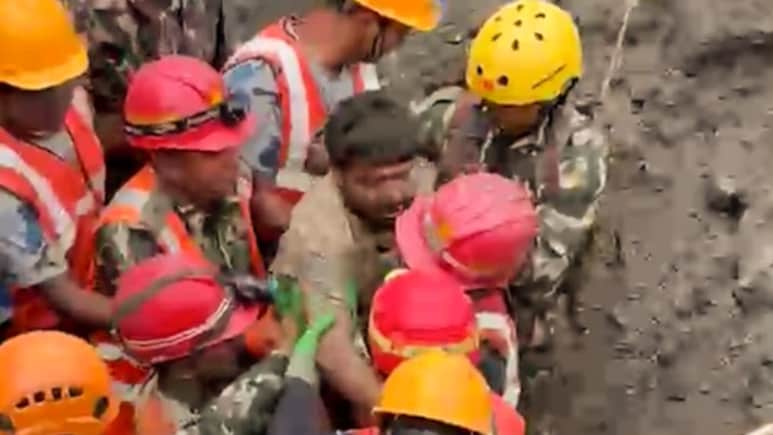
He kept chanting the mahamantra, says the 30-year-old Sanjay Shah, one of the two hydropower workers pulled alive from a tunnel buried by debris in Nepal on Friday, the tenth day of rescue efforts after catastrophic Himalayan flooding.
Rescuers cheered as he was pulled through a muddy opening, a video released by the energy ministry showed.
He was helped to his feet by rescuers, and later carried on the backs of the emergency workers, raising his hand as they took him towards a helicopter.
A photograph showed the second man caked in mud, his hands pressed together in prayer, as rescuers carried him on a stretcher.
Both are Nepali.
The two were among hundreds of hydropower workers who had been missing since a wall of mud and debris swept through the region on August 26 after a vast glacial and rock collapse on a mountain on the China-Nepal border.
2 Rescued Alive From Hydropower Tunnel 9 Days After Nepal Floods pic.twitter.com/pjl0ogXCcy
— NDTV (@ndtv) September 4, 2026
Searches were continuing at the Trishuli 3A tunnel where the two men were rescued, as well as multiple other sites, with at least 12 hydropower projects smashed by the floods.
Rescuers called it a "miracle" after the August 26 glacial and mountain collapse on the China-Nepal border, that has killed at least 1,280 people and left more than 5,500 missing.
Sanjay Shah, a mechanical foreman at Upper Trishuli 3A, was rescued from a depth of 170 meters inside the tunnel, according to Nepal Army spokesperson Brigadier General Raja Ram Basnet.
The 30-year-old refused to abandon his colleagues amid the tragedy.
"As soon as the danger warning was received, I set about trying to get everyone out safely. I simply could not bring myself to flee alone and leave the others behind. In the effort to save others, the time available for escape ran out. Suddenly, water began rushing in at high speed, and all exit routes were blocked," Shah, who is in a "stable condition", told NDTV.
"The tunnel was so long that, in no time at all, we were all trapped inside. After that, it became impossible to know who was trapped where or what condition they were in," he said.
He said there were six people around me and he remained in constant contact and communication with them.
"We did not lose heart during this difficult time. We kept chanting the mahamantra and praying to God to save our lives. Spending nine days without food or water was incredibly hard for us. Every moment, it felt as though escaping might no longer be possible," he said, recounting the tough period.
"But finally, when I emerged safely after nine days, my joy knew no bounds. It is difficult to put that moment into words; it felt as though I had been given a new lease on life," he said.
According to experts and those monitoring the rescue operation, the deep underground sections of the massive 4.5-kilometer-long tunnel structure contained a stable air pocket with breathable oxygen and trapped water.
Nepali rescuers, aided by experts from India, China and South Korea, have continued searching for survivors feared trapped inside hydropower tunnels, but teams had repeatedly hit walls of hard-packed debris.
Until Friday, none of the tunnel workers had been confirmed alive.
"As long as there is breath, there is hope!" Nepal Energy Minister Biraj Bhakta Shrestha said in a statement.
"Rescue operations are continuing in all the affected tunnels. Let everyone's efforts and prayers continue. We have not lost hope," the Minister added.
Track Latest News Live on NDTV.com and get news updates from India and around the world


