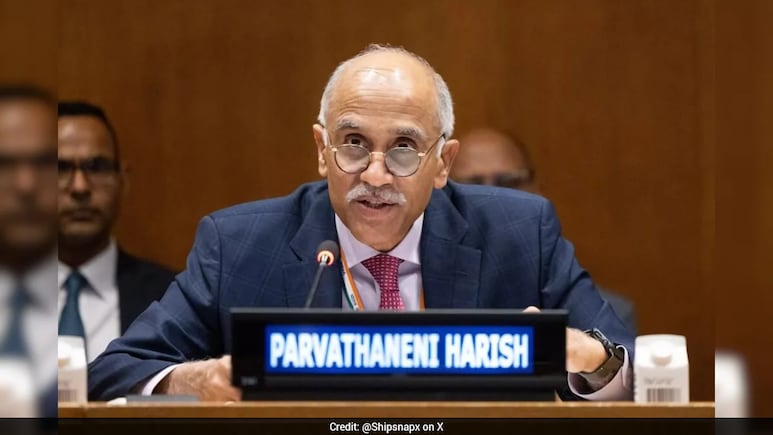
India delivered a pointed and wide-ranging critique of the latest Elements Paper circulated by co-chairs of the Inter-Governmental Negotiations (IGN) on United Nations Security Council reform, calling the document subjectively drafted, inaccurate in its characterisation of member state positions, and inadequate in reflecting the overwhelming support for expanding the permanent membership category.
Ambassador Harish Parvathaneni, India's Permanent Representative to the United Nations, addressed the IGN session on Monday, June 15, aligning with statements delivered by St Vincent and the Grenadines on behalf of the L.69 group and Japan on behalf of the G4 before elaborating India's national position in a detailed eight-point rebuttal of the document.
A Reform Process Decades In Making
The push to reform the UN Security Council -- widely seen as a Cold War-era relic frozen in the geopolitical realities of 1945 -- has been one of the most contentious and long-running debates in multilateral diplomacy. The Council's five permanent members (P5) -- the United States, Russia, China, France and the United Kingdom -- hold veto power, a privilege that critics argue renders the body unrepresentative of today's global order.
The IGN process, established under UNGA Resolution 62/557, was created to move member states toward a solution with the "widest possible political support". Over the years, key blocs have emerged with distinct visions: the G4 (India, Germany, Japan and Brazil) advocates for new permanent seats; the African Union pushes for at least two permanent seats under the Ezulwini Consensus; and the L.69 group of developing nations broadly supports expanded permanent representation. Opposing blocs, often labelled "status-quoists", prefer limiting any expansion to non-permanent seats.
India's Eight-Point Challenge
Ambassador Parvathaneni's statement was methodical and assertive, taking aim at the Elements Paper -- circulated on June 10, giving delegations just two working days to respond -- on multiple fronts.
He questioned the very definitions used in the paper, arguing that "convergence" should operationally mean a majority view, not unanimity, and that the co-chairs' application of the term was "ambiguous and subjective". He stressed that the IGN's founding document makes no mention of bridging proposals and that such proposals, in standard UN practice, only emerge after text-based negotiations have begun -- not before.
The ambassador reserved particular criticism for what he called the "Fixed Regional Seats" proposal, described in the Elements Paper as a pathway to expanding the permanent category. India rejected this outright, arguing it neither creates genuine permanency nor serves the principle of regional representation if elected members act only in their national capacity. He further contended that the proposal effectively amounts to granting veto-like privileges to elected members -- confusing permanency with veto power -- while also undermining the interests of Small Island Developing States (SIDS), a cross-regional group India has consistently backed.
On the question of permanency itself, Parvathaneni was unequivocal: the UN Charter's Article 23 already draws a clear line between permanent and non-permanent members, leaving no room for the "further clarification" the Elements Paper calls for.
Perhaps most strikingly, he challenged the paper's language downgrading majority support for permanent seat expansion to support from merely "a significant number of delegations" -- a formulation India rejected as a deliberate dilution of the actual state of play, given the positions of G4, L.69, CARICOM and the African Group collectively represent a substantial majority of the UN's 193 member states.
Demand for a Negotiating Text
India's most concrete demand was a call for the co-chairs to move the process to formal text-based negotiations, with clearly defined milestones and timelines -- consistent with how other UN negotiating processes function. "IGN cannot be fundamentally different from other UN processes," Parvathaneni stated, warning that the "nothing is agreed until everything is agreed" principle must not be weaponised by status-quoists to indefinitely stall progress.
India called on the co-chairs to revise the Elements Paper to make it more objective and to more faithfully reflect the balance of member state opinion.
With geopolitical pressures mounting and the UN's 80th anniversary year drawing scrutiny to the body's representational legitimacy, Monday's session underscored that the fault lines in the Security Council reform debate remain as deep as ever -- and that India, one of the most vocal advocates for a permanent seat, is in no mood to accept incremental half-measures.
Track Latest News Live on NDTV.com and get news updates from India and around the world


