US President Donald Trump's objective for launching the war in Iran has shifted frequently in the four weeks since the strikes started. But he has been consistent about his primary objective in joining Israeli military action--to permanently derail Iran's nuclear weapons programme and ensure Tehran will "never have a nuclear weapon".
It has the same goal that the US chased when it pummelled Iranian nuclear sites last June, a month after the United Nations' nuclear watchdog, the International Atomic Energy Agency (IAEA), said Iran had stockpiled 408.6 kilograms of 60 per cent enriched uranium, which with further refinement could potentially fuel nine warheads.
According to the IAEA, Tehran also has nearly 200 kilograms of 20 per cent fissile material, which is easily converted into 90 per cent weapons-grade uranium.
US fears were not unfounded. The Islamic Republic's inventory had some 2,500 ballistic missiles --the largest in the Gulf. It also has support for terrorist proxies under its 'Axis of Resistance' across the region, adding to its defence prowess. Days before the US-Israeli strikes that started the war on February 28, Trump had declared Iran "can't have nuclear weapons".
"It's very simple. You can't have peace in the Middle East if they have a nuclear weapon."
ALSO READ: "If They Pump It...": Iran's Speaker On How To Make Money From Trump's Mood Swings
Why War Could Strengthen Iran's Nuke Dream
Experts believe that US military action on Iran, especially on its nuclear sites and scientists, will no doubt slow the Islamic Republic's atomic ambitions in the near-term. But now the regime -- providing it survives the war, which all signs suggest it will -- will be even more determined to acquire a nuclear weapon for its survival.
"For Iran, nuclear weapons are now the only thing that will guarantee regime survival," Ramesh Thakur, professor emeritus and director of the Centre for Nuclear Non-Proliferation and Disarmament in the Crawford School of the Australian National University, told Time magazine.
"So why wouldn't they get them?"
Jennifer Kavanagh, director of military analysis for the Washington-based think tank Defence Priorities, told the publication that now that Iran's ballistic missile infrastructure has been badly degraded by US and Israeli attacks, a nuclear bomb may prove "a faster route to restore deterrence for a regime that is now more radical and has been attacked twice in the midst of negotiations".
ALSO READ: NDTV On Ground Zero: Israel Steps Up Lebanon Strike, Hezbollah Fights On
Nukes For Survival?
But now, it is not just Iran's nuclear programme that will be a threat to the US and the world. It will likely release a nuclear genie that will be hard to put back in the bottle.
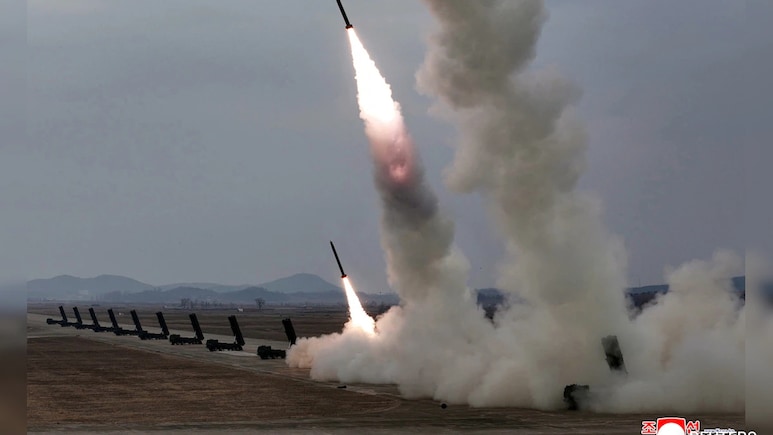
Last week, North Korean dictator Kim Jong Un, while referring to the Iran war, said the "present situation clearly proves" his country was right in its decision not to let go of its nuclear arsenal, which he termed "irreversible". He also accused Washington of "state-sponsored terrorism and aggression".
For the rogue North Korean leader, the fates of Libyan leader Muammar Gaddafi and Iraq's Saddam Hussein are also a lesson for the future. Both were toppled after abandoning their nuclear programmes.
Ukraine, too, no doubt regrets voluntarily giving up its nukes following the breakup of the Soviet Union. The world now knows that the US's, and by extension the European, guarantees of security mean little at the time of real conflict. The message was underscored when the US, under Trump's previous administration, pulled out of the Iran nuclear deal, officially the Joint Comprehensive Plan of Action (JCPOA), in 2018. It laid bare the message that it's futile to strike a bargain with a capricious US, where any administration can walk out of promises made by its predecessor.
The conflict in the Gulf has also been a wake-up call for US allies in the Middle East, who relied on American security guarantees following Iranian reprisals. Since the start of the US-manufactured conflict, Washington's overriding focus has been on protecting its military bases instead of safeguarding host populations and infrastructure, further plunging the Gulf's people and economies into crisis.
"If Iran survives the current onslaught, expect its nuclear ambitions emboldened, prompting Saudi Arabia, Turkey, and possibly Egypt to explore their own deterrents," Thakur told Time.
Moreover, the Iran war has also left US allies and other neutral states pondering their own nuclear deterrents. Europe has already been reeling from Trump's humiliating broadsides-- be it threats to seize Greenland or trashing of NATO -- prompting discussions toward a new protective alliance chiefly against Russia, which has already claimed to have moved nuclear-capable missile systems into neighbouring Belarus.
ALSO READ: Ground War On? US Rushes 57,000 Troops As Iran Crisis Escalates
Further east, India and Pakistan are already nuclear powers, and after recent border skirmishes, neither will dial back on its efforts in the near future. East Asia is another story in itself, where North Korea's belligerence and rising fears over China's threat to Taiwan's autonomy had already reenergised the nuclear debate. Taiwan itself once had nuclear ambitions but was strong-armed into abandoning them by the US in 1988. Now, if Taipei tries to resurrect a nuclear programme, it would hand Beijing a gift-wrapped excuse for invasion.
In South Korea, polls show that public support for the indigenous nuclear programme reached a record 76.2 per cent, highlighting the anxiety about just relying on the US security guarantees.
"The bipartisan U.S. position through many decades has been that we can provide extended deterrence, so you don't need nuclear weapons...But this administration is not interested in any kind of security cooperation," Daniel Pinkston, an adjunct professor at Troy University in Seoul, told Time.
The heightened anxieties are likely to bring more nuclear weapons into the world, raising the risks of catastrophic miscalculation and missteps.
Track Latest News Live on NDTV.com and get news updates from India and around the world


