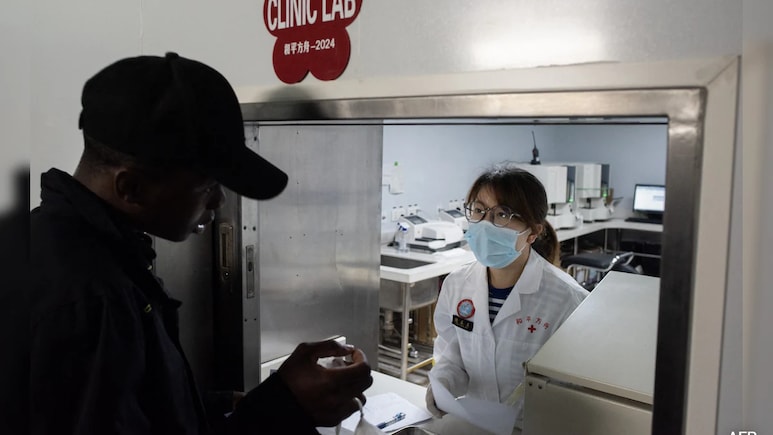
- Charges against 3 Chinese scientists accused of smuggling biological materials were dropped by US authorities
- The materials involved were non-dangerous transparent worms used for research, not harmful substances
- China's government reportedly intervened to facilitate dismissal of the charges, according to defense lawyers
A case against three Chinese scientists, which the Donald Trump administration once framed as a national security win, has been dropped by Washington. The three researchers, who were accused of helping a colleague smuggle biological materials into the US, are back in China after the Justice Department abruptly dropped charges against them on Beijing's intervention, according to a report by the Associated Press.
The "biological materials" that the three Chinese scientists tried to smuggle were nothing dangerous but were mostly "tiny transparent worms". However, when the case came to light last year, US officials hailed the arrests as a victory for national security. Attorney General Pam Bondi said the government must be vigilant when foreign nationals try to "advance a malicious agenda".
What Was The Case
Xu Bai and Fengfan Zhang were charged with conspiring to help another scientist who shipped packages to them from China before she arrived in 2025 for temporary lab research at the University of Michigan. A third man, Zhiyong Zhang, was charged with making false statements.
Bai, Fengfan Zhang and Zhiyong Zhang were in jail for more than three months while the case was pending in federal court in Detroit. A judge suddenly dismissed the charges on February 5 at the Justice Department's request, and the three traveled home to China.
Reason Behind Sudden Dismissal
China's government intervened and helped get charges dropped against three Chinese scientists, AP reported, citing defence lawyers.
"The dismissal came as a pleasant surprise," defence lawyer John Minock said. "We don't know the details. What we were told was there was some kind of intervention by the Chinese consulate in Chicago."
Another attorney, Ray Cassar, said he was working toward a misdemeanour plea deal to resolve the case against Fengfan Zhang when prosecutors simply dropped it.
"We get this phone call saying China is negotiating with the US over these three students. Serious talks," Cassar said. "These were kids studying for their PhDs. The last thing you want to do is destroy their careers. ... Was it the proper thing to do? Absolutely."
Defence attorney Mark Satawa said the Chinese Consulate "getting involved moved the needle." He was planning to seek dismissal of the false statements charge, noting that Zhiyong Zhang, who spoke Mandarin, didn't have a translator when he was questioned by investigators.
The US Attorney's Office in Detroit refused to comment on China's role or the government's retreat. The Chinese embassy in the US has also not issued any statement so far.
About The 3 Chinese Scientists
Bai, Fengfan Zhang and Zhiyong Zhang were research scholars admitted to the US to temporarily work at the University of Michigan.
According to a defence attorney, the worms they were trying to get inside the US had a limited lifespan. The packages, Ray Cassar said, were not properly labelled because Chengxuan Han, the woman who sent them, likely didn't want to have them held up by US inspectors.
"There was no intention of doing anything nefarious," Cassar said. "The worms have been consistently used for studying chemical reactions and light sensitivity."
In September, Han pleaded no contest to smuggling and making false statements and was deported to China after three months in jail.
A Pattern?
In a separate case, Yunqing Jian, another temporary researcher at a campus lab, pleaded guilty to similar charges involving a common plant fungus. She was deported after five months in custody.
Roger Innes, an Indiana University expert who looked at the evidence for Jian's attorneys, said there was no risk to anyone in the US.
Track Latest News Live on NDTV.com and get news updates from India and around the world


