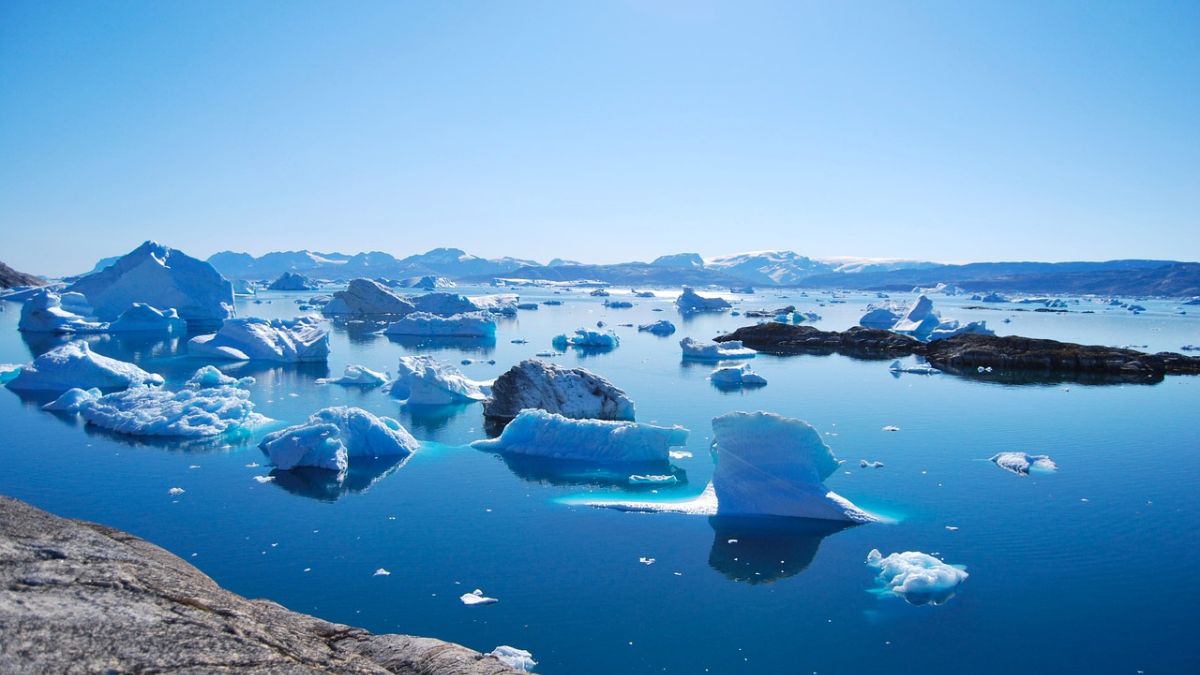
At first glance, Greenland still looks like the edge of the world. A vast sweep of ice, rock and silence stretching into the Arctic. But beneath the retreating ice sheet, something else is surfacing- strategic minerals, new shipping routes, and a geopolitical competition that is growing sharper by the year. The question now being asked quietly in defence ministries and more loudly in climate circles is unsettling: Could Greenland become the world's first major climate war hotspot?
Former British Army General Richard Nugee was careful not to overstate the present danger. "It's not a war at the moment," he said. "It might be a war of words." But he did not dismiss what comes next. "Could it be the first climate war? It could be."
That possibility lies at the intersection of climate physics and hard power politics, where melting ice is transforming geography faster than diplomacy can keep up.
When Climate Change Redraws The Map
Greenland is warming at more than twice the global average. Winters are now around 5 degrees warmer than in the mid-1990s; summers are about 2 degrees warmer. In 2021, rain fell for the first time at Summit Station, the highest point on the ice sheet-an event so unprecedented that scientists had no instruments ready to measure it. By 2025, rain returned.
The ice sheet is now losing mass five times faster than it did in the 1990s. As it thins and sinks to lower, warmer elevations, melting accelerates in a vicious feedback loop. Researchers estimate Greenland alone holds enough ice to raise global sea levels by 7.4 metres if fully melted. Even a partial loss this century could affect hundreds of millions of people living near today's coastlines.
"What happens in the Arctic does not stay in the Arctic," warned Professor Gail Whiteman of the University of Exeter. Rising seas, destabilised weather systems, health impacts and displacement ripple outward. "This is a systemic risk," she said-one that global risk assessments still fail to fully integrate.
And yet, even as the climate signal becomes more alarming, human activity in the Arctic is ramping up.
Ice Retreats, Interest Moves In
As the ice pulls back, Greenland is becoming more accessible not just to scientists, but to miners, militaries and global powers.
Beneath its surface lie iron ore, uranium, gold, graphite, oil, and, most importantly, rare earth elements. Greenland ranks eighth globally in rare earth reserves, hosting two of the world's largest known deposits. These minerals are essential for everything from electric vehicles and wind turbines to missiles, radar systems and advanced electronics.
At the same time, melting sea ice is opening Arctic shipping routes that could slash thousands of kilometres off journeys between Asia and Europe. Control of these routes-and the territory that flanks them- has immense strategic value.
This convergence of climate change and resource access is reshaping the region into what analysts increasingly describe as a new security frontier.
Great Powers, New Pressures
The United States has long maintained a military presence in Greenland, dating back to World War II. Today, the Pituffik Space Base remains a critical node for missile warning and space surveillance.
But recent rhetoric has heightened tensions. President Trump has repeatedly framed Greenland as a national security necessity, tied to missile defence ambitions and hemispheric control. According to Nugee, the logic is straightforward: "For President Trump's Golden Dome... that includes Canada, Alaska, Greenland, and probably Iceland as well."
China, meanwhile, has pursued its own Arctic ambitions through its "Polar Silk Road," seeking access via infrastructure investment, research partnerships and mineral interests. While many Chinese projects in Greenland have been blocked due to security concerns, Beijing's dominance in rare earth processing gives it leverage that cannot be ignored.
Caught in between is Greenland itself-an autonomous territory with a small population, limited infrastructure, and growing aspirations for economic independence.
Security Without Certainty
For Jakob Dreyer of the University of Copenhagen, Greenland's situation reflects a broader European dilemma. "We cannot rely or base our security and interests on transatlantic relations anymore," he argued. As the Arctic becomes more contested, Europe must become more autonomous-economically, politically, and strategically.
But autonomy comes with risks. Mining rare earths in Greenland is environmentally sensitive and politically divisive. Local opposition, particularly to uranium-linked projects, has already stalled major developments and triggered billion-dollar legal disputes. Infrastructure is sparse. Power supply is limited. Roads barely exist.
Add climate volatility, fragile ecosystems, indigenous rights, and the spectre of militarisation, and the Arctic begins to resemble not a frozen wilderness, but a pressure cooker.
Beyond Missiles And Minerals
There is another, less visible danger emerging alongside military and economic competition: Geoengineering. Whiteman warned that large-scale climate interventions-potentially tested or deployed in polar regions-are not being adequately discussed as a security risk. In a geopolitically tense Arctic, unilateral climate experiments could spark conflict as surely as troops or trade controls.
For Laurie Laybourn of Chatham House, the deeper problem is complacency. "There's been an assumption that these impacts are for the future-for grandchildren," she said. "They're not. They're redrawing the map of geopolitics globally."
A Climate War-Or A Choice?
Greenland is not yet a battlefield. No shots have been fired, no borders crossed. But the forces gathering around it-climate collapse, resource scarcity, strategic rivalry-are the same forces that have driven conflicts throughout history.
As of now, President Donald Trump has significantly moderated his aggressive push to acquire Greenland, ruling out military force and dropping earlier threats of imposing 10-25% tariffs on Denmark and other European allies. In his January 21 speech at the World Economic Forum in Davos, he stated he "won't use force" and described US interest as "a very small ask," while calling for immediate negotiations. After a meeting with NATO Secretary-General Mark Rutte, Trump announced a "framework of a future deal" on Greenland and the broader Arctic region via social media, leading him to abandon the tariff plans. The focus has shifted from full ownership to enhanced US security access, potentially including sovereign claims over select areas around existing military bases (similar to Cyprus-style arrangements), though Denmark and Greenlandic officials strongly oppose any sovereignty transfer and insist the island remains non-negotiable. Trump continues to frame this as essential for countering Russia and China in the Arctic, but the episode has eased immediate tensions while leaving details vague and transatlantic relations strained.
Whether Greenland becomes the first major climate war may depend less on the ice itself and more on the decisions made now: About cooperation versus coercion, investment versus exploitation, and whether climate change is treated as a shared security threat or an opportunity to be seized before someone else does.
For the moment, the ice is still melting faster than diplomacy is moving. And that may be the most dangerous imbalance of all.
Track Latest News Live on NDTV.com and get news updates from India and around the world


