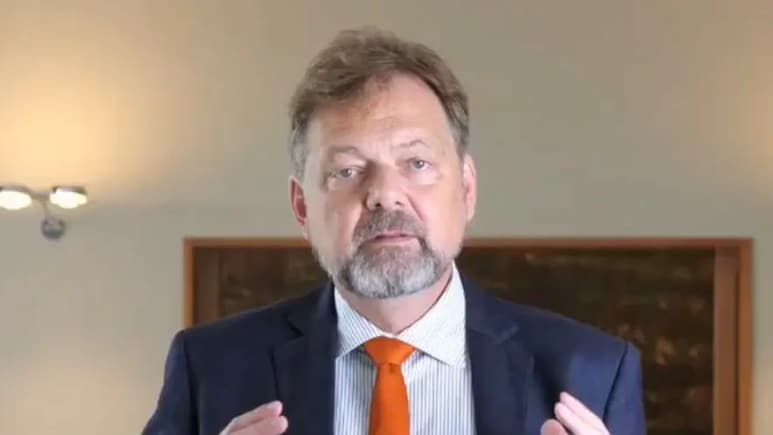
New Delhi is set to host a historic diplomatic moment as the top leadership of the European Union arrives as chief guests for India's Republic Day on January 26, followed immediately by a crucial India-EU Summit that could redefine the partnership between the two sides. At the heart of the visit is the long-pending EU-India Free Trade Agreement (FTA), and Germany's Ambassador to India, Dr Philipp Ackermann, says there is reason for optimism.
In an exclusive interview with NDTV's Senior Executive Editor Aditya Raj Kaul, Dr Ackermann described the visit of the Presidents of the European Commission and the European Council as "a first in a way" and "a huge honour," underlining the political symbolism of the moment. "It will show how strong and close the partnership between the EU and India has become," he said, adding that Europeans are "very, very happy about it and excited."
On the much-anticipated FTA, the German envoy struck a hopeful but cautious note. "I think we can be cautiously optimistic that something like the FTA will be announced," he said, pointing to encouraging signals from Brussels and the EU delegation in New Delhi. If announced, he called it "a game changer in EU-India relations," one that the German business community is watching closely because it would "increase their business in India, no doubt."
Dr Ackermann had, along with other EU envoys, met External Affairs Minister S Jaishankar ahead of the summit. While he declined to reveal details of the closed-door discussions, he said the meeting made one thing clear: "How many overlaps there are between India and the European Union." In a "world full of tensions," he argued, "it is very important to find partners that really align on many issues," and between India and the EU, "there is a lot of common ground."
The ambassador also placed the prospective FTA in a wider global context marked by trade tensions and tariff wars. Without naming any country directly, he said tariff policies were "exactly the contrary of what the EU is advising and advocating." The EU, he noted, remains "the most important single market in the world with 450 million inhabitants," and the message from an India-EU trade deal would be clear: "Free trade is the way forward and not tariffs."
Beyond trade, Dr Ackermann said the summit would also deepen cooperation in security and defence, with a roadmap expected to be agreed upon. Climate change, artificial intelligence and emerging technologies are also high on the agenda. "These are things that are very much on our mind, which need to be tackled and need to be coped with," he said, describing the summit as a platform where "the EU, a strong confederation of countries, and India sit together and discuss that."
People-to-people ties are another area of focus. Acknowledging concerns about visas and paperwork, Dr Ackermann pointed to recent steps such as lifting the German transit visa requirement for Indians and said that visa issuance numbers were growing by five to 10 per cent every year. "Waiting times are mostly not more than two or three days," he said, adding that Germany wants to be "a very reliable service provider to the Indian traveller."
On global conflicts, the ambassador was forthright. Speaking about the Russia-Ukraine war, he said "every opportunity to discuss a ceasefire is very welcome," but stressed that any peace must be acceptable to Kyiv. "Ukraine is the aggressed partner," he said, and "any ceasefire, any negotiations for a peace need a clear approval of Ukraine. Otherwise, it is not fair and not just."
On recent tensions over Greenland and transatlantic uncertainty, Dr Ackermann said Europe had shown unity and resolve, and while the immediate threat of military action appeared to have receded, the episode was "a wake-up call" for Europe to act more independently and cohesively.
Turning to West Asia, he expressed caution about the proposed "Board of Peace" initiative and underlined that "without the United Nations, there is no legitimacy in international dealings," arguing that global peace efforts must be anchored within the UN system.
Looking ahead, Dr Ackermann confirmed strong German participation in the upcoming AI summit in New Delhi and said technology and research cooperation would play "an ever-growing role" in bilateral ties.
Finally, reflecting on German Chancellor Friedrich Merz's recent visit to India with a large business delegation, Dr Ackermann said it was meant to send a clear signal ahead of the EU summit. "We wanted to make sure that this FTA really sees the light of day at some stage," he said, reiterating that he remains "cautiously optimistic" about an announcement.
As New Delhi prepares to host Europe's top leadership, all eyes will now be on whether this optimism translates into a concrete breakthrough, one that could reshape India-EU relations for years to come.
Track Latest News Live on NDTV.com and get news updates from India and around the world


