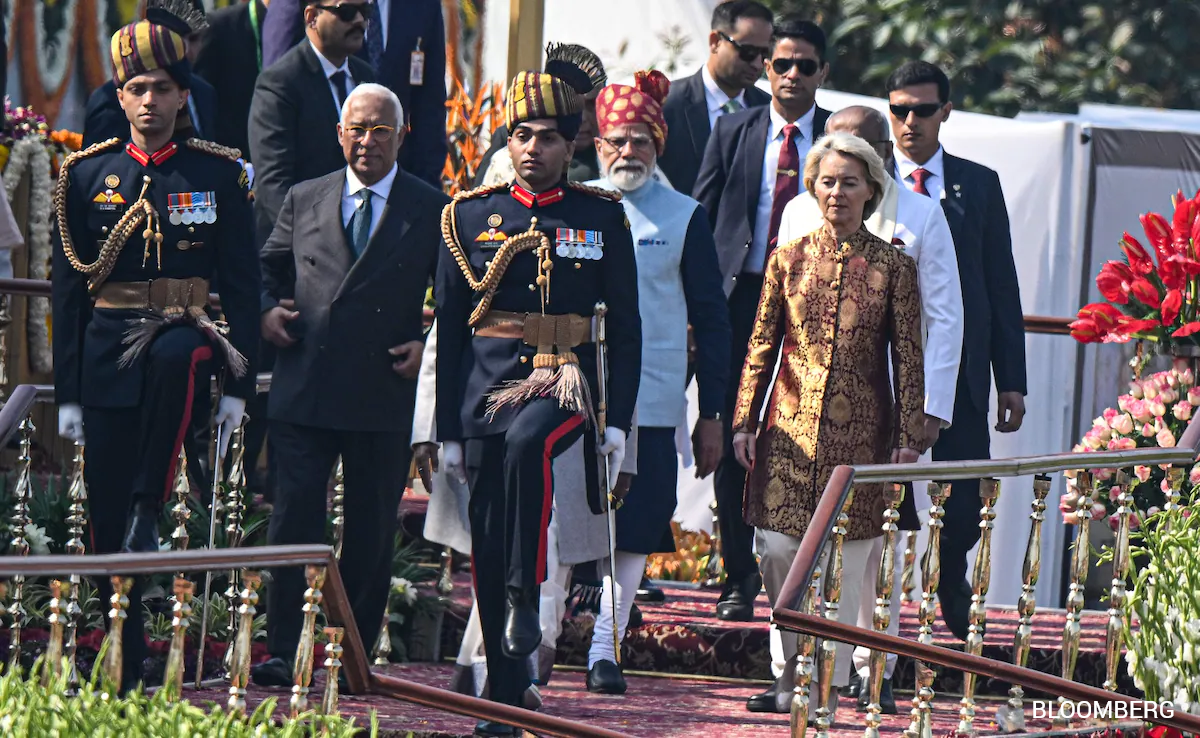
The European Union and India are set to announce an agreement on a long-awaited trade deal on Tuesday, forging closer economic ties to hedge against US President Donald Trump's tariffs.
European Commission President Ursula von der Leyen and European Council President Antonio Costa are in New Delhi to mark the moment, which caps almost two decades of negotiations.
The conclusion of negotiations after years of halting talks reflects the rapidly shifting global alignment under Trump.
The EU, despite long clashing with Indian officials over trade matters, is now focused on shedding its economic reliance on the US and China. India is similarly trying to shake its protectionist reputation and offset a 50% Trump tariff, while at the same time balance its ties with Russia.
Nations are increasingly willing to "bury the hatchet" given the "atmosphere of uncertainty" around Trump's policies, said Amitendu Palit, the research lead on trade and economics at the Institute of South Asian Studies.
"Diversification is absolutely essential," he added. "That is the name of the game."
I'm so glad to be in India today.
— Ursula von der Leyen (@vonderleyen) January 25, 2026
India and Europe have made a clear choice.
The choice of strategic partnership, dialogue and openness.
Leveraging our complementary strengths.
And building mutual resilience.
We are showing a fractured world that another way is possible. pic.twitter.com/J04vNQbW30
The agreement would lower tariffs on most consumer and industrial goods traded between India and EU members, although it's expected to exclude some agricultural products. The EU would also get enhanced market access for its car exports subject to a cap.
The pact is expected to be formally signed after legal vetting, which will likely take around six months. The European Parliament will also have to ratify it.
Tuesday's announcement comes only days after the EU finally polished off a separate, long-gestating trade deal with the Mercosur bloc of South American countries - another pact meant to help the EU pivot away from the US and China. EU lawmakers have yet to ratify that deal, however.
Prime Minister Narendra Modi is similarly trying to find new markets for a country Trump once dubbed the "tariff king." Tuesday's agreement marked PM Modi's fourth trade deal since last May, following pacts with the UK, Oman and New Zealand.
Next up, PM Modi is seeking partnerships with the Mercosur bloc, Chile, Peru and the Gulf Cooperation Council, hoping to secure strategic resources and increase India's global footprint.
Export Boost
The EU-India deal could give India, Asia's third-largest economy, a competitive edge in the export of labor-intensive goods hit hard by Trump's sky-high tariffs, including apparel and footwear.
More broadly, it could boost the country's exports to the EU roughly $50 billion by 2031, according to a report by Madhavi Arora, lead economist at Emkay Global Financial Services Ltd. Arora singled out pharmaceutical, textiles and chemicals as sectors likely to benefit.
For the EU, the agreement would mean access to one of the world's fastest growing economies, with a market of over 1.4 billion people. But the deal will not offer as much market access for European goods as the one the EU recently reached with the Mercosur countries - Argentina, Brazil, Uruguay and Paraguay.
Still, "in a world where the transatlantic relationship is fundamentally broken and trusted partners are hard to come by, this is a pretty big win for the EU," said Garima Mohan, an Indo-Pacific specialist who focuses on EU-India ties at the German Marshall Fund. "It signals the EU's shift to a more geopolitical, pragmatic stance."
Bilateral trade between the EU and India stood at $136.5 billion in India's fiscal year through March 2025, with the EU making up more than 17% of India's total exports, official data showed. Conversely, India is the EU's ninth largest trading partner.
Security Partnership
The EU and India are also growing closer on the defense front, recently unveiling a new security partnership.
The agreement mostly offers a political signal - part of an EU effort to expand its alliances as Trump rattles the transatlantic bond. The EU has struck similar deals recently with countries like the UK and Canada.
The EU-India security partnership shows just how difficult these pacts can be. Negotiators ran into disagreements in the final moments over language about Russia's invasion of Ukraine. Ultimately, they dropped any mention from the final text.
But while the partnership remains broad-brush, it offers promise on a few fronts.
The two sides vowed to tighten defense industry cooperation, which could give the EU better access to a market that currently buys lots of arms from Russia. Officials also opened the door to more maritime security cooperation and possible joint naval exercises.
"Europe is the biggest beneficiary of India's effort to wean away from Russia," Mohan said. "The arc of Indian foreign policy is bending westwards. "
(This story has not been edited by NDTV staff and is auto-generated from a syndicated feed.)
Track Latest News Live on NDTV.com and get news updates from India and around the world


