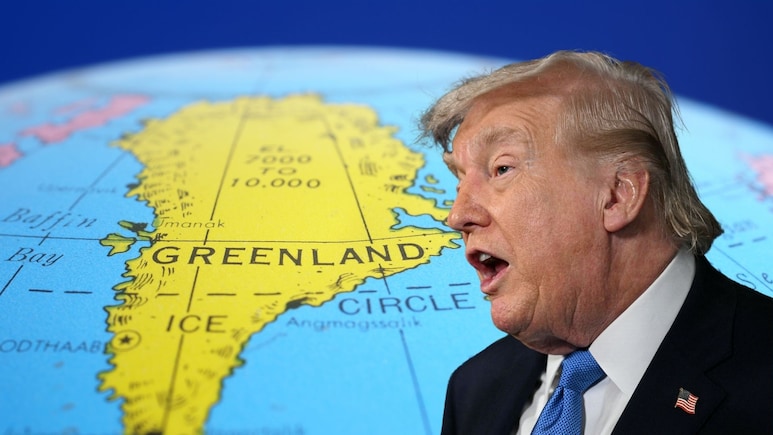
In a move that has unsettled Europe and NATO, US President Donald Trump has renewed his push to acquire Greenland, with the White House saying that several options are being explored to bring the semi-autonomous Danish territory under US control, including possible military action.
Greenland, the world's largest island, is rich in untapped mineral resources. Though it lies on the North American continent, it remains politically linked to Europe through Denmark.
-

-
 NDTV World Summit 2026: AI, Chips, Warfare And The Future Of The World | Key Conversations
 -
 Kriti Sanon On Situationships, Open Relationships And Being Old-School
 -
 'AI Scares Me': Kriti Sanon On Personality Rights And Need For Laws
 -
 'This Time I Wanted Gold': Savita Punia Reflects On Historic Asiad Success
 -
 Favourite Bollywood Actor To 5-Year Plan, Kriti Sanon Interviews AI Actor Tilly Norwood
 -
 Neeru Dhanda Carried Homemade Churma To Asiad, Returned With Two Gold Medals
 -
 Inside The Mind Of Archer Kumkum Mohod, Who Dared To Challenge South Korea
 -
 India's Golden Girls: Asian Games Champions On Sacrifice, Success And LA 2028
 -
 RBI Governor Was Asked About Tata Sons' Listing. He Read The Rulebook
 -
 "High Inflation Is Like Tax On Everyone": RBI Governor At NDTV World Summit
Any attempt to seize the island would be complex. Beyond political hurdles, a military move would place the US in confrontation with its own NATO allies.
Denmark and Greenland are nonetheless taking the threat seriously. According to CNBC, Danish Defence Minister and Deputy Prime Minister Troels Lund Poulsen said Denmark would do “anything” to rearm Greenland, citing “the serious security situation we find ourselves in.” Despite this, analysts told CNBC they do not believe European forces would ever open fire on US troops.
The United States: Military Advantage
The United States already enjoys extensive access to Greenland. Under a little-known 1951 Cold War agreement, Washington has sweeping rights to establish and expand military facilities on the island with Danish and Greenlandic consent.
The US currently maintains more than 100 military personnel at its Pituffik base. Under the same agreement, Washington could rapidly increase troop numbers without breaching any formal treaty obligations, effectively allowing it to seize control of the territory without launching a conventional invasion.
US military manpower dwarfs that of other NATO members, states the CNBC report. In 2024, NATO estimates showed that the United States fielded about 1.3 million active personnel, while the remaining alliance members together accounted for roughly 2.1 million troops. Turkey followed as the largest contributor after the US, with its armed forces numbering around 4,81,000.
According to Global Firepower's 2025 rankings, the US is placed at number one, while Denmark ranks 45th among 145 countries. The gap in military strength is stark. The United States has around 2,127,500 personnel in its armed forces, compared with about 83,000 across Denmark's army, navy and air force. The disparity is even clearer in air power: the US operates roughly 1,790 fighter jets and 5,843 helicopters, while Denmark has just 31 fighter jets and 34 helicopters.
As per reports, the Royal Danish Navy employs around 3,500 personnel and operates about nine frigates, with no submarines in service. The size of its naval manpower is reportedly comparable to the combined crews of India's aircraft carriers INS Vikrant and INS Vikramaditya.
Geography further weakens Denmark's defensive posture. Greenland lies nearly 3,000 kilometres from the Danish mainland, making rapid troop mobilisation difficult and time-consuming in the event of a sudden escalation.
Why Greenland Matters To The US
Greenland has taken on growing strategic importance for North America's defence. Its location above the Arctic Circle provides access to key naval and shipping routes. The island's significance is further heightened by its vast reserves of rare earth minerals. Trump has repeatedly pointed to both its natural resources and its strategic value, arguing that US control would help counter Chinese and Russian activity in the Arctic, where he claims their ships have established a presence.
Track Latest News Live on NDTV.com and get news updates from India and around the world


