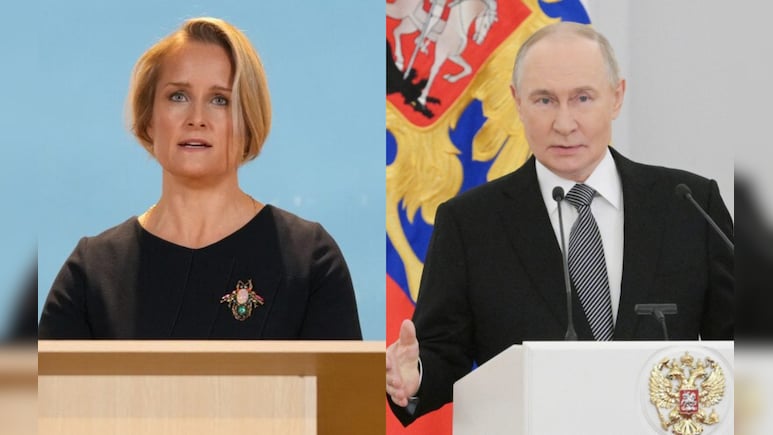
The new chief of Britain's foreign intelligence service MI6 accused Russian President Vladimir Putin of deliberately prolonging negotiations to put an end to the war in Ukraine, in an assessment that complicates President Donald Trump's efforts to broker a deal by year-end.
"We all continue to face the menace of an aggressive, expansionist and revisionist Russia, seeking to subjugate Ukraine and NATO members," Blaise Metreweli said in her first public appearance since she became the head of MI6 in September. She said of Putin: "He is dragging out negotiations and shifting the cost of war onto his own population."
"Putin should be in no doubt, our support is enduring. The pressure we apply on Ukraine's behalf will be sustained," she added, in comments that may imply UK intelligence officials think Russia sees its advantage in fighting through the winter.
Metreweli's words suggest there has been little alteration in Western security officials' assessment that Putin doesn't intend to stop fighting in Ukraine anytime soon, despite talks to end the war that have taken place between the Kremlin and American negotiators in recent weeks.
Last month, her predecessor Richard Moore told Bloomberg that the latest intelligence he'd had access to before leaving his post indicated the same.
Metreweli also warned about the threat posed by Russia and Britain's other adversaries. Hours later, the head of Britain's armed forces cautioned in his own speech that more Britons should be ready to fight for their country in a "whole of nation response" to the Russian threat. The stark language reflects recent remarks from NATO chief Mark Rutte about being "prepared for the scale of war our grandparents and great-grandparents endured."
The Trump administration has made a renewed push for peace in recent weeks. A US delegation led by Special Envoy Steve Witkoff and Trump's son-in-law Jared Kushner held talks with Ukraine's President Volodymyr Zelensky and European national security advisers on Sunday, in an effort to establish a framework for a deal that could be accepted by both Kyiv and Moscow.
Earlier this month, Witkoff and Kushner met Putin for several hours of talks in the Kremlin. On Sunday, Yuri Ushakov, foreign policy aide to Putin, warned that Russia deems some of the Ukrainian proposals for a settlement "unacceptable," citing as example that Russia "1 million percent" won't cede control of the Crimean peninsula it annexed in 2014.
Threat From Russia
Metreweli also warned in her debut speech as the first female MI6 chief that the world is "more dangerous and contested now than it has been for decades," leaving Europe "operating in a space between peace and war." That sentiment was echoed in the speech given by Chief of the Defence Staff Richard Knighton on Monday, who warned that Britons don't feel the threat from Russia as acutely as others in Europe.
The UK is subject to an onslaught of cyber-attacks from Russia every day, he revealed, while Metreweli confirmed MI6's assessment that Russia was behind some drone operations "buzzing airports and bases" in Europe. "We should be under no illusions that Russia has a massive, increasingly technically sophisticated, and now, highly combat-experienced, military," said Knighton.
He called on a "whole of nation response" so that the rest of government, society and industry are prepared to "act or bear the costs" as the price of peace rises. He said France's defense chief Fabien Mandon was right to say that more people need to be prepared to fight for their country, and that "more families will know what sacrifice for our nation means."
The warnings over Britain's security comes amid frustration in the military and defense industry at the lack of clarity on funding. The government hasn't said beyond 2027 how quickly defense spending will rise and where the money will come from. Its defense investment plan - which will detail how it will allocate funding - was due to be published already, but is now unlikely to be unveiled before Christmas.
Though Knighton didn't explicitly call on the government to bring forward its spending commitments, he did say Britain's defense industry requires more private capital and that the new era of threats "might require difficult decisions on priorities," alluding to an emerging debate around redirecting money from welfare into defense.
The two speeches also touched on the need to exploit new technology to provide an edge over Britain's adversaries. Metreweli warned the West's enemies were taking advantage of social media algorithms to sow discord, and that control over new technologies was "shifting from states to corporations and sometimes to individuals."
Much of Metreweli's speech was devoted to her personal experience in her former position as MI6's technology chief, a role known as 'Q' that was made famous in the James Bond movie franchise.
She argued "the defining challenge of the 21st century is not simply who wields the most powerful technologies, but who guides them with the greatest wisdom." She listed artificial intelligence, biotechnology and quantum computing as having the potential to create "science-fiction-like tools" that offered both challenge and reward.
"As China will be a central part of the global transformation taking place this century, it is essential that we, as MI6, continue to inform the government's understanding of China's rise and the implications for UK national security," Metreweli added, as Prime Minister Keir Starmer prepares to visit Beijing next month.
(Except for the headline, this story has not been edited by NDTV staff and is published from a syndicated feed.)
Track Latest News Live on NDTV.com and get news updates from India and around the world


