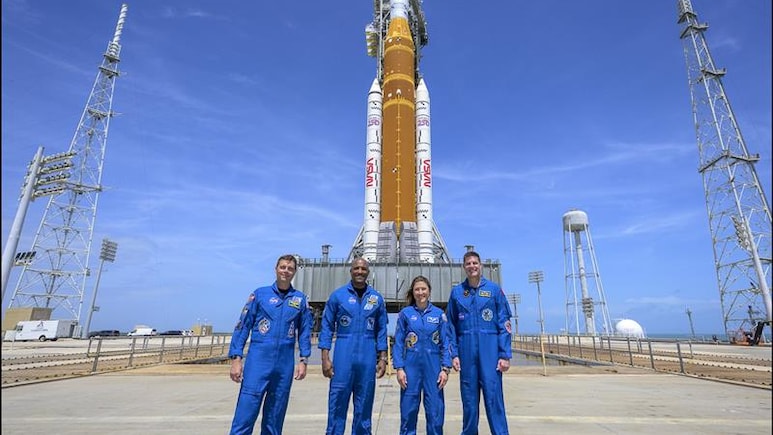
When NASA's Space Launch System (SLS) lifts off with astronauts aboard on Artemis II, it will do something no rocket has done since the Apollo era: carry humans beyond low Earth orbit toward the Moon in a single launch. It will also do something else that makes the mission exceptional, fly people on only its second-ever flight.
So far, SLS has flown just once.
That solitary mission, Artemis I, launched in November 2022, sending an un-crewed Orion spacecraft around the Moon and back. According to NASA's own post-flight assessment, the rocket performed "near-perfectly," meeting or exceeding its required performance parameters and returning an enormous volume of engineering data that validated the design of the core stage, engines, boosters, avionics and software. But it faced its own share of glitches which NASA says they have ironed out.
That success now underpins NASA's confidence as it prepares SLS for Artemis II, the first crewed flight of the Artemis program and the first human lunar flyby since Apollo 17 in 1972.
But the leap from one un-crewed flight to a human mission is precisely what places SLS under intense scrutiny.
NASA's Artemis II documents makes clear that Artemis II remains a test flight, even with astronauts on board. Over roughly ten days, the crew will test the Orion spacecraft and SLS systems in deep space, fly around the Moon, and return safely to Earth. The mission is designed to gather critical data for Artemis IV, which aims to land humans on the lunar surface.
SLS itself is presented as a national strategic capability, the only rocket capable of sending crew and large exploration payloads directly to the Moon in a single launch. Standing over 98 metres tall, generating 8.8 million pounds of thrust, and powered by a core stage derived from space shuttle heritage hardware, SLS is described as the most powerful rocket ever flown.
Yet power alone does not erase risk.
NASA's own documentation highlights how Artemis II preparations differ from earlier test philosophies. Based on Artemis I experience, the agency reduced the number of integrated pre-launch tests, applying lessons learned to streamline the path to launch. NASA notes that pre-launch Integrated Test and Check Out activities were reduced, and that a wet dress rehearsal, loading and draining cryogenic propellants, is used as the final major systems test before flight.
NASA frames these changes as risk-reduction measures, supported by extensive data from Artemis I. More than four terabytes of on-board data and 31 terabytes of imagery were collected and analysed to validate the rocket's behaviour from countdown through ascent and stage separation. Numerous design updates were applied for Artemis II, including software refinements, updated power distribution units, structural changes to reduce vibrations, and enhancements to quick-disconnect systems to lower leak risk.
From NASA's engineering perspective, Artemis I provided the confidence needed to proceed.
Still, Artemis II represents a stark reality of modern deep-space exploration: humans are flying on a rocket with extremely limited flight history. Unlike the Saturn V, which flew twice un-crewed before Apollo 8 carried astronauts, SLS moves from one un-crewed mission straight to a crewed lunar flight.
NASA emphasises that SLS is human-rated, with extensive ground testing, heritage engines, and multiple abort systems built into the design. The Artemis II configuration retains the same Block 1 architecture flown on Artemis I, with mission-specific upgrades rather than a new vehicle variant.
The same core stage design, the same five-segment solid rocket boosters, and RS-25 engines with thousands of seconds of prior shuttle flight experience form the backbone of the rocket. SLS, NASA argues, is not experimental hardware, but an integrated system whose components have decades of pedigree.
Yet the philosophical question remains unavoidable: how much testing is enough before humans fly?
That question gains additional weight when viewed against global human spaceflight strategies.
India's Gaganyaan program has taken a more incremental approach. ISRO plans at least three un-crewed flights of its human-rated Launch Vehicle Mark-3 before committing astronauts to orbit, using those missions to progressively validate systems under real flight conditions.
NASA's Artemis strategy reflects a different calculus, one shaped by legacy hardware, exhaustive ground testing, and the urgency to re-establish human presence beyond Earth orbit. NASA repeatedly stresses that Artemis II is designed not to demonstrate perfection, but to identify, characterise and manage risk before lunar landing missions begin.
In many ways, Artemis II is as much a systems-engineering experiment as it is a historic voyage. Astronauts will manually fly Orion near the spent SLS upper stage to test proximity operations, evaluate spacecraft handling, and stress environmental control and life-support systems far from Earth. SLS will be monitored by tens of thousands of sensors transmitting data to engineering teams across multiple NASA centres.
For NASA, the message is clear: Artemis II is not about speed, but about readiness.
For observers, the stakes are equally clear. SLS has already proven it can fly. Now it must prove it can do so with people aboard, carrying not just hardware, but national ambition and human lives.
When the SLS rises from Launch Complex 39B with four astronauts inside Orion, it will mark a defining moment - not only for Artemis, but for how modern space agencies balance confidence, caution and courage on the road back to the Moon.
Track Latest News Live on NDTV.com and get news updates from India and around the world


