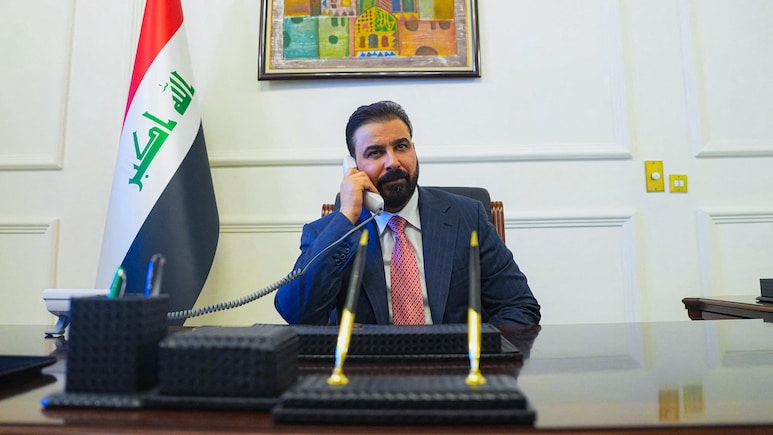
- Ali Al Zaidi is now the man Washington wants to be Iraq's next prime minister
- Trump has invited Zaidi to Washington and declared that the US "is with him all the way"
- He founded Al Janoob Islamic Bank roughly a decade ago
He has never held public office, built his fortune in banking, satellite broadcasting and government contracts, and runs a financial institution that the United States Treasury barred from the dollar system in 2024. Yet Ali Al Zaidi is now the man Washington wants to be Iraq's next prime minister.
According to a report by the Wall Street Journal, President Donald Trump has invited Zaidi to Washington and declared that the US "is with him all the way."
The choice came after months of stretched-out negotiations in which former prime minister Nouri al-Maliki, who is considered close to Iran, was put forward for the role. Trump warned he would cut off US assistance to Iraq if Maliki was confirmed. Lawmakers eventually turned to Zaidi as a compromise, with Iraqi officials confirming to the Wall Street Journal that both the US and Iran were consulted before the nomination was announced.
A Businessman, Not A Politician
Zaidi is not a career politician. In fact, he is largely unknown outside Iraq's business circles. He made his money across several sectors. He founded Al Janoob Islamic Bank roughly a decade ago and set up Al Awees, a company that imports agricultural commodities for Iraq's Ministry of Trade. He has since taken telephone calls from both Trump and Iranian President Masoud Pezeshkian, an example of a delicate balancing act.
He is still working to assemble enough support in parliament to be formally voted into office in the coming weeks, along with his nominees to head Iraq's ministries.
When Zaidi's Bank Raised 'Red Flag' In Washington
Zaidi's path to the US backing came with a rebuke first. In 2024, Zaidi's bank, Al Janoob, was among two dozen Iraqi banks prohibited by the US Treasury from conducting dollar transactions. As per the WSJ report, Washington cited intelligence suggesting Al Janoob likely had connections to an Iran-backed militia leader named Shibl Al Zaidi, a claim the bank called "false and based on rumour and speculation."
Shibl Al Zaidi, whose political party won nine seats in parliament, was sanctioned by the US in 2018 for alleged involvement with Iran's Revolutionary Guard Corps and for ties to Hezbollah, the Iranian-backed militia in Lebanon. Treasury also found that the bank likely had close ties to Kataib Hezbollah, a militia the US has designated as a terrorist organisation.
Ali Al Zaidi owns 9.90 per cent of the bank's stock and, together with other family members, controls a majority of its shares. He "has no direct role or responsibility in the bank's operations and has had no such role since 2019," when he stepped down as chairman, Al Janoob's chairman, Mazen Ahmed, told the Wall Street Journal.
Balancing Act That Awaits Iraq's Next Prime Minister
A delicate balancing act awaits Zaidi when he assumes office. The White House has made clear it expects him to exclude Iranian-backed militias from Iraq's next government and to reduce Tehran's influence in Baghdad. These militias, according to the US, have carried out 600 attacks on American diplomatic and military facilities in Iraq since the onset of the US-Israeli conflict with Iran.
Iran, for its part, is pushing back. As per the report, General Esmail Qaani, a senior officer in Iran's Revolutionary Guard, visited Baghdad on Sunday and urged Iraqi officials not to exclude militia leaders from the government or to pursue disarmament.
The militias Zaidi is being asked to sideline are not peripheral actors. They came up during the US occupation of Iraq and later played a significant role in defeating the Islamic State. Since then, they have extended their reach into Iraq's political institutions and financial system.
Victoria Taylor, who oversaw Iraq policy as a State Department official during the Biden administration, told the Wall Street Journal, "The reality is that the militia groups have pretty deeply entrenched themselves into the Iraqi state and the economic system, and regardless of who the prime minister is, it will be a challenging and quite lengthy process to begin to chip away at those groups."
She added that reducing their influence would be "a challenging and quite lengthy process" that could risk provoking a violent reaction.
Track Latest News Live on NDTV.com and get news updates from India and around the world


