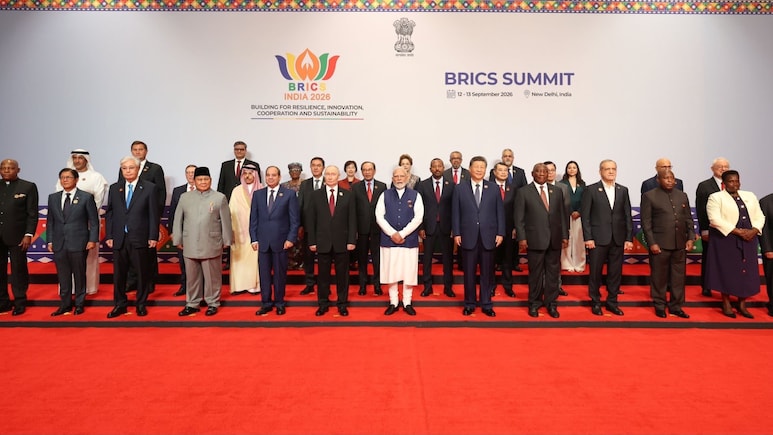
India's BRICS presidency has given New Delhi something better than a successful summit. It has given the country room to move. The summit wrapped up in the capital with all 11 members signing off on a 140-paragraph declaration. That alone was an achievement.
The grouping, known to agree on almost nothing, met in the middle of a war in the Middle East, while Russia and Ukraine are still fighting, trade disputes are piling up, and sanctions are reshaping how countries do business with each other, and yet they agreed on a declaration.
But you can't measure what India got out of this meeting by counting paragraphs. The real question is what New Delhi does next with the goodwill it just built. It has to prove that a stronger seat at the BRICS table doesn't come at the cost of its relationships with Washington and Brussels.
Now the goal will be to build strategic autonomy with sharper edges. India isn't pulling away from the West, but it is trying to get strong enough to reduce its reliance on the West.
India's Wins
The obvious victory for India during the summit was to get 11 countries, with wildly different interests, to sign one document. Iran and the United Arab Emirates (UAE) were both in the room, on opposite sides of a region at war with itself. According to a Reuters report, their presence alone nearly derailed consensus. The final text called for restraint and dialogue and avoided anything that would have blown up the talks.
New Delhi didn't fix BRICS' internal fights. It just kept them from sinking the summit. That skill, holding a room together when the people in it don't agree, is becoming India's calling card with the developing world.
Then there's the UN angle. The declaration backed reform of the Security Council and a bigger role for developing nations, and Russia and China both restated their support for India getting a permanent seat. Nothing new there, but it's a card India keeps in play, and it does more than help with the Security Council push. It positions India as speaking for developing economies broadly, not just for itself.
Third, the economics. The summit signed off on the BRICS Economic Partnership Strategy 2030, and India's chairship was specifically praised for pushing it forward. It's meant to be the master plan for trade and investment among members, with more specific roadmaps to come. The declaration also called for tougher, more diversified supply chains and a bigger role for developing economies in high-value manufacturing, which lines up neatly with India's own 'Make in India' ambitions.
In simpler terms, none of this is binding. A paragraph in a declaration doesn't move a single factory. Its relevance depends on the money, execution, and whether India is actually competitive enough to win the business.
The Payments Story
Finance was the touchiest part of the summit and probably the most misunderstood. The declaration mentioned work by the BRICS Payment Task Force on cross-border payments, and it noted growing interest in settling trade using local currencies rather than dollars. It also admitted, in so many words, that there's no single formula for how that's supposed to work.
This is the part the West will read most closely. BRICS countries have spent years trying to reduce how exposed they are to Western financial systems and sanctions. This summit pushed that another step.
But nobody should mistake this for the launch of a BRICS currency or a serious threat to the dollar. What's actually happening is slower and less dramatic: countries are testing whether their payment systems can talk to each other and experimenting with local-currency trade.
India has a real card to play here. The Financial Times reported that UPI and Brazil's Pix processed more than $10 trillion between them over the past year and a half, and the two countries are now talking about linking the systems across borders. That's not a talking point. That's infrastructure India can actually offer other countries, instead of just complaining about the dollar.
New Delhi isn't trying to burn down the dollar system. It just doesn't want Indian trade to be one sanction away from getting cut off. That's risk management, not a revolution.
Minerals and the China Problem
Energy security and critical minerals also received serious attention. Stable energy markets, sturdier infrastructure, and cooperation on the materials that go into batteries and electronics were part of discussions. This might end up mattering more than anything else that came out of the summit.
The race for lithium, cobalt, nickel, and rare earths is only getting more intense as the world builds out EVs and renewables, and right now China controls a huge share of that supply chain. BRICS gives India a way to build relationships with resource-rich countries outside China's orbit.
This doesn't put India at odds with the West, as the US, EU, Japan, and Australia are chasing the same diversification. India can sit in the middle, between BRICS' mineral producers and Western manufacturers who need those materials.
Tech Cooperation
The declaration also touched on science and technology cooperation, including quantum computing, and floated a shared BRICS research repository.
This fits where Indian foreign policy is heading generally. Technology, not just diplomacy, is going to decide who has power over the next decade, and India wants a foot in every camp.
However, the move has its limits. India can't build a serious AI or semiconductor industry through BRICS alone. The capital, the research networks, and the chip expertise -- most of that still runs through the US, Europe, and Japan. BRICS adds options. It doesn't replace what India needs from the West.
The Smaller Stuff Still Counts
Not everything from this summit was about grand strategy. India pushed cooperation on regenerative and digital agriculture and helped set up a BRICS network for research on sustainable cities.
These tasks don't make headlines, but they matter for a specific reason. India's credibility in the Global South isn't going to be built on speeches about reforming world institutions. It's going to be built on whether India can actually help with things like food security and urban planning. This is New Delhi trying to make BRICS useful in ways people can feel, not just read about.
What Didn't Happen Matters Too
Maybe the most telling part of this summit is everything it didn't materialise -- no military alliance, no shared currency, no formal bloc against the West, no resolution to the deep disagreements over Russia, China, Iran, or the Gulf.
That's good for India. A tightly bound, openly anti-Western BRICS would force New Delhi to pick a side, which is the last thing it wants. A loose BRICS lets India move freely. This summit showed exactly what the grouping can do (agree on broad economic principles) and what it can't (act like NATO or the EU). For India, that looseness is the whole point.
The Harder Part
The real test isn't whether India leans toward BRICS or the West. It's whether India can run both relationships at the same time without either side feeling shortchanged.
India would likely keep working each relationship on its own terms, from technology and defence with the US, trade and clean energy with Europe, supply chains with Japan and Australia, energy and defence continuity with Russia, investment with the Gulf, all while using BRICS to push developing-world interests. None of this is contradictory. It's India spreading its bets, the same way an investor wouldn't put everything in one stock.
China Story
In India's story going forward, the biggest complication is China, which carries enormous weight inside BRICS and takes over the chairmanship in 2027. That gives Beijing real influence over where the grouping goes next.
India has to make sure BRICS doesn't quietly become an extension of Chinese economic priorities, without turning the grouping into a battleground with Beijing, which would wreck the flexibility that makes BRICS worth being in. New Delhi's likely approach will be to work with Beijing where interests line up, push back where they don't, and lean on the US, Japan, Europe, and Australia to make sure China can't simply outweigh everyone else.
The Caution
Going forward, India needs to avoid mistaking diplomatic success for actual power. Getting 11 countries to sign something is hard, but a declaration doesn't build a semiconductor plant or a port. It doesn't produce defence technology or guarantee a single tonne of lithium.
The 2030 economic strategy only matters if trade numbers actually move. The payments work only if businesses start using it. The mineral cooperation only matters if it turns into real supply chains. And India's push for a bigger global role will only matter if other countries keep backing it once the summit is over.
This is where the West comes back into the picture. India needs Western capital and technology just as much as the West needs India as a manufacturing base and strategic partner. That's mutual dependence, not India being the junior partner. It's exactly the balance New Delhi is after.
From Non-Alignment To Something Sharper
Put the whole thing together, and the logic is pretty consistent. Reform the system rather than tear it down. Build alternatives to the dollar rather than abandon it. Get more room to breathe from American pressure without joining an anti-American club. Keep Russia close without making it the only relationship that matters. Build enough leverage to stop China from calling the shots, without picking a fight. Turn BRICS into a tool for India's interests rather than an ideology.
That's a step beyond old-fashioned non-alignment, which was mostly about staying out of blocs. This is about holding several strong relationships at once and deliberately building alternatives so no single country can squeeze India too hard.
BRICS 2026 fit that plan well. It called for weightage on UN reform, more say over how payments evolve, movement on the 2030 economic strategy, progress on minerals and supply chains, a bigger tech agenda, and a stronger platform with the Global South. None of it requires India to walk away from Washington or Brussels. If anything, it's the reverse. The more options India has inside BRICS, the more confidently it can negotiate with the West. The deeper it ties itself to Western capital and technology, the more choices it has within the emerging-market world too. And the more India can stand on its own, the less anyone can push it around.
India isn't picking BRICS over the West. It's trying to make sure it never has to pick at all.
This summit gave India a stronger hand at the table. What happens now is the real test. New Delhi needs to turn the goodwill into factories, technology, investment, and the kind of capability that doesn't depend on anyone else's cooperation. If India pulls that off, its relationship with the West won't look like dependency. It will transform into two sides that need each other about equally.
Track Latest News Live on NDTV.com and get news updates from India and around the world


