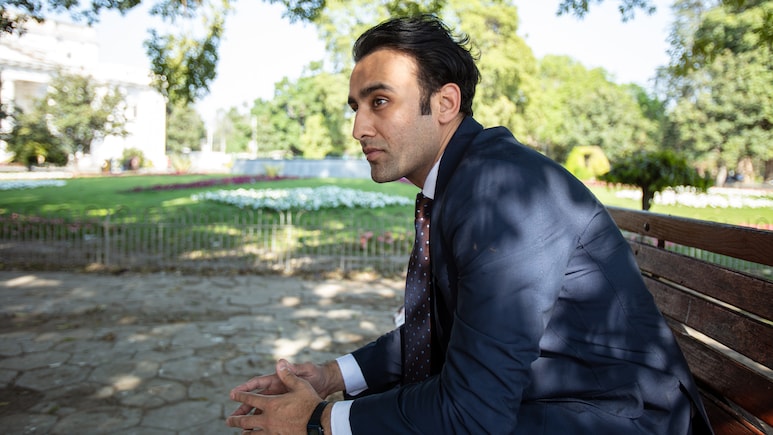
- Plucked from relative obscurity last year, Bilal Bin Saqib Saqib is now one of Pak's most influential figures
- Pakistan uses crypto diplomacy to strengthen US ties amid Iran conflict and energy challenges
- The US is working with Pak on a number of topics, including energy, critical minerals and counterterrorism.
At an ornate building in the heart of Islamabad, Pakistan's most powerful leaders gathered in January to welcome a special visitor: Zachary Witkoff, chief executive officer of World Liberty Financial, the crypto platform co-founded by US President Donald Trump.
The prestigious guest list made the event look more like a state visit than a ceremony for a non-binding stablecoin agreement that is exploratory in nature and doesn't involve a major financial commitment.
A group photo showed the 32-year-old son of Trump adviser Steve Witkoff flanked by Pakistani Prime Minister Shehbaz Sharif and Field Marshal Asim Munir, the nation's even more powerful military chief.
Standing on the other side of Munir was a key player in transforming the relationship between the US and Pakistan over the past year:
Bilal Bin Saqib, a 35-year-old self-described "crypto bro" who says he worked three jobs to get through college, including cleaning toilets.
At the event, Saqib hailed the visit by Zachary Witkoff and other World Liberty Financial executives as helping to "put Pakistan on the map."
Pakistan's adept use of crypto diplomacy - or "biplomacy" as Saqib calls it, a reference to Bitcoin - has buttressed a burgeoning friendship between Trump and Munir.
The red carpet treatment in Islamabad for the American president's family business underscores the growing depth of an increasingly important geopolitical relationship, seen by Pakistan's emergence as a key intermediary between the US and Iran in a war that threatens to upend the global economy.
Steve Witkoff confirmed last week that Pakistan delivered a 15-point action plan, and Islamabad has also been mentioned as a potential venue for any talks ahead of Trump's April 6 deadline for Iran to strike a deal or face attacks on critical infrastructure.
Pakistan also has an incentive to get this resolved:
The country is facing the prospect of an acute energy shortage as Iran blocks most ships from passing through the Strait of Hormuz.
"Given how important personal connections are in the Trump White House's policy process, Pakistan may well have bought itself some influence in the White House that advantaged it when it pitched itself to Washington as a mediator," said Michael Kugelman, resident senior fellow for South Asia at the Washington-based Atlantic Council, citing the deals with Zachary Witkoff.
"With this unconventional US administration, unconventional factors can help your cause - and that's certainly the case with crypto."
Plucked from relative obscurity last year, Saqib has suddenly become one of Pakistan's most influential figures.
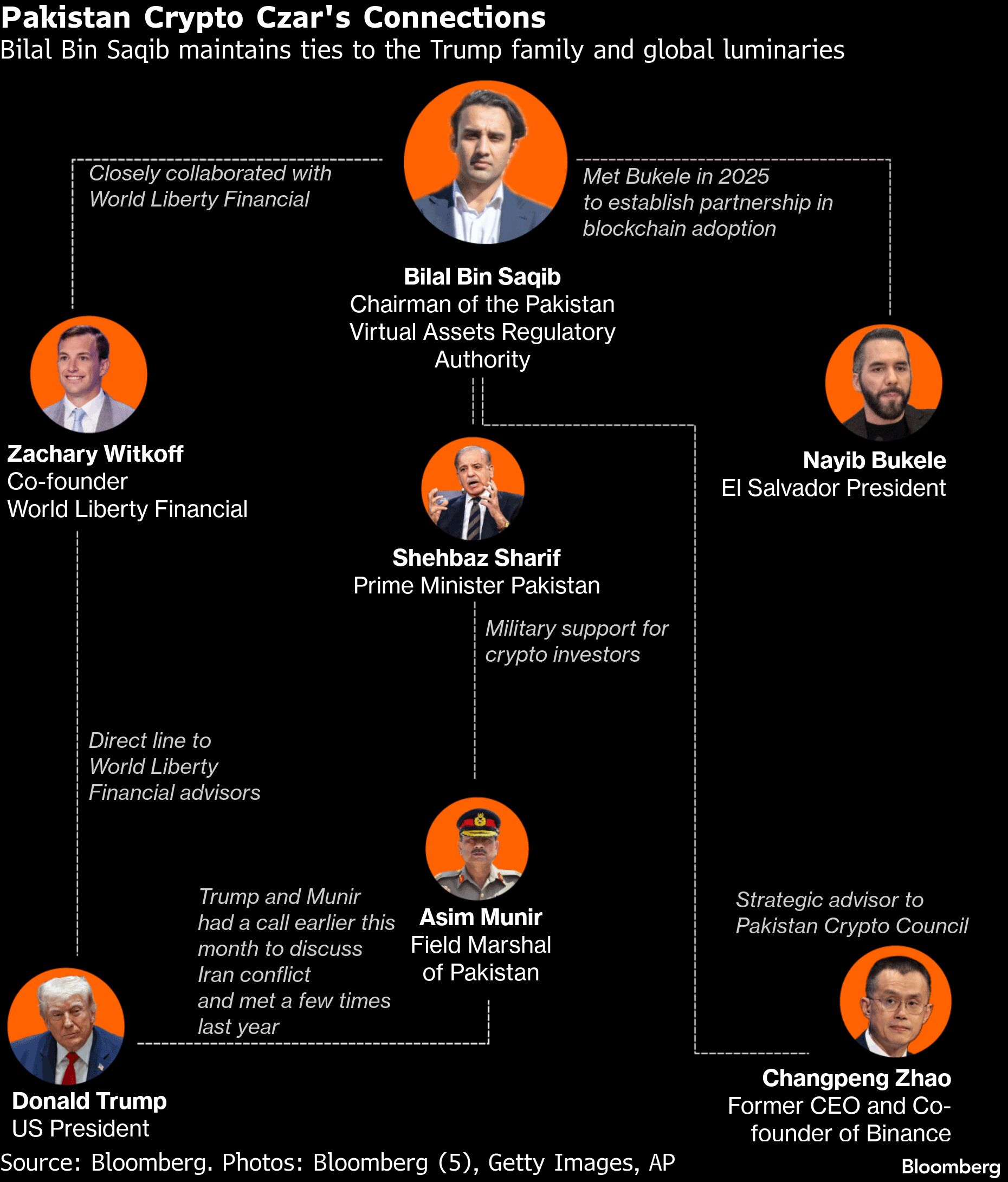
He's forged partnerships with crypto luminaries such as Changpeng Zhao, better known as CZ, the billionaire founder of Binance Holdings Ltd., the world's largest cryptocurrency-exchange.
He's also rubbed shoulders with the likes of fund manager Cathie Wood, Bitcoin billionaire Michael Saylor and Nayib Bukele, El Salvador's president who made Bitcoin legal tender in 2021 and established a Strategic Bitcoin Reserve Fund.
Yet no relationship has paid more diplomatic and commercial dividends than his close ties with World Liberty Financial, which named Saqib as an adviser last April.
He stepped away from that role when he entered government service and wasn't being paid, said David Wachsman, a spokesman for World Liberty Financial.
Last month, Saqib posted a selfie with Zachary Witkoff and other company executives at Trump's Mar-a-Lago club in Florida.
That came around the same time that Pakistan reached an agreement with the US to revamp the Roosevelt Hotel in Manhattan, a deal negotiated by Steve Witkoff.
"Because of crypto, doors have opened," Saqib said in a recent interview. "New conversations have opened, trust has been built. We have gotten an opportunity to rebrand."
White House deputy press secretary Anna Kelly said in a statement that the US is working with Pakistan on a number of topics of mutual interest, including energy, critical minerals and counterterrorism.
Responding to a question about the country's adoption of cryptocurrency and ties with World Liberty Financial, Kelly said: "There are no conflicts of interest."
Trump only acts in the "best interest of the American people" and his assets are in a trust managed by his children, she added.
For Pakistan, it all amounts to a remarkable turnaround.
The nation has spent much of the past decade on the brink of bankruptcy and diplomatic isolation as the US strengthened ties with India to counter China's rising military and economic strength.
Those dynamics abruptly changed last May, when Pakistan's generals credited Trump with stopping an armed conflict with India, termed 'Operation Sindoor' by New Delhi, which it claimed was in response to the Pahalgam terror attack.
Trump's mediation claim was rejected outright by New Delhi, leading to months of terse relations with the US.
While the White House has since mended ties with India, Trump regularly heaps praise on Munir: At a Board of Peace meeting in February, the president called Pakistan's military chief a "great general," "great guy" and "serious fighter."
Pakistan has reciprocated with calls for Trump to be awarded the Nobel Peace Prize and other forms of flattery, while also using crypto as a way to further cement ties with the White House.
"For a country starved of global investor interest, aligning with Washington's crypto pivot isn't just about tech," said Uzair Younus, who is a partner at The Asia Group, a Washington DC-based advisory firm.
"It's about signaling relevance in a shifting global order."
Until two years ago, Pakistan wanted little to do with crypto.
The country's regulators had spent a decade keeping the industry at arm's length, citing concerns over fraud, ponzi schemes and money laundering risks. Struggling with high inflation, heavy debt and dwindling foreign reserves, Pakistan was also reliant on a bailout from the International Monetary Fund that it had struggled to pay back.
But by 2024, sentiment shifted.
An economic recovery coincided with a realization within Pakistan's military establishment that crypto could be a useful bargaining chip in global diplomacy.
The nation rushed to pass a law governing virtual assets, establish a dedicated regulator and invite global exchanges to apply for licenses. It also proposed a national crypto reserve and earmarked 2,000 megawatts - about 5 per cent of its power grid - for crypto mining.
As part of that push, it needed someone to oversee everything - and that's where Saqib entered the picture.
Starting in March of last year, he was appointed to a series of positions in quick succession:
The finance minister's chief adviser on crypto, chief executive officer of the Pakistan Crypto Council, special assistant to the prime minister on blockchain and crypto.
Finally he ended up as chairman of the Pakistan Virtual Assets Regulatory Authority.
Exactly how he skyrocketed to become one of Pakistan's most influential officials in such a short amount of time remains unclear.
When asked who approached him to join the government, Saqib wouldn't give specifics, only mentioning it was the Finance Ministry.
Responding to a question on his expertise, Saqib said it was "essentially turning an idea into execution."
"I am not a trader," he said. "I'm a builder. I am the artist, not the scientist."
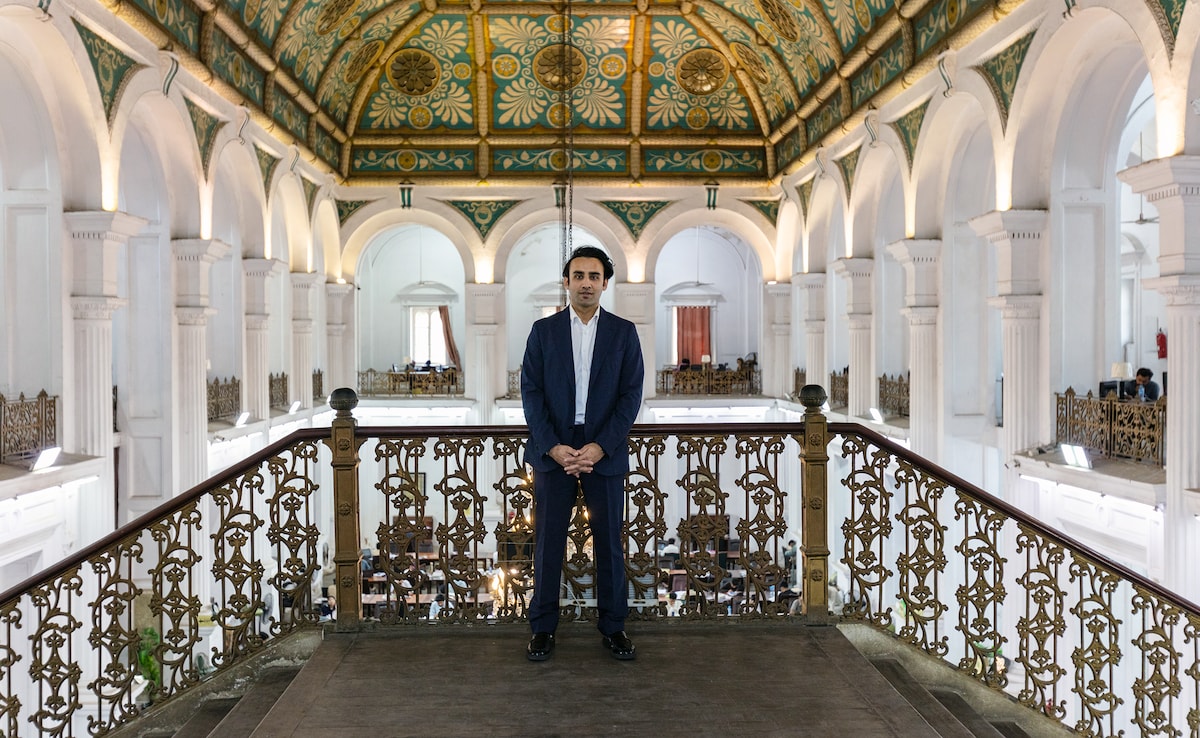
However Saqib defines it, suddenly he's seeing lots of success.
Originally from Lahore, Pakistan's second-most populous city, Saqib said his interest in crypto started during Bitcoin's historic bull run in 2017, when it surged from below $1,000 in January to $14,000 by the end of the year.
Spending time in both the UK and Pakistan, Saqib said he worked three jobs while getting a bachelor's degree, including at the university's grocery store where he manned the register, stocked shelves and cleaned toilets.
After later receiving a graduate degree at the London School of Economics for social innovation and entrepreneurship, he was soon giving TED Talks and recognised by Forbes for his work helping poor women access drinking water at a charity called Tayaba, which he founded with his brother in 2019.
While in the UK during Covid, Saqib co-founded the One Million Meals campaign to deliver fresh meals to health workers and others in need, a move that won him recognition from former Prime Minister Boris Johnson as well as the royal family, which honoured him as a Member of the Order of the British Empire.
For all his accolades in social work, Saqib struggled to find his footing in the crypto space.
In the four years prior to his appointment in Pakistan, Saqib's LinkedIn profile shows he was at The Coin Master, whose profile page says it has two-to-10 employees and goes by the slogan "Helping Tokens Develop Routes to Web3 Markets."
In the interview, Saqib acknowledged he's had some difficult times, without going into details.
"In crypto, failure is the best teacher," he said.
"There is no formal school for this. And you learn by doing, by making mistakes and getting back up every time."
"One thing I know," he added.
"If you throw enough mud against the wall, something will stick."
It didn't take long for Saqib to make his mark after he formally started working with Pakistan's government in March 2025.
The next month, he persuaded Binance's Zhao - who had recently finished a US prison term after being convicted for failing to set up appropriate money laundering safeguards - to sign on as a strategic advisor to the Pakistan Crypto Council.
Trump would end up pardoning Zhao in October.
"The chef pulled up to Pakistan.
We cooking heavy - good vibes, no brakes!" Saqib posted about the visit on X, where his profile picture is a photo of himself wearing a T-shirt declaring "cryptocurrency is not a crime."
A Binance spokesperson said the company had obtained permission from Pakistan's regulator to conduct activities in the country, and "remains committed to operating in full compliance with all applicable regulatory requirements and to working closely with local authorities to support the responsible development of the digital asset ecosystem."
Getting Zhao on board was just the start.
Some three weeks later, Saqib hosted World Liberty Financial's Zachary Witkoff and other executives in Islamabad, where the company signed a "letter of intent" with Pakistan's government to deepen cooperation on stablecoin adoption.
Pakistan publicised the moment with enthusiasm.
World Liberty Financial is "backed by the Trump family, including President Donald Trump and his sons," and Trump has "personally endorsed WLF," the government said in a statement at the time.
Zachary Witkoff similarly has lofty ambitions.
In a video conversation with Saqib in May posted from Lahore's scenic Shalimar Gardens, he spoke about wanting to help digitise Pakistan's economy, tokenise the nation's "trillions of dollars" worth of rare-earth minerals and target the world's third-largest unbanked population with services like digital wallets and stablecoins.
Pakistan, he said, has "enormous potential."
Later in May, Saqib pitched Pakistan's emergence as a crypto player at a Bitcoin conference in Las Vegas, which also drew attendees such as US Vice President JD Vance and the US president's sons, Eric Trump and Donald Trump Jr., both co-founders of World Liberty Financial.
Several days later, Saqib was at the White House meeting with Bo Hines, who was then director of the President's Council of Advisers on Digital Assets.
The following month, Saqib found himself as a last-minute addition to a Pakistani delegation heading to the US for trade talks.
While on a family vacation in a Himalayan resort town that barely had any mobile reception, an official called him with an urgent message: "You're going to Washington. Pack quickly."
Despite having no background in tariffs, no idea of the agenda and no suit to wear in the meetings, Saqib jumped at the opportunity.
Once he landed in DC, he made a beeline to buy a blazer off the rack.
The next morning, seated across from American trade officials, he was holding forth on digital assets and trade corridors. By the time he left Washington, he had helped draft the framework for a trade deal.
That agreement was one of several tangible benefits Pakistan received from the Trump administration.
It cut tariffs on Pakistani goods to 19 per cent, far lower than many Asian peers and well below US rates at the time on Indian products, which climbed as high as 50 per cent before Trump brought them down to 18 per cent in January.
The Trump administration officially designated the Balochistan Liberation Army a terrorist organisation, a group that Pakistan has long sought to outlaw internationally.
For the US, Pakistan offers several prizes. Besides being a strategically located nuclear power, the nation also could help the US diversify critical mineral supply chains.
In September, Missouri-based US Strategic Metals signed a memorandum of understanding with a military-owned firm to develop rare-earth resources.
Trump's family business also stands to benefit from access to Pakistan's virtual asset market.
The country has 40 million crypto users with an estimated trading volume of more than $300 billion, according to the Finance Ministry, one of the world's highest adoption rates as residents look for investment alternatives in an economy with chronic inflation.
Plenty can always go wrong, particularly as oil prices surge.
Pakistan still needs to pay back the International Monetary Fund, which has shown an aversion to sovereign crypto experiments.
El Salvador learned the hard way: Bitcoin adoption strained relations with the IMF, contributing to stalled funding negotiations.
Trump has also shown he can quickly turn on any leader, no matter how chummy they seem.
He could demand that Pakistan, which last year signed a defence agreement with Saudi Arabia, join the fight against Iran in some fashion - a scenario that would put Munir in a tight spot.
For Saqib, however, the focus is on building up tech skills among Pakistan's younger generations so they can develop the economy and avoid running to the IMF every few years for cash.
And he's optimistic that the nation is heading in the right direction despite all the uncertainty around the globe.
"It's a lot of serendipity, a lot of good timing," Saqib said. "All the stars have aligned."
(Except for the headline, this story has not been edited by NDTV staff and is published from a syndicated feed.)
Track Latest News Live on NDTV.com and get news updates from India and around the world


