


Zwicky Transient Facility
- All
- News
-
Black Hole Tears Star Apart, Sends Out Powerful Flares Six Months Later
- Friday October 17, 2025
- Written by Gadgets 360 Staff
Astronomers detected a black hole 650 million light-years away devouring a star and then erupting twice with powerful flares months later. Observed by the Zwicky Transient Facility and tracked by ALMA and the VLA, this rare off-centre event hints at a rogue black hole cast out from its host galaxy.
-
www.gadgets360.com
-
Astronomers Discover Most Powerful Cosmic Explosions Since the Big Bang
- Saturday June 7, 2025
- Written by Gadgets 360 Staff
Astronomers have discovered extreme nuclear transients — rare and powerful explosions caused by stars being torn apart by supermassive black holes. These events, brighter and longer-lasting than supernovae, were observed using data from Gaia and ZTF. As the most energetic cosmic outbursts since the Big Bang, they offer valuable insights into blac...
-
www.gadgets360.com
-
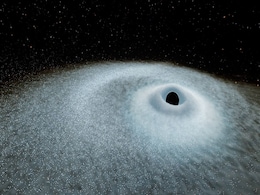
Rare Cosmic Event: Supermassive Black Hole Wakes Up After 20-Year Slumber, Stuns Astronomers
- Tuesday May 27, 2025
- Science | Edited by Ritu Singh
This event marks the first real-time observation of a black hole transitioning from a quiescent to an active state.
-
www.ndtv.com
-
Hubble Captures First-Ever Rogue Black Hole Devouring a Star Outside Galactic Core
- Thursday May 15, 2025
- Written by Gadgets 360 Staff
Astronomers led by Dr. Yuhan Yao have discovered the first offset tidal disruption event (TDE), where a rogue black hole outside a galaxy's core ripped apart a star. Spotted by the Hubble telescope and Zwicky Transient Facility, this marks historic evidence of a wandering supermassive black hole in action.
-
www.gadgets360.com
-
Scientists Spot Light Flare From a Black Hole Collision for the First Time Ever
- Friday June 26, 2020
- Abhik Sengupta
A team of international astronomers believe that they might have detected light from a black hole merger, for the first time ever. This unprecedented event was noted by scientists at Caltech' Zwicky Transient Facility (ZTF) in California after studying gravitational waves and electromagnetic radiation from the collision of two black holes.
-
www.gadgets360.com
-
Black Hole Tears Star Apart, Sends Out Powerful Flares Six Months Later
- Friday October 17, 2025
- Written by Gadgets 360 Staff
Astronomers detected a black hole 650 million light-years away devouring a star and then erupting twice with powerful flares months later. Observed by the Zwicky Transient Facility and tracked by ALMA and the VLA, this rare off-centre event hints at a rogue black hole cast out from its host galaxy.
-
www.gadgets360.com
-
Astronomers Discover Most Powerful Cosmic Explosions Since the Big Bang
- Saturday June 7, 2025
- Written by Gadgets 360 Staff
Astronomers have discovered extreme nuclear transients — rare and powerful explosions caused by stars being torn apart by supermassive black holes. These events, brighter and longer-lasting than supernovae, were observed using data from Gaia and ZTF. As the most energetic cosmic outbursts since the Big Bang, they offer valuable insights into blac...
-
www.gadgets360.com
-
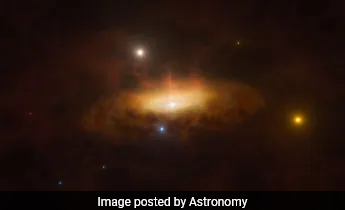
Rare Cosmic Event: Supermassive Black Hole Wakes Up After 20-Year Slumber, Stuns Astronomers
- Tuesday May 27, 2025
- Science | Edited by Ritu Singh
This event marks the first real-time observation of a black hole transitioning from a quiescent to an active state.
-
www.ndtv.com
-
Hubble Captures First-Ever Rogue Black Hole Devouring a Star Outside Galactic Core
- Thursday May 15, 2025
- Written by Gadgets 360 Staff
Astronomers led by Dr. Yuhan Yao have discovered the first offset tidal disruption event (TDE), where a rogue black hole outside a galaxy's core ripped apart a star. Spotted by the Hubble telescope and Zwicky Transient Facility, this marks historic evidence of a wandering supermassive black hole in action.
-
www.gadgets360.com
-
Scientists Spot Light Flare From a Black Hole Collision for the First Time Ever
- Friday June 26, 2020
- Abhik Sengupta
A team of international astronomers believe that they might have detected light from a black hole merger, for the first time ever. This unprecedented event was noted by scientists at Caltech' Zwicky Transient Facility (ZTF) in California after studying gravitational waves and electromagnetic radiation from the collision of two black holes.
-
www.gadgets360.com