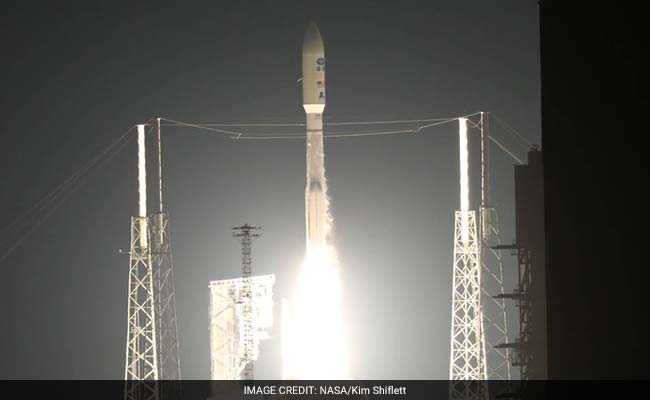
Nasa Weather Satellite
- All
- News
-
NASA’s Carruthers Observatory Begins Mission to Study Earth’s Hydrogen Halo
- Tuesday March 3, 2026
- Written by Gadgets 360 Staff
NASA’s Carruthers Observatory has begun its two-year science mission to study Earth’s hydrogen-rich exosphere from a halo orbit at Sun–Earth L1. Equipped with ultraviolet cameras, the small satellite will continuously image the faint geocorona, tracking how solar storms and fast solar wind streams cause the upper atmosphere to expand, contrac...
-
www.gadgets360.com
-
NASA’s GNEISS Mission Will Map Electric Currents Behind the Aurora
- Sunday February 8, 2026
- Written by Gadgets 360 Staff
NASA’s GNEISS mission will launch from Alaska in early 2026 to probe the electric currents that drive auroras. Two rockets will fly through glowing auroral arcs, releasing sub-payloads whose radio signals act like a CT scan. By mapping electron density and direction, scientists aim to improve space weather forecasting and better protect satellite...
-
www.gadgets360.com
-
NASA’s GNEISS Mission Will Map Electric Currents Behind the Aurora
- Saturday February 7, 2026
- Written by Gadgets 360 Staff
NASA’s GNEISS mission will launch from Alaska in early 2026 to probe the electric currents that drive auroras. Two rockets will fly through glowing auroral arcs, releasing sub-payloads whose radio signals act like a CT scan. By mapping electron density and direction, scientists aim to improve space weather forecasting and better protect satellite...
-
www.gadgets360.com
-
NASA’s Parker Solar Probe Observes Solar Wind Making ‘U-Turn’, Shedding Light on Space Weather
- Wednesday December 17, 2025
- Written by Gadgets 360 Staff
NASA’s Parker Solar Probe captured solar wind reversing toward the sun, revealing how magnetic fields recycle coronal material. This process, seen during a close flyby, helps refine models of space weather and may allow scientists to better predict solar storms that can impact satellites, communications, and power systems across the solar system.
-
www.gadgets360.com
-
Massive Sunspot Complex on the Sun Raises Risk of Strong Solar Storms
- Tuesday December 9, 2025
- Written by Gadgets 360 Staff
A massive sunspot complex has appeared on the Sun, covering an area comparable to the legendary Carrington Event region. Known as AR 4294-96, the active cluster features highly tangled magnetic fields that could unleash powerful solar flares and geomagnetic storms, potentially disrupting satellites, power grids, and global communications if Earth-d...
-
www.gadgets360.com
-
SpaceX Launches IMAP, CGO, SWFO-L1 to Probe Solar Frontier and Space Weather
- Sunday September 28, 2025
- Written by Gadgets 360 Staff
A Falcon 9 lifted off from Kennedy Space Center on Sept. 24, 2025, carrying NASA’s IMAP, CGO, and SWFO-L1 spacecraft. The mission aims to chart the heliosphere’s boundary, monitor Earth’s geocorona, and deliver constant space-weather alerts, protecting satellites and astronauts while expanding knowledge of the solar system’s outer edge.
-
www.gadgets360.com
-
IMAP Space Weather Mission to Lift Off Soon, NASA Confirms Broadcast Plans
- Thursday September 18, 2025
- Written by Gadgets 360 Staff
NASA will stream the Sept. 23 launch of IMAP with two rideshare satellites from Kennedy Space Centre. IMAP will study the heliosphere, Carruthers will image Earth’s exosphere, and NOAA’s SWFO-L1 will provide early solar storm warnings. Together, the missions advance space weather science while protecting satellites, communications, and power sy...
-
www.gadgets360.com
-
10 Strange 'Dark Voids' Appear Over Remote Island Near Antarctica in Rare Satellite View
- Sunday August 17, 2025
- Written by Gadgets 360 Staff
A rare NASA satellite image shows 10 sharply defined “dark voids” above Heard Island, a volcanic peak in the southern Indian Ocean. Formed by von Kármán vortices bent nearly 90 degrees by fierce westerly winds, the striking gaps pierce thick cloud cover, offering a vivid glimpse of nature’s intricate atmospheric patterns from space.
-
www.gadgets360.com
-
NASA's TRACERS Satellites Begin Solar Wind Study Despite SV1 Glitch
- Wednesday August 6, 2025
- Written by Gadgets 360 Staff
NASA launched its twin TRACERS satellites on July 23, 2025, to study how solar wind causes magnetic reconnection in Earth's magnetosphere. However, a power issue on one spacecraft, SV1, has caused intermittent communication. Engineers believe the issue relates to sunlight availability on its solar panels and plan recovery efforts in August. Meanwhi...
-
www.gadgets360.com
-
NASA to Live Stream SpaceX Crew-11 Launch Docking, Know How to Watch Online
- Friday July 25, 2025
- Written by Gadgets 360 Staff
On July 25, 2025, Russia launched two Ionosfera-M satellites and Iran’s Nahid-2 communication satellite aboard a Soyuz-2.1b rocket from Vostochny. The new Ionosfera-M probes expand Russia’s space weather tracking constellation, while Nahid-2 reflects Iran’s space ambitions. The joint launch highlights deepening space collaboration between Mos...
-
www.gadgets360.com
-
NASA’s Carruthers Observatory Begins Mission to Study Earth’s Hydrogen Halo
- Tuesday March 3, 2026
- Written by Gadgets 360 Staff
NASA’s Carruthers Observatory has begun its two-year science mission to study Earth’s hydrogen-rich exosphere from a halo orbit at Sun–Earth L1. Equipped with ultraviolet cameras, the small satellite will continuously image the faint geocorona, tracking how solar storms and fast solar wind streams cause the upper atmosphere to expand, contrac...
-
www.gadgets360.com
-
NASA’s GNEISS Mission Will Map Electric Currents Behind the Aurora
- Sunday February 8, 2026
- Written by Gadgets 360 Staff
NASA’s GNEISS mission will launch from Alaska in early 2026 to probe the electric currents that drive auroras. Two rockets will fly through glowing auroral arcs, releasing sub-payloads whose radio signals act like a CT scan. By mapping electron density and direction, scientists aim to improve space weather forecasting and better protect satellite...
-
www.gadgets360.com
-
NASA’s GNEISS Mission Will Map Electric Currents Behind the Aurora
- Saturday February 7, 2026
- Written by Gadgets 360 Staff
NASA’s GNEISS mission will launch from Alaska in early 2026 to probe the electric currents that drive auroras. Two rockets will fly through glowing auroral arcs, releasing sub-payloads whose radio signals act like a CT scan. By mapping electron density and direction, scientists aim to improve space weather forecasting and better protect satellite...
-
www.gadgets360.com
-
NASA’s Parker Solar Probe Observes Solar Wind Making ‘U-Turn’, Shedding Light on Space Weather
- Wednesday December 17, 2025
- Written by Gadgets 360 Staff
NASA’s Parker Solar Probe captured solar wind reversing toward the sun, revealing how magnetic fields recycle coronal material. This process, seen during a close flyby, helps refine models of space weather and may allow scientists to better predict solar storms that can impact satellites, communications, and power systems across the solar system.
-
www.gadgets360.com
-
Massive Sunspot Complex on the Sun Raises Risk of Strong Solar Storms
- Tuesday December 9, 2025
- Written by Gadgets 360 Staff
A massive sunspot complex has appeared on the Sun, covering an area comparable to the legendary Carrington Event region. Known as AR 4294-96, the active cluster features highly tangled magnetic fields that could unleash powerful solar flares and geomagnetic storms, potentially disrupting satellites, power grids, and global communications if Earth-d...
-
www.gadgets360.com
-
SpaceX Launches IMAP, CGO, SWFO-L1 to Probe Solar Frontier and Space Weather
- Sunday September 28, 2025
- Written by Gadgets 360 Staff
A Falcon 9 lifted off from Kennedy Space Center on Sept. 24, 2025, carrying NASA’s IMAP, CGO, and SWFO-L1 spacecraft. The mission aims to chart the heliosphere’s boundary, monitor Earth’s geocorona, and deliver constant space-weather alerts, protecting satellites and astronauts while expanding knowledge of the solar system’s outer edge.
-
www.gadgets360.com
-
IMAP Space Weather Mission to Lift Off Soon, NASA Confirms Broadcast Plans
- Thursday September 18, 2025
- Written by Gadgets 360 Staff
NASA will stream the Sept. 23 launch of IMAP with two rideshare satellites from Kennedy Space Centre. IMAP will study the heliosphere, Carruthers will image Earth’s exosphere, and NOAA’s SWFO-L1 will provide early solar storm warnings. Together, the missions advance space weather science while protecting satellites, communications, and power sy...
-
www.gadgets360.com
-
10 Strange 'Dark Voids' Appear Over Remote Island Near Antarctica in Rare Satellite View
- Sunday August 17, 2025
- Written by Gadgets 360 Staff
A rare NASA satellite image shows 10 sharply defined “dark voids” above Heard Island, a volcanic peak in the southern Indian Ocean. Formed by von Kármán vortices bent nearly 90 degrees by fierce westerly winds, the striking gaps pierce thick cloud cover, offering a vivid glimpse of nature’s intricate atmospheric patterns from space.
-
www.gadgets360.com
-
NASA's TRACERS Satellites Begin Solar Wind Study Despite SV1 Glitch
- Wednesday August 6, 2025
- Written by Gadgets 360 Staff
NASA launched its twin TRACERS satellites on July 23, 2025, to study how solar wind causes magnetic reconnection in Earth's magnetosphere. However, a power issue on one spacecraft, SV1, has caused intermittent communication. Engineers believe the issue relates to sunlight availability on its solar panels and plan recovery efforts in August. Meanwhi...
-
www.gadgets360.com
-
NASA to Live Stream SpaceX Crew-11 Launch Docking, Know How to Watch Online
- Friday July 25, 2025
- Written by Gadgets 360 Staff
On July 25, 2025, Russia launched two Ionosfera-M satellites and Iran’s Nahid-2 communication satellite aboard a Soyuz-2.1b rocket from Vostochny. The new Ionosfera-M probes expand Russia’s space weather tracking constellation, while Nahid-2 reflects Iran’s space ambitions. The joint launch highlights deepening space collaboration between Mos...
-
www.gadgets360.com