



Gravitational Wave
-
{
- All
- News
-

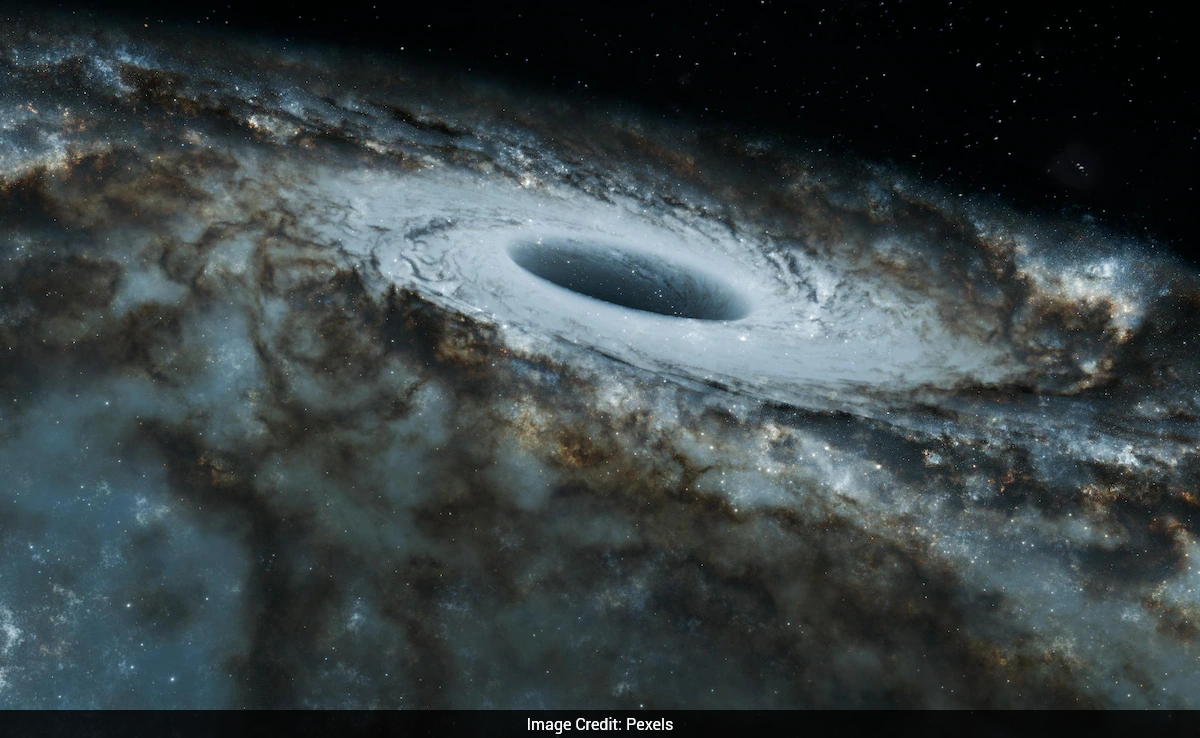
Study Reveals Black Hole Collisions May Be Creating Universe's Biggest Cosmic Giants
According to the study, this creates a forbidden mass range for stellar-mass black holes formed from collapsing stars.
-
Largest Black Holes May Form Through Repeated Collisions, Study Suggests
New gravitational-wave data from LIGO Scientific Collaboration, Virgo, and KAGRA suggests the largest Black Holes form through repeated mergers inside dense star clusters rather than directly from collapsing stars.
-
Hubble Constant Puzzle Deepens as Supernova and CMB Measurements Clash
Astronomers are testing a new way to measure the universe’s expansion rate using the gravitational-wave background detected by NANOGrav. By treating the cosmic hum from merging supermassive black holes as a statistical “stochastic siren,” researchers hope to calculate the Hubble constant and help resolve the long-standing Hubble tension betwe...
-
New Study Explores How LIGO-Style Lasers Could Test Quantum Gravity
Gravitational waves, first directly detected in 2015, have opened a new way of observing the universe. Now, physicist Ralf Schützhold of HZDR proposes going a step further—actively interacting with these ripples in spacetime using powerful lasers. His theoretical scheme builds on LIGO-style interferometers, where intense laser pulses bounce repe...
-
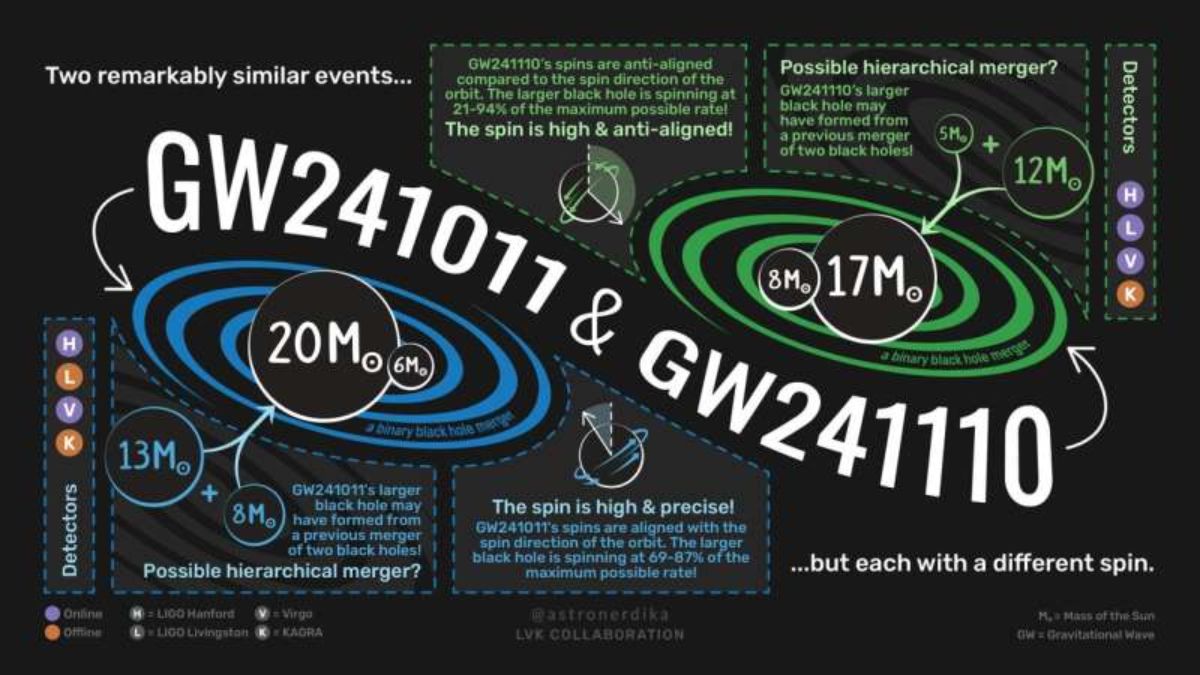
LIGO Detect Possible Second-Generation Black Holes with Extreme Spins
LIGO-Virgo-KAGRA observatories detected two extraordinary black hole collisions in late 2024—GW241011 and GW241110. The first involved a rapidly spinning black hole, while the second revealed one rotating opposite its orbit. These findings fit predictions for second-generation black holes, born from earlier mergers within crowded star clusters. T...
-
Pulsar Observations Could Reveal Gravitational Wave Interference From Black Holes
A new study proposes detecting gravitational-wave “beats” using pulsar timing. Researchers from Hirosaki University suggest that interference between waves from supermassive black hole binaries could appear as periodic variations in pulsar signals. The method may help distinguish individual sources from a diffuse gravitational-wave background i...
-
Gravitational Waves Reveal Most Massive Black Hole Merger Ever Observed
The GW231123 event marks the most massive black hole merger ever detected through gravitational waves, involving black holes of 100 and 140 solar masses. Observed by the LIGO-Virgo-KAGRA network, it challenges current black hole formation models with extreme mass and spin, suggesting a complex origin. Scientists believe its full implications may ta...
-
Scientists Detect Biggest Merger Of Two Black Holes In History
Scientists have detected the most massive merger of two black holes ever recorded for the first time in history.
-
New Theory Challenges Black Hole Singularities, But Critics Raise Red Flags
A new black hole theory proposes a fix to the long-standing singularity paradox by modifying gravity equations. But scientists like Nikodem Poplawski argue that the model lacks observational support and rests on speculative assumptions. He suggests future data from gravitational waves or the cosmic microwave background may one day help us uncover t...
-
Magnetic Fields Could Significantly Influence Oscillations in Merging Neutron Stars, Study Finds
Magnetic fields may play a bigger role in neutron star mergers than previously thought. A new study using advanced simulations shows that these fields can shift or suppress oscillation frequencies, altering gravitational wave signatures. This discovery could change how astronomers decode post-merger signals and refine models of neutron star interio...
-
New Polar Cataclysmic Variable Identified by Astronomers: What You Need to Know
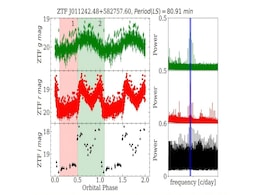
Astronomers have detected ZTF J0112+5827, a newly identified polar cataclysmic variable. This binary system, composed of a white dwarf and a low-mass donor star, features an 80.9-minute orbital period and a strong magnetic field of 38.7 MG. It lacks an accretion disk, with emissions mainly from its accretion stream and magnetic field lines. The sys...
-
Gravitational Waves Reveal Black Hole Ancestry Through Spin Analysis
A study published in Physical Review Letters explores how gravitational waves reveal the ancestry of black holes. By examining 69 black hole mergers, researchers found that spin shifts indicate repeated collisions in dense star clusters. This insight supports models suggesting black holes grow through sequential mergers. Observatories like LIGO and...
-
Astronomers Discover Unusual X-Ray Oscillations From a Black Hole 100 Million Light-Years Away
A supermassive black hole 100 million light-years away is showing an unprecedented increase in X-ray oscillations, starting from 18-minute intervals and accelerating to 7 minutes in just two years. Astronomers believe a white dwarf, orbiting perilously close to the event horizon, is causing these flashes. The findings offer a glimpse into black hol...
-
MeerKAT Detects Gravitational Wave Background, Uncovering Cosmic Activity
Scientists using the MeerKAT Pulsar Timing Array have made a groundbreaking discovery, confirming the presence of a gravitational wave background in the universe. This unexpected phenomenon, detected with unprecedented precision, suggests that supermassive black hole collisions may occur more frequently than previously thought. By observing the sig...
-
Scientists Develop New Approach to Capture Gravitational Wave Memory from Supernovae
A study published in Physical Review Letters highlights new methods to detect the gravitational wave memory effect, a unique phenomenon predicted by Einstein's general relativity. Core-collapse supernovae (massive stellar explosions) generate these low-frequency gravitational waves, offering a rare glimpse into stellar interiors. Despite their weak...


-
Study Reveals Black Hole Collisions May Be Creating Universe's Biggest Cosmic Giants
According to the study, this creates a forbidden mass range for stellar-mass black holes formed from collapsing stars.
-
Largest Black Holes May Form Through Repeated Collisions, Study Suggests
New gravitational-wave data from LIGO Scientific Collaboration, Virgo, and KAGRA suggests the largest Black Holes form through repeated mergers inside dense star clusters rather than directly from collapsing stars.
-
Hubble Constant Puzzle Deepens as Supernova and CMB Measurements Clash
Astronomers are testing a new way to measure the universe’s expansion rate using the gravitational-wave background detected by NANOGrav. By treating the cosmic hum from merging supermassive black holes as a statistical “stochastic siren,” researchers hope to calculate the Hubble constant and help resolve the long-standing Hubble tension betwe...
-
New Study Explores How LIGO-Style Lasers Could Test Quantum Gravity
Gravitational waves, first directly detected in 2015, have opened a new way of observing the universe. Now, physicist Ralf Schützhold of HZDR proposes going a step further—actively interacting with these ripples in spacetime using powerful lasers. His theoretical scheme builds on LIGO-style interferometers, where intense laser pulses bounce repe...
-
LIGO Detect Possible Second-Generation Black Holes with Extreme Spins
LIGO-Virgo-KAGRA observatories detected two extraordinary black hole collisions in late 2024—GW241011 and GW241110. The first involved a rapidly spinning black hole, while the second revealed one rotating opposite its orbit. These findings fit predictions for second-generation black holes, born from earlier mergers within crowded star clusters. T...
-
Pulsar Observations Could Reveal Gravitational Wave Interference From Black Holes
A new study proposes detecting gravitational-wave “beats” using pulsar timing. Researchers from Hirosaki University suggest that interference between waves from supermassive black hole binaries could appear as periodic variations in pulsar signals. The method may help distinguish individual sources from a diffuse gravitational-wave background i...
-
Gravitational Waves Reveal Most Massive Black Hole Merger Ever Observed
The GW231123 event marks the most massive black hole merger ever detected through gravitational waves, involving black holes of 100 and 140 solar masses. Observed by the LIGO-Virgo-KAGRA network, it challenges current black hole formation models with extreme mass and spin, suggesting a complex origin. Scientists believe its full implications may ta...
-
Scientists Detect Biggest Merger Of Two Black Holes In History
Scientists have detected the most massive merger of two black holes ever recorded for the first time in history.
-
New Theory Challenges Black Hole Singularities, But Critics Raise Red Flags
A new black hole theory proposes a fix to the long-standing singularity paradox by modifying gravity equations. But scientists like Nikodem Poplawski argue that the model lacks observational support and rests on speculative assumptions. He suggests future data from gravitational waves or the cosmic microwave background may one day help us uncover t...
-
Magnetic Fields Could Significantly Influence Oscillations in Merging Neutron Stars, Study Finds
Magnetic fields may play a bigger role in neutron star mergers than previously thought. A new study using advanced simulations shows that these fields can shift or suppress oscillation frequencies, altering gravitational wave signatures. This discovery could change how astronomers decode post-merger signals and refine models of neutron star interio...
-
New Polar Cataclysmic Variable Identified by Astronomers: What You Need to Know
Astronomers have detected ZTF J0112+5827, a newly identified polar cataclysmic variable. This binary system, composed of a white dwarf and a low-mass donor star, features an 80.9-minute orbital period and a strong magnetic field of 38.7 MG. It lacks an accretion disk, with emissions mainly from its accretion stream and magnetic field lines. The sys...
-
Gravitational Waves Reveal Black Hole Ancestry Through Spin Analysis
A study published in Physical Review Letters explores how gravitational waves reveal the ancestry of black holes. By examining 69 black hole mergers, researchers found that spin shifts indicate repeated collisions in dense star clusters. This insight supports models suggesting black holes grow through sequential mergers. Observatories like LIGO and...
-
Astronomers Discover Unusual X-Ray Oscillations From a Black Hole 100 Million Light-Years Away
A supermassive black hole 100 million light-years away is showing an unprecedented increase in X-ray oscillations, starting from 18-minute intervals and accelerating to 7 minutes in just two years. Astronomers believe a white dwarf, orbiting perilously close to the event horizon, is causing these flashes. The findings offer a glimpse into black hol...
-
MeerKAT Detects Gravitational Wave Background, Uncovering Cosmic Activity
Scientists using the MeerKAT Pulsar Timing Array have made a groundbreaking discovery, confirming the presence of a gravitational wave background in the universe. This unexpected phenomenon, detected with unprecedented precision, suggests that supermassive black hole collisions may occur more frequently than previously thought. By observing the sig...
-
Scientists Develop New Approach to Capture Gravitational Wave Memory from Supernovae
A study published in Physical Review Letters highlights new methods to detect the gravitational wave memory effect, a unique phenomenon predicted by Einstein's general relativity. Core-collapse supernovae (massive stellar explosions) generate these low-frequency gravitational waves, offering a rare glimpse into stellar interiors. Despite their weak...

