


Exoplanets Collision
- All
- News
-
New ALMA Images Reveal Complex Rings Left Behind by Planet Formation
- Wednesday January 28, 2026
- Written by Gadgets 360 Staff
Astronomers used ALMA to capture unprecedented images of young exoplanetary systems. The ARKS survey mapped 24 debris disks, revealing rings, gaps and collisions that trace planetary evolution. These snapshots expose chaotic transitional stages, helping scientists understand how newborn planets mature into stable systems like our own Solar System t...
-
www.gadgets360.com
-
Hubble Observations Turn Exoplanet Into Dust; Reveal Rare Double Asteroid Impact in Nearby System
- Saturday January 3, 2026
- Written by Gadgets 360 Staff
NASA’s Hubble Space Telescope has revealed that a vanished exoplanet near the star Fomalhaut was never a planet at all. Scientists discovered two rare, violent collisions between asteroid-sized bodies, producing glowing debris clouds that briefly mimicked planets. The findings offer a rare glimpse into how planetary systems evolve and how mislead...
-
www.gadgets360.com
-
Hubble Captures Rare Collision in Nearby Planetary System, Revealing Violent Planet Formation
- Friday December 19, 2025
- Written by Gadgets 360 Staff
Astronomers using NASA’s Hubble Space Telescope have witnessed rare collisions between rocky bodies in the Fomalhaut system. The glowing debris clouds created by these impacts offer a unique glimpse into how planets form and highlight challenges in identifying true exoplanets.
-
www.gadgets360.com
-
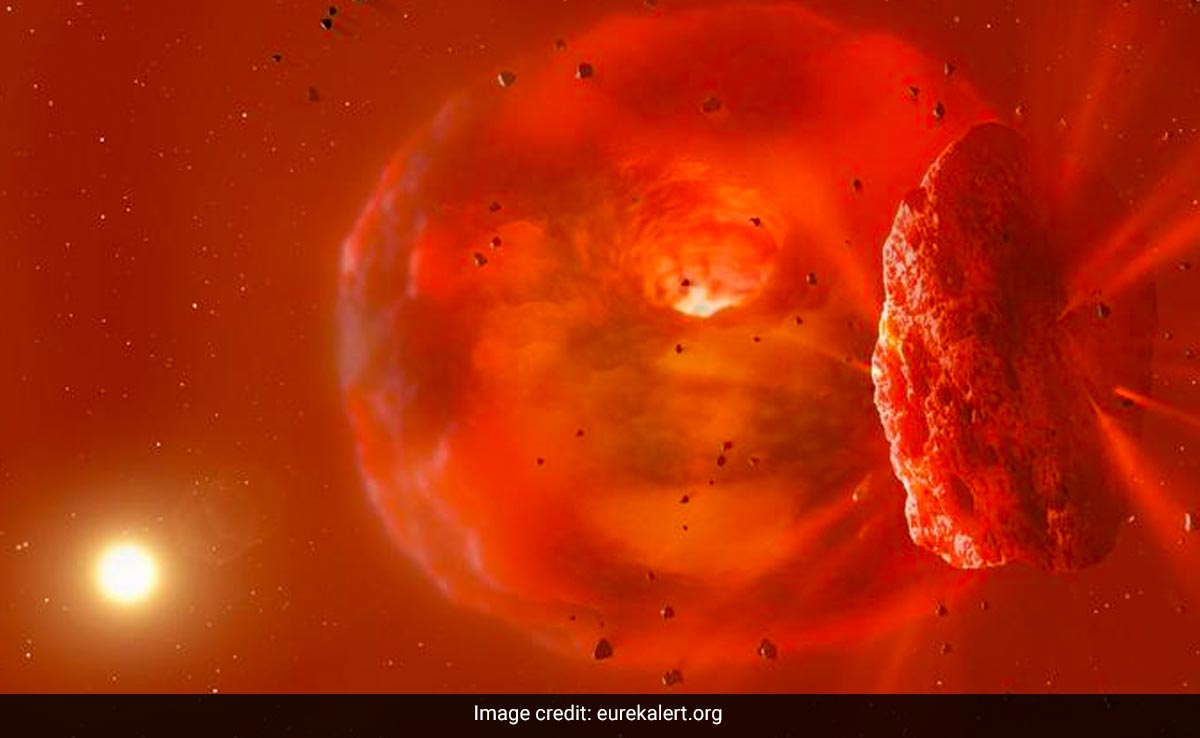
Astronomers Spot Afterglow After Two Giant Planets Collided In Distant Star System
- Friday October 13, 2023
- Science | Edited by Anjali Thakur
The researchers believe that the wreckage of the collision could eventually cool and form a new planet.
-
www.ndtv.com
-
Exoplanet Discovered Years Ago Disappears in Latest Hubble Observations
- Tuesday April 21, 2020
- Prabhakar Thakur
An exoplanet that was last seen by Astronomers orbiting its star, Fomalhault, 25 light years away, is nowhere to be seen. It has been suggested that the supposed planet could actually be a dust cloud that formed after the collision of two icy bodies.
-
www.gadgets360.com
-
New ALMA Images Reveal Complex Rings Left Behind by Planet Formation
- Wednesday January 28, 2026
- Written by Gadgets 360 Staff
Astronomers used ALMA to capture unprecedented images of young exoplanetary systems. The ARKS survey mapped 24 debris disks, revealing rings, gaps and collisions that trace planetary evolution. These snapshots expose chaotic transitional stages, helping scientists understand how newborn planets mature into stable systems like our own Solar System t...
-
www.gadgets360.com
-
Hubble Observations Turn Exoplanet Into Dust; Reveal Rare Double Asteroid Impact in Nearby System
- Saturday January 3, 2026
- Written by Gadgets 360 Staff
NASA’s Hubble Space Telescope has revealed that a vanished exoplanet near the star Fomalhaut was never a planet at all. Scientists discovered two rare, violent collisions between asteroid-sized bodies, producing glowing debris clouds that briefly mimicked planets. The findings offer a rare glimpse into how planetary systems evolve and how mislead...
-
www.gadgets360.com
-
Hubble Captures Rare Collision in Nearby Planetary System, Revealing Violent Planet Formation
- Friday December 19, 2025
- Written by Gadgets 360 Staff
Astronomers using NASA’s Hubble Space Telescope have witnessed rare collisions between rocky bodies in the Fomalhaut system. The glowing debris clouds created by these impacts offer a unique glimpse into how planets form and highlight challenges in identifying true exoplanets.
-
www.gadgets360.com
-
Astronomers Spot Afterglow After Two Giant Planets Collided In Distant Star System
- Friday October 13, 2023
- Science | Edited by Anjali Thakur
The researchers believe that the wreckage of the collision could eventually cool and form a new planet.
-
www.ndtv.com
-
Exoplanet Discovered Years Ago Disappears in Latest Hubble Observations
- Tuesday April 21, 2020
- Prabhakar Thakur
An exoplanet that was last seen by Astronomers orbiting its star, Fomalhault, 25 light years away, is nowhere to be seen. It has been suggested that the supposed planet could actually be a dust cloud that formed after the collision of two icy bodies.
-
www.gadgets360.com