Dark Matter Mapping
- All
- News
- Videos
-
NASA's New High-Resolution Map Shows Dark Matter In "Stunning Detail"
- Tuesday January 27, 2026
- Science | Edited by Srishti Singh Sisodia
The map provides insights into the universe's evolution, tracing dark matter's influence back to when galaxies were forming most actively.
-
www.ndtv.com
-
James Webb Helps Astronomers Chart the Universe’s Hidden Dark Matter
- Tuesday January 27, 2026
- Written by Gadgets 360 Staff
Astronomers have created the sharpest map yet of dark matter using deep observations from NASA’s James Webb Space Telescope. By analysing the gravitational distortion of hundreds of thousands of distant galaxies, the team traced invisible dark matter across a large region of the sky. The results confirm that dark matter forms the scaffolding arou...
-
www.gadgets360.com
-
Runaway Stars Help Astronomers Trace Dark Matter Distribution Across the Milky Way Galaxy
- Friday January 2, 2026
- Written by Gadgets 360 Staff
Astronomers have identified dozens of runaway stars moving fast enough to escape the Milky Way. By tracking these hypervelocity stars, researchers can map the galaxy’s gravitational pull and better understand how dark matter is distributed across its vast halo, offering new insight into the unseen structure shaping our cosmic home.
-
www.gadgets360.com
-
Astrophysicists Map Invisible Universe Using Warped Galaxies to Reveal Dark Matter
- Thursday December 25, 2025
- Written by Gadgets 360 Staff
Astrophysicists mapped the invisible universe by studying warped galaxies, revealing dark matter distribution and dark energy behaviour, supporting the standard cosmology model, and enabling new cosmic insights.
-
www.gadgets360.com
-
Astronomers Spot Galaxies Moving in Sync Across a 50-Million-Light-Year Stretch
- Friday December 5, 2025
- Written by Gadgets 360 Staff
Astronomers have identified a 50-million-light-year-long cosmic filament in which 14 gas-rich galaxies all rotate in sync with the structure itself. The filament, mapped about 140 million light-years away, appears young, cold and shaped by slow cosmic flows. Galaxies on opposite ends move in opposite directions, suggesting the entire filament is sp...
-
www.gadgets360.com
-
Hubble Unveils Dark Matter Web in Stunning Abell 209 Galaxy Cluster Image
- Sunday July 20, 2025
- Written by Gadgets 360 Staff
NASA/ESA’s Hubble Space Telescope has released a stunning new image of Abell 209, a massive galaxy cluster 2.8 billion light-years away in Cetus. The golden cluster houses over 100 galaxies, but beneath them lies an invisible web of hot gas and dark matter. Using gravitational lensing, Hubble reveals curved arcs of light from background galaxies,...
-
www.gadgets360.com
-
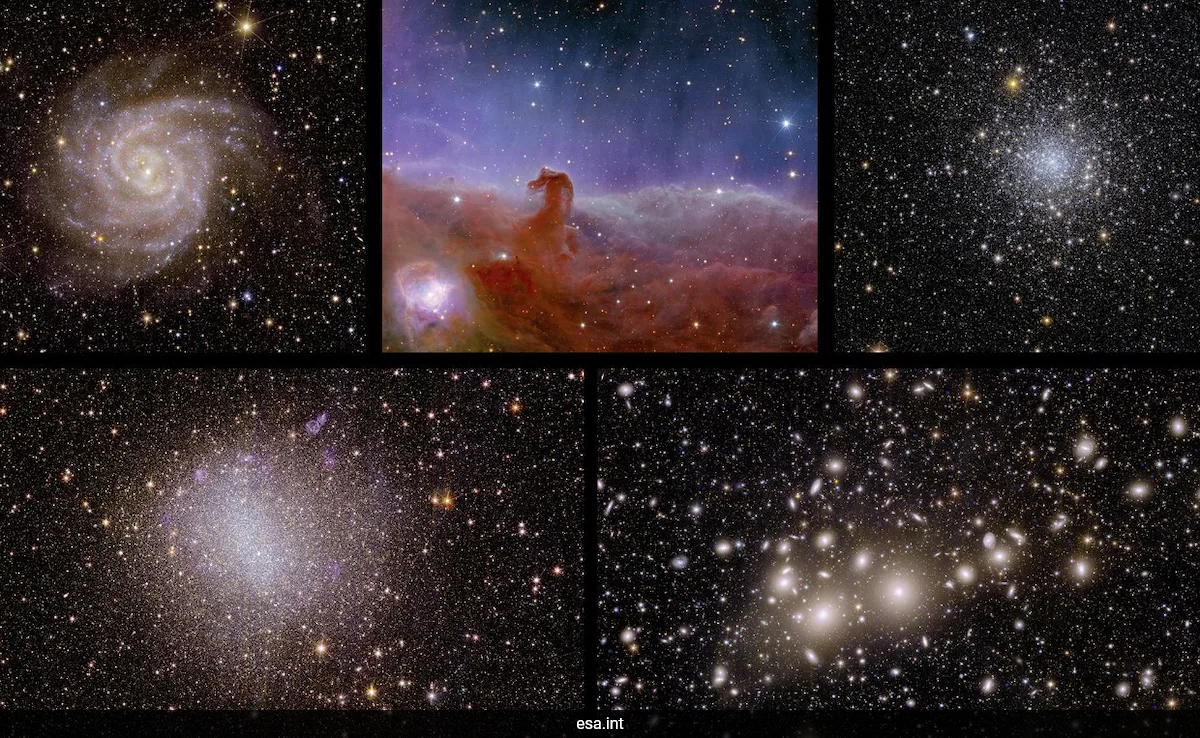
ESA’s Euclid Telescope Releases First Data, Mapping 26 Million Galaxies
- Wednesday March 26, 2025
- Written by Gadgets 360 Staff
ESA’s Euclid telescope has released its first dataset, mapping 26 million galaxies within a week. The observations include deep-field images, a survey of 380,000 galaxies, and 500 new gravitational lens candidates. Scientists will continue tracking cosmic evolution over six years. The dataset, currently 35 terabytes, is expected to grow to 2 peta...
-
www.gadgets360.com
-
New Study Reveals How Pulsars Help Measure Dark Matter in the Milky Way
- Tuesday March 4, 2025
- Written by Gadgets 360 Staff
A breakthrough study has used pulsar acceleration data to measure dark matter density in the Milky Way. Previously, binary pulsars were the primary source of data, but now solitary pulsars have been included, doubling the dataset. The research also provides evidence of the Milky Way’s "wobble" due to interactions with dwarf galaxies. By mapping t...
-
www.gadgets360.com
-
Euclid Space Telescope Discovers Rare Einstein Ring, Revealing Dark Matter Secrets
- Wednesday February 12, 2025
- Written by Gadgets 360 Staff
The Euclid space telescope has detected a rare Einstein ring around galaxy NGC 6505, located approximately 590 million light-years from Earth. This phenomenon, resulting from gravitational lensing, allows scientists to study the distribution of dark matter within the lensing galaxy. The discovery aligns with Euclid's mission to map cosmic structure...
-
www.gadgets360.com
-
NASA's New High-Resolution Map Shows Dark Matter In "Stunning Detail"
- Tuesday January 27, 2026
- Science | Edited by Srishti Singh Sisodia
The map provides insights into the universe's evolution, tracing dark matter's influence back to when galaxies were forming most actively.
-
www.ndtv.com
-
James Webb Helps Astronomers Chart the Universe’s Hidden Dark Matter
- Tuesday January 27, 2026
- Written by Gadgets 360 Staff
Astronomers have created the sharpest map yet of dark matter using deep observations from NASA’s James Webb Space Telescope. By analysing the gravitational distortion of hundreds of thousands of distant galaxies, the team traced invisible dark matter across a large region of the sky. The results confirm that dark matter forms the scaffolding arou...
-
www.gadgets360.com
-
Runaway Stars Help Astronomers Trace Dark Matter Distribution Across the Milky Way Galaxy
- Friday January 2, 2026
- Written by Gadgets 360 Staff
Astronomers have identified dozens of runaway stars moving fast enough to escape the Milky Way. By tracking these hypervelocity stars, researchers can map the galaxy’s gravitational pull and better understand how dark matter is distributed across its vast halo, offering new insight into the unseen structure shaping our cosmic home.
-
www.gadgets360.com
-
Astrophysicists Map Invisible Universe Using Warped Galaxies to Reveal Dark Matter
- Thursday December 25, 2025
- Written by Gadgets 360 Staff
Astrophysicists mapped the invisible universe by studying warped galaxies, revealing dark matter distribution and dark energy behaviour, supporting the standard cosmology model, and enabling new cosmic insights.
-
www.gadgets360.com
-
Astronomers Spot Galaxies Moving in Sync Across a 50-Million-Light-Year Stretch
- Friday December 5, 2025
- Written by Gadgets 360 Staff
Astronomers have identified a 50-million-light-year-long cosmic filament in which 14 gas-rich galaxies all rotate in sync with the structure itself. The filament, mapped about 140 million light-years away, appears young, cold and shaped by slow cosmic flows. Galaxies on opposite ends move in opposite directions, suggesting the entire filament is sp...
-
www.gadgets360.com
-
Hubble Unveils Dark Matter Web in Stunning Abell 209 Galaxy Cluster Image
- Sunday July 20, 2025
- Written by Gadgets 360 Staff
NASA/ESA’s Hubble Space Telescope has released a stunning new image of Abell 209, a massive galaxy cluster 2.8 billion light-years away in Cetus. The golden cluster houses over 100 galaxies, but beneath them lies an invisible web of hot gas and dark matter. Using gravitational lensing, Hubble reveals curved arcs of light from background galaxies,...
-
www.gadgets360.com
-
ESA’s Euclid Telescope Releases First Data, Mapping 26 Million Galaxies
- Wednesday March 26, 2025
- Written by Gadgets 360 Staff
ESA’s Euclid telescope has released its first dataset, mapping 26 million galaxies within a week. The observations include deep-field images, a survey of 380,000 galaxies, and 500 new gravitational lens candidates. Scientists will continue tracking cosmic evolution over six years. The dataset, currently 35 terabytes, is expected to grow to 2 peta...
-
www.gadgets360.com
-
New Study Reveals How Pulsars Help Measure Dark Matter in the Milky Way
- Tuesday March 4, 2025
- Written by Gadgets 360 Staff
A breakthrough study has used pulsar acceleration data to measure dark matter density in the Milky Way. Previously, binary pulsars were the primary source of data, but now solitary pulsars have been included, doubling the dataset. The research also provides evidence of the Milky Way’s "wobble" due to interactions with dwarf galaxies. By mapping t...
-
www.gadgets360.com
-
Euclid Space Telescope Discovers Rare Einstein Ring, Revealing Dark Matter Secrets
- Wednesday February 12, 2025
- Written by Gadgets 360 Staff
The Euclid space telescope has detected a rare Einstein ring around galaxy NGC 6505, located approximately 590 million light-years from Earth. This phenomenon, resulting from gravitational lensing, allows scientists to study the distribution of dark matter within the lensing galaxy. The discovery aligns with Euclid's mission to map cosmic structure...
-
www.gadgets360.com