




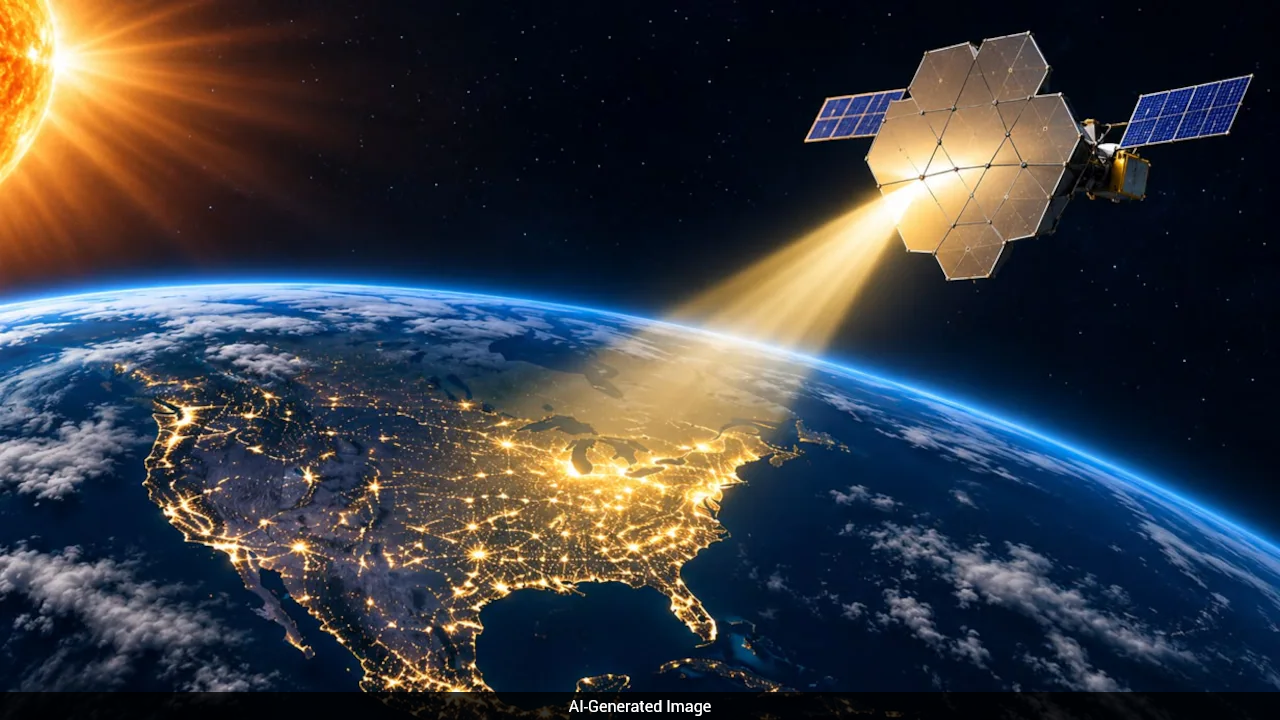
What if sunlight could be bought and sold like electricity? A US-based space startup is working on a plan that sounds straight out of science fiction: Launching giant mirrors into space to reflect sunlight back on to Earth after dark. The plan of California-based Reflect Orbital is to turn sunlight into an on-demand service, which can help solar farms generate electricity for longer, illuminate disaster-hit areas and help in rescue mission. The company has entered into agreement with India's Skyroot Aerospace for two rocket launches to test the technology.
However, the ambitious idea has also raised concerns among astronomers and environmentalists about its impact on the night sky.
What Is The Plan?
Reflect Orbital intends to send 18x18 metre mirrors in low-earth orbit (LEO) that can be steered to give sunlight in intended areas even after the Sun has disappeared.
The demonstration mirrors will reflect the light on to a patch roughly five kilometres across. The company will keep adjusting the steerable mirrors in position to keep the sunlight in areas for which customers have paid.
The inaugural mission is targeted for the second quarter of 2027.
An Ambitious Plan
Reflect Orbital plans to have 50,000 satellites by 2035. It says the reflected light will be comparable to moonlight and will become brighter and last longer as the fleet grows.
The project will use the demostration satellite Earendil-1 and will allow customers to choose the area using their apps.
One Problem: The Atmosphere
A peer-reviewed study published in August 2025 modelled what happens when reflected sunlight passes through our atmosphere. Molecules and aerosols scatter some of the light beam across the surrounding sky. Light reaching the ground is reflected upwards and then scattered again.
It will cause the light to affect a much wider area than intended. If the mirrors are placed even 14 kilometres away, the resulting glow on the surface of the Earth will be brighter than a full moon.
This means people affected may not have ordered the light. However, these are predictions based on calculations from a model; the real-life test is awaited.
The company received US regulatory approval in July, but some astronomers and environmental groups have challenged it and urged the Federal Communication Commission (FCC) to cancel it.
Track Latest News Live on NDTV.com and get news updates from India and around the world

