





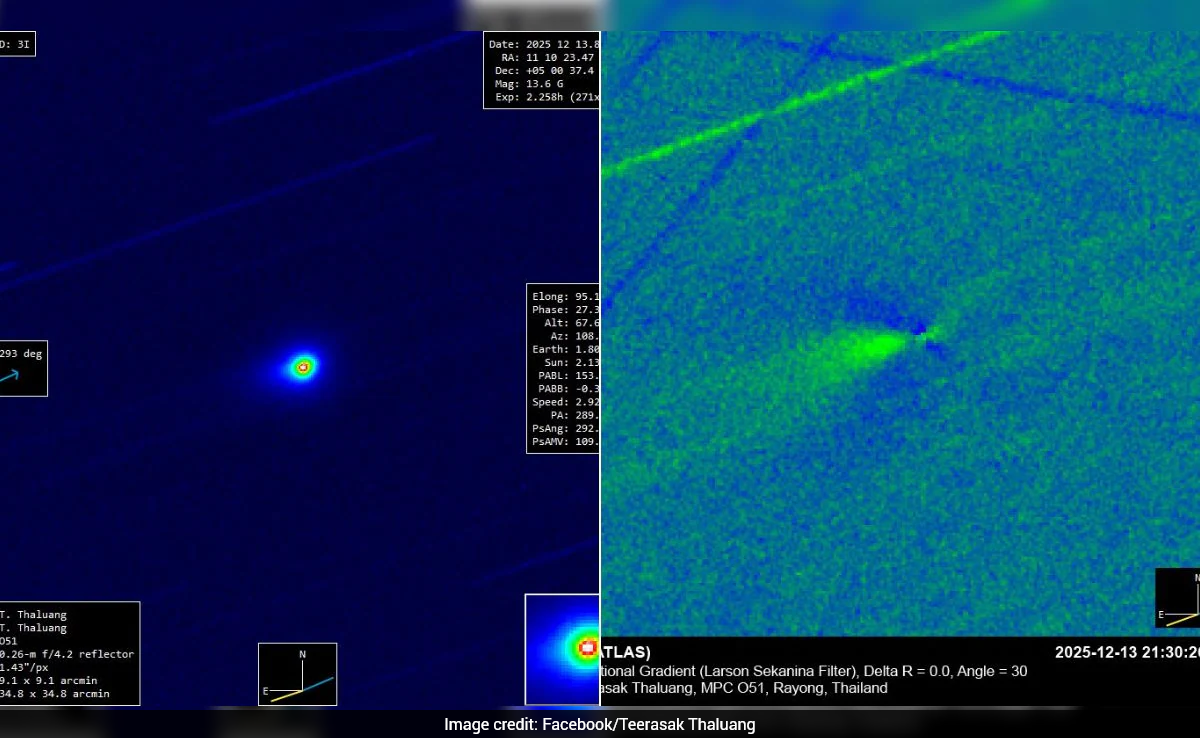
Harvard scientist Avi Loeb has said that interstellar object 3I/ATLAS "still shows an anti-tail" ahead of its closest approach to Earth on December 19 at a safe distance of approximately 270 million kilometres. This event provides a perfect opportunity for scientists to study this object from another star system.
3I/ATLAS, only the third interstellar object ever detected, following 1I/'Oumuamua and 2I/Borisov, has gained massive attention worldwide for its mysterious nature, with many experts suggesting that it might not be a naturally occurring object. But when NASA shared details, the space agency referred to it as a 'comet'.
Recently, Loeb weighed in on the latest images of the comet taken by Teerasak Thaluang in Rayong, Thailand, on December 13, 2025. "The rotational-gradient brightness map shows a prominent anti-tail, uncommon for comets, pointing in the direction of the Sun," he wrote in a blog post on Medium.
Also Read | Interstellar Comet 3I/ATLAS Turns Green Ahead Of Closest Approach To Earth
"Whereas an anti-tail had been seen for solar system comets as a temporary perspective effect when the Earth crossed the comets' orbital plane, this is clearly not the case with 3I/ATLAS."
An anti-tail is a rare phenomenon where a comet's tail appears to point towards the Sun, opposite to the expected direction. This is not an optical illusion, but a physical feature caused by the way dust and gas are ejected from the comet.
Also Read | Ahead Of Closest Approach To Earth, A Look At 3 Latest Images Of Interstellar Comet 3I/ATLAS
In the case of 3I/ATLAS, an anti-tail was observed when the Hubble Space Telescope observed it on July 21 and also recently on November 30, and also in other images taken by different space telescopes.
"The anti-tail of 3I/ATLAS is therefore not a perspective effect. It is a real physical jet, with a glow extending from 3I/ATLAS towards the Sun. Its nature is a mystery because gas and micrometer-dust particles are expected to be pushed away from the Sun by solar radiation pressure and the solar wind, creating the appearance of a tail - as routinely seen in solar-system comets," Loeb said.
Track Latest News Live on NDTV.com and get news updates from India and around the world

