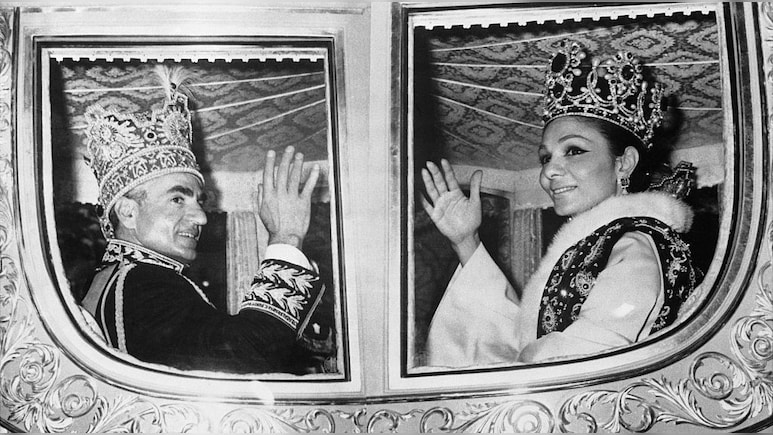
- Iran uses its crown jewels to back its currency, the rial, as state assets held by the Central Bank
- The jewels include historic diamonds, crowns, thrones, and thousands of precious stones dating centuries
- The jewels are valued unofficially between $20 billion and $50 billion but are not insured or auctioned
As fresh protests ripple across Iran and economic pressure tightens once again, the Iranian rial has been sliding further against major currencies.
Inflation remains stubbornly high, sanctions continue to restrict trade, and everyday prices keep climbing. Yet buried deep beneath central Tehran, sits one of the strangest financial safeguards in the modern world: Iran's crown jewels, not as museum pieces or royal symbols, but as assets that officially back the country's currency.
No other nation today uses its royal treasures in quite this way. While Britain's crown jewels shines in the Tower of London and Russia's imperial regalia lies behind glass cases, Iran's collection plays a unique role for its country. It is treated, quite literally, as money.
What Does It Mean To 'Back' A Currency
First things first. Backing a currency means giving it something solid to lean on. Today, most money is "fiat" currency. Its value comes from trust in the state, its economy, and its institutions. There is no physical object you can point to and say, "This note equals this much gold."
Historically, things worked differently. Many countries once operated on a gold standard, where every unit of currency was tied to a fixed quantity of gold held in reserve. The idea was straightforward: governments could not print unlimited money because they had to hold enough gold to support it.
Iran's system echoes that older logic. Instead of gold bars alone, the country treats its crown jewels as a reserve asset. They sit on the balance sheet of the Central Bank of Iran, acting as collateral that limits excessive money printing and reinforces confidence in the rial, at least on paper.
Think of it as an extraordinary pawn shop arrangement. The jewels are never sold, never worn, and almost never moved, but their sheer value underwrites the currency during moments of instability.
More Than Just Royal Bling
Iran's crown jewels are among the largest and most valuable hoards of precious stones ever assembled.
Stored in the vaults of the Central Bank of Iran, the collection includes diamonds, emeralds, rubies, pearls, gold objects, ceremonial thrones, and crowns spanning centuries of Persian history.
The most famous pieces include the Darya-i-Noor, or Sea of Light, one of the largest pink diamonds in the world, weighing around 182 carats, and a gem-studded globe covered in more than 51,000 precious stones (more on that in a bit).
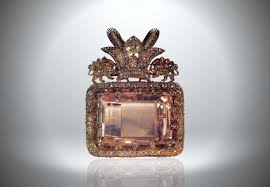
The Darya-i-Noor. Photo: Central Bank of Iran
Unlike European collections designed primarily for coronations and pageantry, Iran's jewels were often treated as portable wealth. They were assets to be displayed, traded, or used to secure power, which partly explains why they transitioned so naturally into a financial role.
How The Jewels Became A Financial Reserve
The turning point came in 1937 under Reza Shah Pahlavi, an Iranian military officer and monarch who was the founder of the Pahlavi dynasty and Shah of Iran from 1925 to 1941.
Determined to modernise Iran's economy and strengthen state institutions, he ordered the royal treasury to be transferred from palace control to Bank Melli, the predecessor of today's Central Bank of Iran.
From that moment, the jewels ceased to be the personal property of the monarch. They became state assets. Legally and economically, they were reclassified as reserves, much like gold or foreign currency holdings.
This move proved crucial decades later. When the Islamic Revolution toppled the monarchy in 1979, many symbols of royal excess were destroyed or sold. The jewels survived precisely because they were no longer considered royal ornaments. They belonged to the nation's financial system.
Even the Islamic Republic, deeply suspicious of monarchical symbolism, retained the arrangement. In times of sanctions, war, and inflation, the jewels were too valuable to discard.
How Was The Collection Created?
The origins of the collection stretch back over 500 years. Early Safavid rulers began gathering precious stones in the 16th century, but the real expansion came in the 18th century under Nadir Shah.
In 1739, Nadir Shah invaded Mughal India, returning with unimaginable wealth from Delhi. Among the spoils were legendary diamonds, including the Darya-i-Noor, as well the Peacock Throne. These treasures transformed Iran's royal collection overnight, turning it into one of the richest on earth.
Later dynasties, including the Qajars and the Pahlavis, continued to add to it through diplomacy, purchases, and commissions. Crowns were redesigned, thrones rebuilt, and gemstones reset to reflect changing tastes and political ambitions.
What Is In The Vault?
Among the standout objects is the Pahlavi Crown (commissioned by Shah Mohammad Reza Pahlavi), created in 1925 and encrusted with 1,469 diamonds.
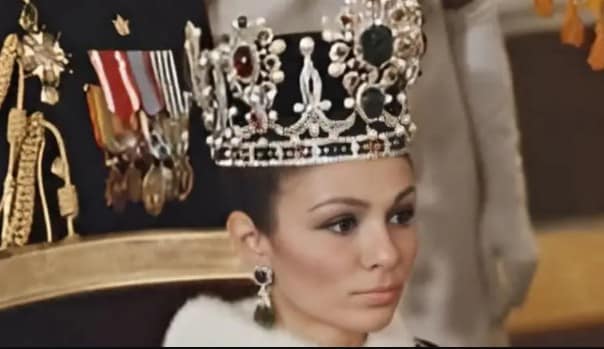
Shah Mohammad Reza Pahlavi, the last Shah of Iran, commissioned the crown for his third wife Farah Pahlavi (Farah Diba) in 1966. Photo: Instagram
Other items include:
- Empress Farah's Crown: White gold with green velvet lining; includes 1,469 diamonds, 36 emeralds (largest 92 carats), 105 pearls, 34 rubies, and two 83-carat spinels.
- Kiani Crown: Qajar-era red velvet crown with 1,800 pearls, 300 emeralds, 1,800 rubies, an 80-carat emerald, and 120-carat Aurangzeb spinel.
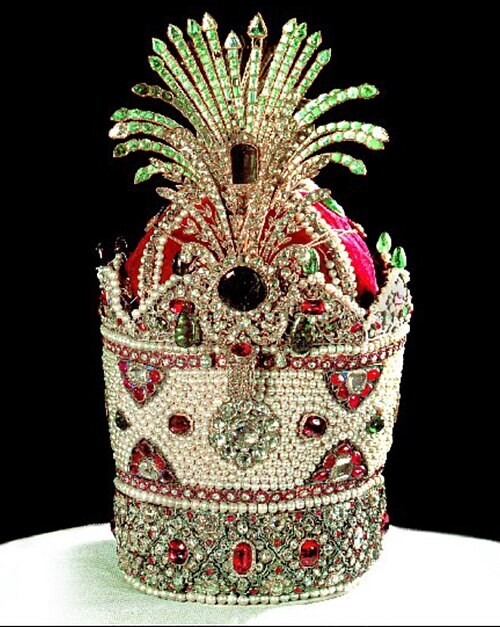
The Kiani Crown was the traditional coronation crown in the Iranian Crown Jewels, worn by the Qajar shahs of Iran. Photo: Wikicommons
Thrones and regalia
- Naderi Throne: Golden sunburst throne with 26,733 jewels (spinels, emeralds, rubies) and peacock motifs, that disassembles into 12 parts for portability.
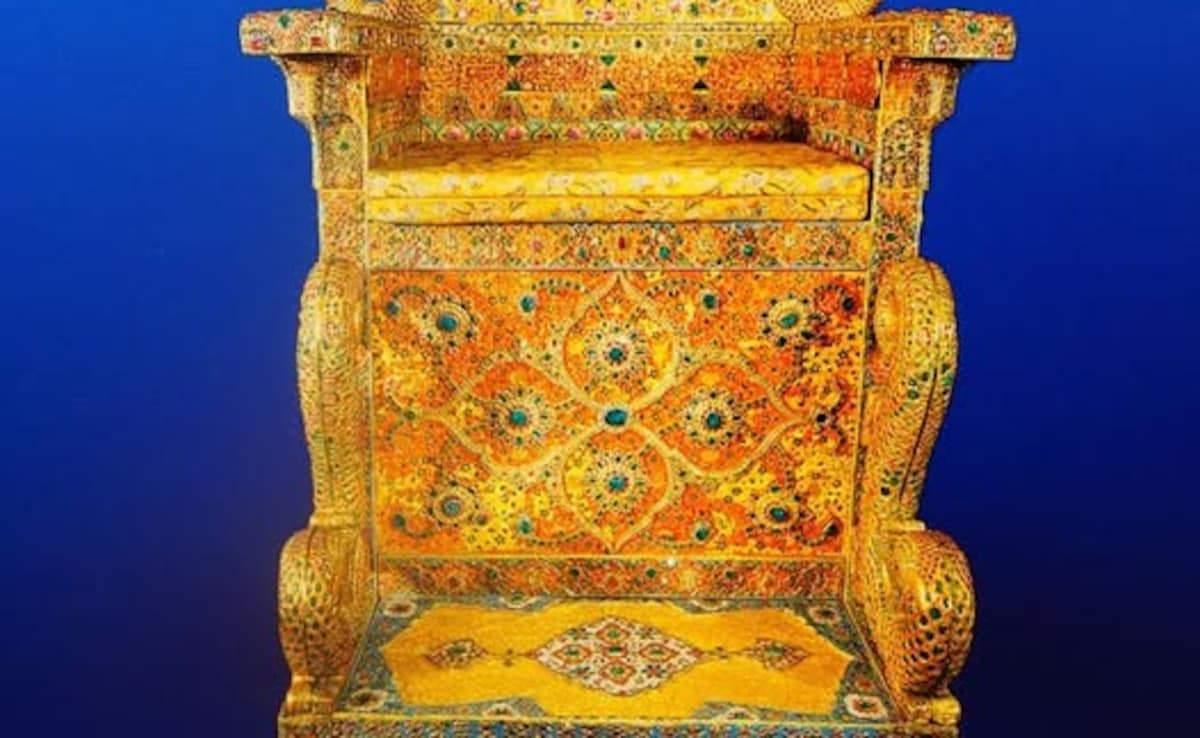
The Naderi Throne is a magnificent, jewel-encrusted golden throne from Iran's Qajar era. Photo: Facebook
- Golden Belt (Shah's Coronation Belt): 119 cm gold strap from 1850 with 176-carat emerald centerpiece, 60 brilliant diamonds, and 145 smaller ones.
- Imperial Sword, Coronation Cape, and Necklace: Sword with jewelled hilt; cape of velvet and gems; necklace with large emeralds and diamonds.
Standout gems and objects
- Darya-i-Noor Diamond: 182-carat pale pink diamond, looted from Mughal India by Nader Shah in 1739.
- Noor-ul-Ain Tiara and Diamond: 60-carat gem cut from the same stone as Darya-i-Noor.
- Jewelled Globe: Gold sphere with 51,366 diamonds, rubies, and emeralds for each specific region.
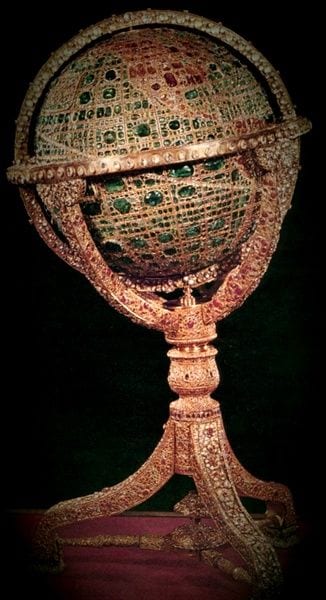
The Jewelled Globe or Koreh-e Javaherneshan is a solid gold globe created in 1869 for Nasser-al-Din Shah Qajar. Photo: Pinterest
- Chest of Pearls: Contains 105 large pearls up to 22 mm.
Other items include emerald necklaces, jewelled dish covers, golden flagons, and men's turban ornaments like aigrettes with sapphires and emeralds.
What makes these objects unusual is not just their beauty, but their status. They are not insured, not auctioned, and not given a precise market value. Officially, the collection is described as "immeasurable".
Unofficial estimates suggest figures ranging from $20 billion to $50 billion, though many experts believe even that fails to capture their true worth.
PS: You can see some of these items in the Iranian Crown Jewels at the Treasury of National Jewels (Muzey-e Jevahirat-e Melli) in Tehran, located in the basement of the Central Bank of Iran.
Why No Other Country Does This
Most monarchies separated their finances from their regalia long ago. Crown jewels elsewhere are cultural artefacts, tourist attractions, or diplomatic props. Using them as financial backing becomes politically awkward and economically unnecessary.
Iran's case is different. The combination of revolution, sanctions, and limited access to global financial systems has made unconventional reserves more valuable. The jewels cannot be frozen by foreign governments, seized through sanctions, or devalued by global markets.
They are, in a sense, the ultimate non-exportable asset. But does Iran's crown jewels stabilise the rial on the street? Not directly. Inflation and exchange rates are driven by far more immediate forces. But symbolically and institutionally, they act as a brake. They are a reminder that there is a finite pool of real value behind the currency.
READ MORE: How The Crown Of Iran's Empress Farah Pahlavi Was Created With 1,469 Diamonds
Track Latest News Live on NDTV.com and get news updates from India and around the world
