Lakes and rivers hold significance across cultures. For instance, the Hindu community worships rivers like the Ganga, the Yamuna, and the Narmada. They also consider Manasarovar Lake in Tibet and Bindu Sarovar in Gujarat sacred.
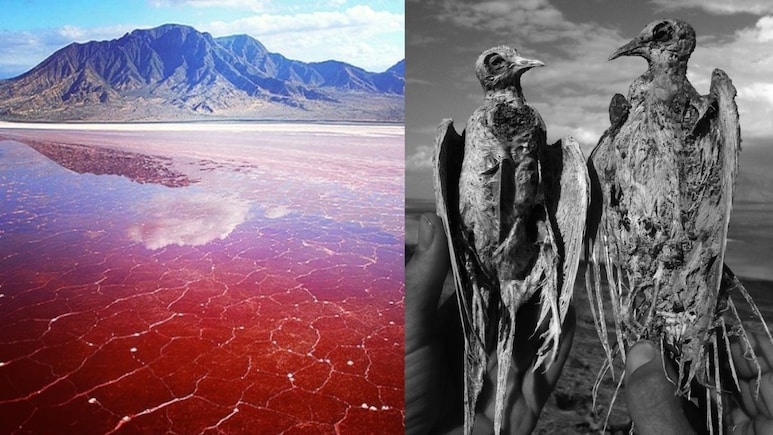
Similarly, Jews and Christians consider the Jordan River holy, Lake Guatavita in Colombia is linked to the legend of El Dorado, and Lake Bled in Slovenia has an island with a church. Amid these sacred waterbodies is Lake Natron in Tanzania, which is deadly.
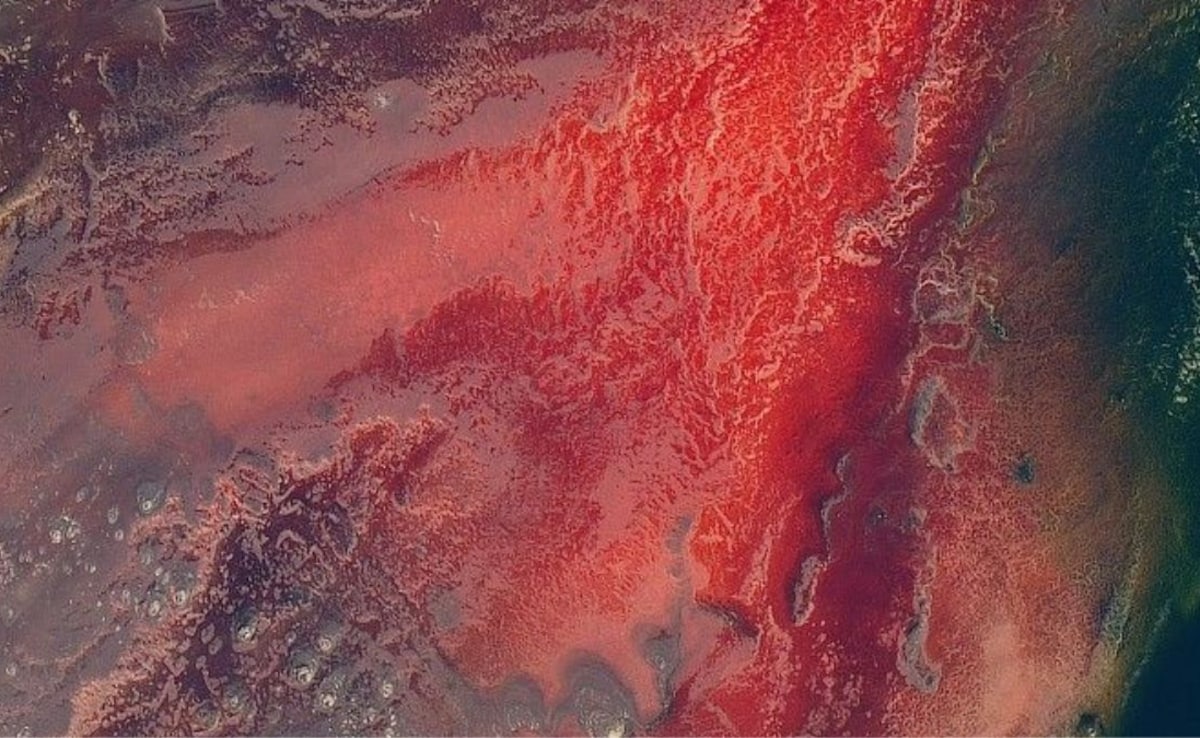
Despite being deadly, Lake Natron is not lifeless. Photo: NASA
Boasting a striking red hue, its alkaline water turns everything it touches into stone-like. Yes! You read it correctly. Despite being infamous for its deadly waters, it is not lifeless. But more on that later.
Origins Of Lake Natron, Tanzania
In the remote regions of northern Tanzania lies one of the two alkaline lakes of East Africa. Its distinct colour is noticeable thousands of feet above the ground. How is it red? The answer to this question lies in the tale of its origin.
Bradt has reported that the deadly water body came alive around 1.5 million years ago. Numerous volcanic processes and tectonic activities not only birthed the lake but also Ol Doinyo Lengai, the 'Mountain of God' in Maasai, to its immediate south.
The natural processes also cursed it with high amounts of calcium bicarbonate and sodium carbonate. Live Science reported that the salts and minerals continue to bleed into the lake from the surrounding hills. These substances enter the water body from below via hot springs. Interestingly, Lake Natron is not alone, but it has a sibling, Lake Bahi.
Both lakes are not only alkaline, but they also do not flow into any river or sea, making them terminal. Fed by small rivers and hot springs, both waterbodies are shallow, and their temperatures in summer can soar up to 41°C.
How Lake Natron Turns Animals Into Stones
Photographer Nick Brandt published a book in 2013, Across the Ravaged Land, showcasing carcasses of animals he found on the shores of Lake Natron. The stone-like creatures were not dead, but they looked petrified. Just like students and animals in Hogwarts turned into stones when they indirectly looked into the eyes of the Basilisk in Harry Potter and the Chamber of Secrets.
The photographer placed the dead animals in life-like poses before capturing them. Animals that come in contact with the salt and mineral-rich water of Lake Natron turn into stone-like lumps, with desiccated flesh and feathers.
"I unexpectedly found the creatures - all manner of birds and bats - washed up along the shoreline of Lake Natron," Brandt wrote in his book. "No one knows for certain exactly how they die."
While he did not know why and how animals die on the shore of the red lake, science has answers. The alkaline water of the lake has a pH of 10.5, which is high for anyone who is not adapted to its surroundings. It can burn the eyes and flesh of animals, leaving them dead.
Why do dead animals look like stone and not decompose? The reason for this is sodium carbonate, which was once used to mummify dead bodies in Egypt. It acts like a preservative for dead animals.
Unlike what reports suggest, animals don't instantly die when they come in contact with the water of Lake Natron. Instead, the liquid absorbs the fat and moisture, leaving them dehydrated. Eventually, they die, and their bodies lie stiff, preserved on the shores of Natron Lake.
Why Is Deadly But Not Lifeless Lake Natron Red
The salts and minerals surely impart the lake a red hue, but they are not the only reasons behind its distinct colour. As mentioned before, the lake is not lifeless. Salt-loving microorganisms like haloarchaea and cyanobacteria (blue-green algae) are also responsible for Lake Natron's.
The algae is also one of the reasons why this otherwise deadly lake is home to lesser flamingos. The stunning pink wading birds eat the algae, making the red lake their breeding ground.
It is also nature's most cruel and devised strategy. Since the lake is deadly for other animals, flamingos have no predators here. In fact, during the breeding season, millions of flamingos turn this red lake into a crimson and pink water body.
Nick Brandt's pictures also included images of a fish eagle and a dove. However, they reportedly don't live or feed at the red lake; instead, they thrive in freshwater wetlands and salt marshes around it. One can also spot wildebeest, ostriches, pelicans, and other creatures in the regions.
Also Read | Where Is The World's Oldest River, Older Than Dinosaurs, And What It Looks Like
Track Latest News Live on NDTV.com and get news updates from India and around the world
