In Manipur, The More Things Change, The More They Stay The Same
As 2026 arrives, where do things stand today for Manipur, a border state that faces a situation so unique that modern India has never seen or found the correct words to define it adequately
Thousands of people in Manipur will spend a third New Year in relief camps. A few of them have returned to villages in the foothills where the district borders meet. With hours to go before the world enters 2026, we see where things stand today for Manipur, a border state that faces a situation so unique that modern India has never seen or found the correct words to define it adequately.
Not much has changed in the 31 months since May 3, 2023, the day clashes broke out between the Meitei and Kuki communities. Or, maybe Manipur is a personification of the cliche that the more things change, the more they stay the same.
Over 50,000 people have been displaced from their homes, and more than 260 people have been killed; Meiteis and Kukis do not visit each other they way they used to; new armed groups that want a return to ideologies have appeared; new armed groups that only want money have appeared; new armed groups that don't know what they want have also appeared in the 'volunteer' category; N Biren Singh resigned as chief minister; the President's rule came; the legislative assembly fell silent; MLAs lost the power to make or amend state laws, and communities no longer trusted each other, perhaps more than ever.
But nothing really changed.
The Meiteis and Kukis still carry the burden of the predicament they had before they started attacking each other over two years ago. The Meitei community hasn't been added to the Scheduled Tribes (ST) category, and the Kuki tribes have not got 'Kukiland'. Instead, both have memories of killings, burnings, lootings and shootings.

The state did not have a lot of money of its own. With the two communities not using roads that pass through their areas, businesses started to fail till it became certain the common people in the small border state had slipped from the infamy of being poor to being broke.
Nothing changed for the good, but everything changed for the worse. Here's a roundup on Manipur as we move to 2026:
President, Prime Minister's Visit
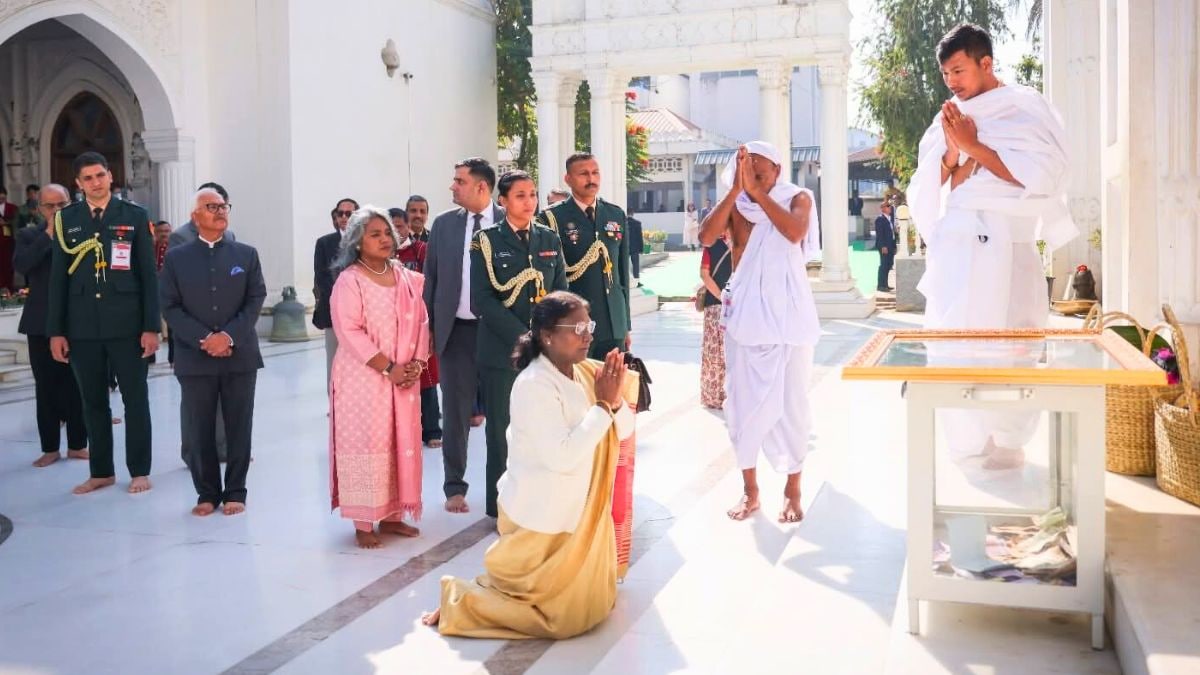
Both President Droupadi Murmu and Prime Minister Narendra Modi visited Manipur this year. The sum total of their speeches indicate a request to everyone in Manipur to live and grow together.
President Murmu's mention of hill-valley unity gave a message so clear that only those who refuse to see it by choice will not see it.
"Manipur's strength lies in its diversity - its culture, languages, and traditions. The hills and the valley have always complemented each other, like two sides of the same beautiful land," the President said.
PM Modi had also asked the people of Manipur to build a strong bridge of trust between the valley and the hills.
"I recall that in 2014, when I came here, I had said one thing. I had said that without Manipuri culture, Indian culture is incomplete, and without the players of Manipur, Indian sports too are incomplete. The youth of Manipur are those who dedicate their all for the pride of the tricolour. We must not allow this identity to be suppressed under the shadow of violence," the Prime Minister said in the state capital Imphal.
No Free Movement On Highways
This is a strange one, a matter that can neither be confirmed nor denied. However, it's exactly a situation that would violate everything the Constitution stands for. It is symptomatic of the condition 'Schrodinger's Manipur', where the good is also the bad and the bad is also the good, where battle-hardened insurgents are righteous volunteers and righteous volunteers are battle-hardened insurgents. In the same way, there is both free movement and no free movement on Manipur's highways.
The Ministry of Home Affairs (MHA) on September 4 in a statement announced that the Kuki-Zo Council (KZC) has decided to open National Highway-2 for free movement of commuters and essential goods. The MHA said that after several meetings with a KZC delegation in Delhi, the KZC "has given commitment to cooperate with security forces deployed by GoI [Government of India] to maintain peace along NH-2."

The twist came within 24 hours. The KZC, which represents the civilian side and coordinates with the Kuki insurgent groups that are in talks with the central government for a "Kukiland", said the Imphal-Dimapur NH-2 has never been closed or blocked, and has consistently remained open for commuters and cargo.
"Therefore, the question of 'reopening' does not arise, contrary to certain media reports," KZC spokesperson Ginza Vualzong said, contradicting the MHA. The KZC then clarified its appeal for free movement was specifically confined to the stretch of NH-2 passing through Kangpokpi district, and not "unrestricted access or free movement" between Meitei and Kuki settlements. The KZC said it is neither the duty of the public in Kangpokpi nor of KZC to guarantee foolproof security for national highway users. "The MHA has assured that adequate central forces will be deployed to provide necessary security along NH-2 (Imphal-Dimapur)," it said.
The MHA never responded to this doublespeak, which has become so frequent in Manipur that it may be taken as a virtue, to be passed on to the next generation. While it may not be the public's duty or the public may not be able to guarantee security for highway users, it is also not any private organisation's call to imply a threat to any particular community by denying access to a road maintained by the National Highways Authority of India (NHAI).
All Gains Reversed
A BJP-led government came to power in Manipur for the first time in 2017, also the year N Biren Singh became the chief minister. The six years between 2017 and 2023 saw rapid development in infrastructure, trade, and notably, startups. At one point Manipur had almost become a new playground of startups in the northeast.
The results of the central government's 'States Startup Ranking Framework 2022' recognised Manipur and two other states as 'leader' in category B states (population less than one crore); only three other states came ahead of Manipur in the 'best performer' and 'top performer' categories.
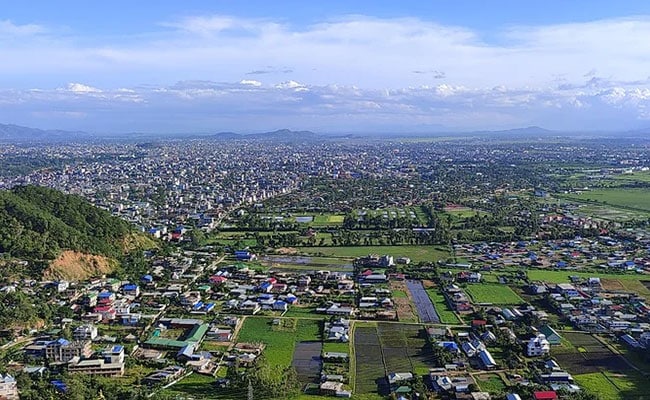
Nightlife, new restaurants, new markets, new shops, cafes, and young people and families freely roaming around in most towns even after 6 pm - which was unheard of in the last three decades - stood as the biggest evidence of Manipur's recovery from a bloody past. Roads widened; shiny new cars ran on the widened roads; multinational fast food chains arrived (a big indicator of a small town's march to progress), and ice-cream parlours and bakeries exploded in intense competition. A big lifestyle brand held a beauty pageant in Imphal.
The days of "demand letters" had ended. The difference in the experiences shared by retired officers who ran things back in the tumultuous 90s and their younger successors in the current lineup proved that the tentacles of extortion by hardcore Meitei insurgents based in the jungles of India-Myanmar border had gone extinct. The 'customary' chai-paani payment by transporters, the lesser of many evils, to insurgents of multiple communities on the highways went on as usual. The security forces including the dreaded Manipur Police commandos, who gained some reputation, had succeeded in wiping out Meitei insurgency from Manipur. They continued their vigil despite random attacks which had become far and few compared to the 80s and 90s.
The outbreak of ethnic violence in May 2023 reversed all the good that had happened since 2017. The conflict divided the two sides into ethnic camps and both expected their armed groups to come for help. Meitei insurgents returned from Myanmar; Kuki insurgents came out of their designated camps. The police have more than once confirmed the part played by insurgents on both sides in the Manipur violence.

Today, the Manipur Police's X handle is full of arrests for extortion. Many are unemployed young people who came out to make a quick buck in the name of some armed group.
There are broadly three major communities in Manipur: Meitei, Naga, and Kuki. All have their respective armed groups, the only difference is that no Meitei insurgent group has shown serious intent on taking the path to peace by coming for talks. The Naga's NSCN(IM) and the Kuki-Zomi-Hmar's armed groups have signed detailed ceasefire agreements with the central government. The only Meitei armed group that signed any ceasefire is the UNLF(P), but little is known about it. Other than this, all Meitei armed groups that appear in the Centre's 'banned organisations' list are still hostile to India. Manipur will never recover from a general condition of rot and stunting unless the remnants of Meitei armed groups give it up. There is no ambiguity here - either the intent is peace or pepetual misery. This much is clear to anyone and everyone who matters, from leaders to policymakers to the military.

Like nongmangkha, reality tastes bitter sometimes. That's okay.
Do keep in mind though, these are not the common people. No armed group of any community are the common people. Murderers with political ambition are not the common people. As we move on to 2026, how about we try a different approach - protect the common people for a change, the rest be damned, or we let things stay the same?
-
Blog | 'Baap Da Brat': Kerala Mini Cooper Crash, And Why 'Daddy' Can't Keep Saving You

There are three things you should never underestimate in India: the power of 'jugaad', the elasticity of the law, and the confidence of a 'Baap da Brat' who believes his Papa Posh can fix absolutely anything.
-
Opinion | 'Say Our Name': Why A Tiny Island Nation Wants The World To Get Its Name Right
Standing before the UN hall of nations, Naoero President David Adeang asked the world to unlearn its comfortable habits and speak a restored truth.
-
TVS Succession Row Explained: Why Venu Srinivasan's Family Is Divided Over Wealth
TVS Family Dispute: TVS Holdings is a key entity because it owns a controlling stake in TVS Motor Company. It owns 50.26% of TVS Motor.
-
Opinion | The US Is Showing India Just How Cheap Its 'Friendship' Is
Can local talent fully replace Indian contribution? Why is the US leading in setting up Global Capability Centres in India - over 60% - and pocketing the IP?
-
Jantar Mantar Tells Time. The Clock Just Stopped On Its Time As An Iconic Protest Site
On Monday, October 12, 2026, Delhi Police denotified Jantar Mantar Road as a designated site for demonstrations. The Supreme Court had given it a nudge. Here's how history met politics on that street for decades.
-
Opinion | Saudi Airport Attack, And Why Pakistan Keeps Biting Off More Than It Can Chew
For all those who were envious of Pakistan's 'new status' as "mediator extraordinaire", here is a reality check
-
Opinion | Visa Shocks To Racist Attacks, When Did America Come To Hate Indians So?
Sometimes it is about H-1B visas. Sometimes it is jobs. Sometimes it is "foreigners." Sometimes it is about temples. The language of the attack varies, but the message is consistent
-
How El Nino And Warming Oceans Could Shape Earth's Climate In 2027
From changing ocean currents to extreme weather, scientists are watching a combination of climate signals that could influence temperatures, rainfall and ecosystems in the months ahead.
-
Blog | Nana Patekar, And The Sharp, Lasting Sting Of His 'Plain-Speak'
"Subah ghar se niklo, bheed ka hissa bano..." Nana Patekar's characters often spoke with the bluntness of men who had little patience for pretence. Just like Nana himself.