





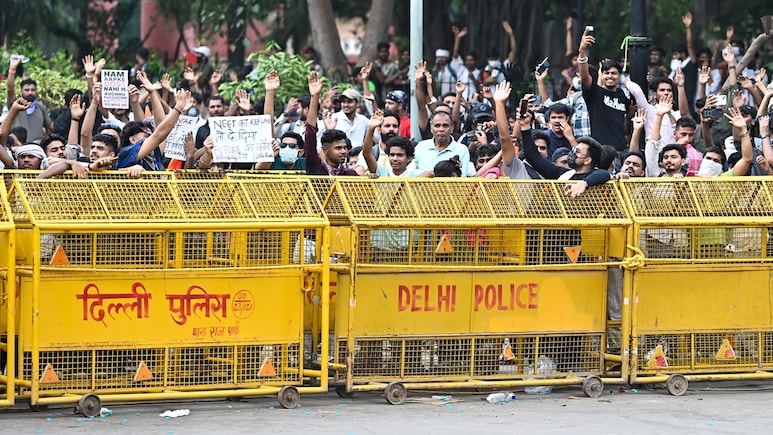
- Delhi Police will overhaul intelligence to gather detailed data before major protests in the capital
- Police will analyze at least 10 critical pieces of information about protester numbers and roles
- Profiles of protest participants, their origins, and organisers will be compiled in advance
Following the violence and large-scale protests at in the Capital on July 20, the Delhi Police have decided to overhaul its intelligence-gathering mechanism.
According to sources, Delhi Police Commissioner Anurag Kumar has directed the intelligence wing-the Special Branch-to gather and analyse at least 10 critical pieces of information prior to any major proposed protest in the Capital.
On July 20, a large number of protesters had suddenly converged on Jantar Mantar and the surrounding areas. Approximately 30,000 youths took to the streets, attempting to march towards Parliament to demand educational reforms. As the situation deteriorated, clashes erupted between the police and the protesters. The police resorted to the use of force to control the crowd. Its actions have subsequently invited heavy criticism.
Now, the Delhi Police are reviewing their intelligence system. According to sources in Delhi Police, officials felt there was a lack of adequate and precise prior intelligence regarding the number of protesters, their mobilisation, and the roles played by various organisations. Consequently, the Special Branch has now been instructed to generate more detailed and actionable intelligence, rather than simply gathering information on the protest venue and estimated crowd size.
Read | Supreme Court Sets Up Panel To Probe Cop Action, Violence During NEET Protests
The police will now also compile profiles of the individuals participating in the protests. Furthermore, they will ascertain how many people are arriving from specific states, the methods used to mobilise them, and the roles of key protest leaders and organisers. Efforts will also be made to understand the protest's agenda and primary demands in advance.
Additionally, the police will gather information on where the protesters are staying, the areas they are frequenting, and their local contacts within Delhi. Details regarding their affiliations with various organizations, potential sources of funding for the protest, and logistical arrangements made for the crowd will also be collected.
In other words, the police will no longer focus solely on the location and timing of a protest; instead, they will also seek to identify the participants, determine who is mobilising them and where they are coming from, ascertain their local contacts, and understand how the entire protest has been organised.
The Police Commissioner has also issued strict directives to make the wireless communication system more effective. Instructions have been given to thoroughly inspect the wireless network and immediately rectify any shortcomings to ensure the rapid exchange of information between senior officers and police personnel deployed on the ground during protests.
According to sources, the objective of this entire exercise is not to prevent protests, but to better assess the law-and-order situation during major public events. Particular emphasis will be placed on protests that draw large numbers of people from outside Delhi or involve the participation of multiple organisations.
Track Latest News Live on NDTV.com and get news updates from India and around the world

