





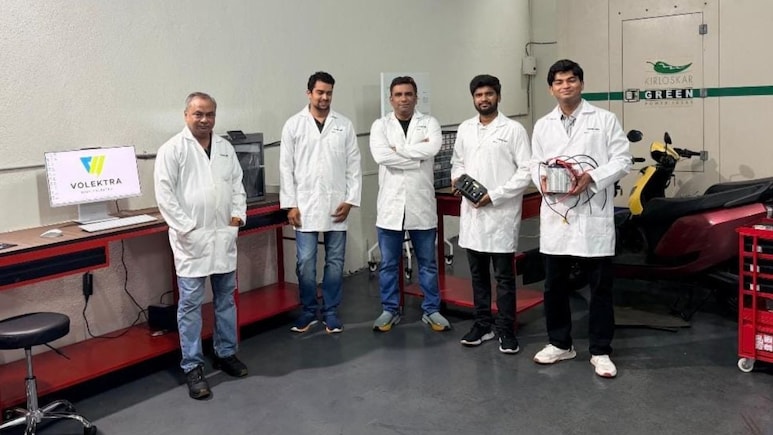
As India accelerates its transition to electric mobility, one of the biggest challenges facing the electric vehicles (EV) industry is its dependence on rare-earth magnets, nearly all of which are processed and supplied by China. Bengaluru-based deep-tech company Vimag Labs claims to have developed a breakthrough technology that could change that.
In an exclusive interview with NDTV, Vimag Labs Co-Founder and CEO Manish Seth spoke about the company's patented "Virtual Magnet" technology, how it works, its commercial rollout plans, and why the company believes it can match or even outperform traditional permanent magnet motors without using any rare-earth materials.
NDTV: Vimag Labs claims to have developed a technology that eliminates the need for rare-earth magnets in EV motors. How does it work?
Manish Seth: We actually have physical products undergoing testing and getting ready for deployment. We invented what we call the 'Virtual Magnet'. Using proprietary technology, wireless power transfer and sophisticated software algorithms, we generate electric fields inside the motor that behave like a permanent magnet. This allows us to build motors using only copper and steel, completely eliminating the need for rare-earth materials.
NDTV: Why is the world so dependent on rare-earth magnets and why is China at the centre of this supply chain?
Manish Seth: The most efficient EV motors today use permanent magnets made with rare-earth materials. Around 90 to 95 per cent of these rare-earth minerals are processed and controlled by China. Since the refining process is highly toxic, many countries chose not to develop this capability. China invested heavily over the years, creating a major global supply chain dependency."
NDTV: Can EVs perform just as well without rare-earth magnets?
Manish Seth: From day one, we decided we would not compromise on range, acceleration or weight. Our internal tests and customer trials are actually showing that our motors perform better than traditional permanent magnet motors. The complexity shifts from the motor hardware to software and electronics, allowing us to continuously improve performance.
NDTV: Will this technology make electric vehicles more expensive?
Manish Seth: No. Performance, quality and cost are our three pillars. Our motors will be competitively priced with permanent magnet motors. By removing rare-earth materials, we also avoid the price volatility associated with those minerals. We are certainly not charging a green premium.
NDTV: When will this technology be available commercially and which vehicle segments will you target first?
Manish Seth: Our motors are already inside test vehicles. We are currently going through regulatory approvals and certifications. By the end of this year, we plan to roll out pilot batches of around 1,000 to 10,000 units, followed by mass production next year. We will first target two-wheelers and three-wheelers before expanding into passenger cars, buses and heavy-duty electric trucks.
NDTV: What makes Vimag Labs different from others working on similar technology?
Manish Seth: Many alternative technologies rely on physical brushes, slip rings or bulky wireless systems. Our architecture is fully integrated into the motor itself, making it compact and robust. We have secured a patent for our core wireless power transfer technology, have six to seven more patents filed, with several more in the line. Our software algorithms are protected as trade secrets.
NDTV: Is Vimag Labs still a startup? How are you funding your growth?
Manish Seth: We raised a $5 million Series A funding round in December last year. At this stage, we are transitioning from research and development to manufacturing, so we consider ourselves a scale-up. We will be raising more capital soon to support mass production.
NDTV: Vimag Labs was born in Bengaluru but you're speaking to us from Germany. Why Bengaluru and what are your long-term ambitions?
Manish Seth: Bengaluru has an incredible engineering talent pool, a mature startup ecosystem and access to early customers. Despite the city's infrastructure challenges, it has a unique energy for building technology companies. While we were born in Bengaluru, our outlook has always been global. We develop technology in India while operating integrated teams across Germany, Poland and the United States to solve a global supply chain challenge.
Track Latest News Live on NDTV.com and get news updates from India and around the world

