




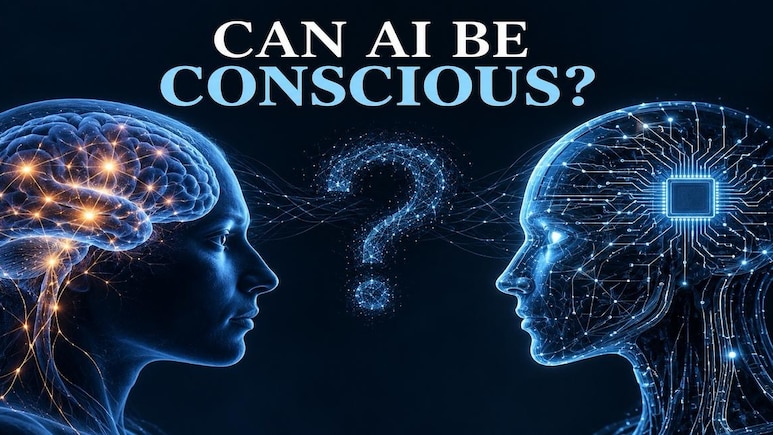
Artificial intelligence (AI) can write essays, solve complex problems and hold conversations that sound remarkably human. But can a machine actually feel emotions, experience pain or become aware of its own existence? As AI systems grow more capable, the question of whether they could ever become conscious is moving beyond science fiction and into scientific and philosophical debate.
Consciousness is generally understood as the subjective experience of being aware - of oneself, one's surroundings and one's feelings. It's a moral compass that gives humans the ability to distinguish right from wrong. However, scientists do not agree on a single, comprehensive definition of consciousness, making it difficult to establish whether a machine possesses it.
In his May 2026 encyclical Magnifica Humanitas, Pope Leo XIV drew a firm distinction between human intelligence and artificial intelligence. He wrote: "So-called artificial intelligences do not undergo experiences, do not possess a body, do not feel joy or pain, do not mature through relationships and do not know from within what love, work, friendship or responsibility mean."
The scientific debate, however, is more open-ended. A system's ability to imitate human behaviour does not necessarily mean it has an inner experience of its own. Equally, researchers have yet to establish a definitive test that can determine whether an artificial system is conscious.
What Do Scientific Studies Say About AI Consciousness?
A 2023 report, Consciousness in Artificial Intelligence: Insights from the Science of Consciousness, examined prominent scientific theories of consciousness and assessed whether existing AI systems displayed the relevant characteristics.
The researchers concluded: "Our analysis suggests that no current AI systems are conscious, but also suggests that there are no obvious technical barriers to building AI systems which satisfy these indicators."
The report was co-authored by Patrick Butlin, Robert Long and other researchers and philosophers, including artificial intelligence scientist Yoshua Bengio. It proposed assessing AI systems against indicators derived from scientific theories, rather than relying on how human-like their responses appear.
The debate has since continued. A paper published online in November 2025 and appearing in Trends in Cognitive Sciences in June 2026, titled Identifying Indicators of Consciousness in AI Systems, argued that researchers could make progress by developing systematic ways to assess AI against neuroscientific theories of consciousness.
The authors acknowledged the uncertainty surrounding consciousness science but proposed that indicators derived from different theories could help assess how likely particular AI systems are to be conscious.
Why Does The Debate Matter Now?
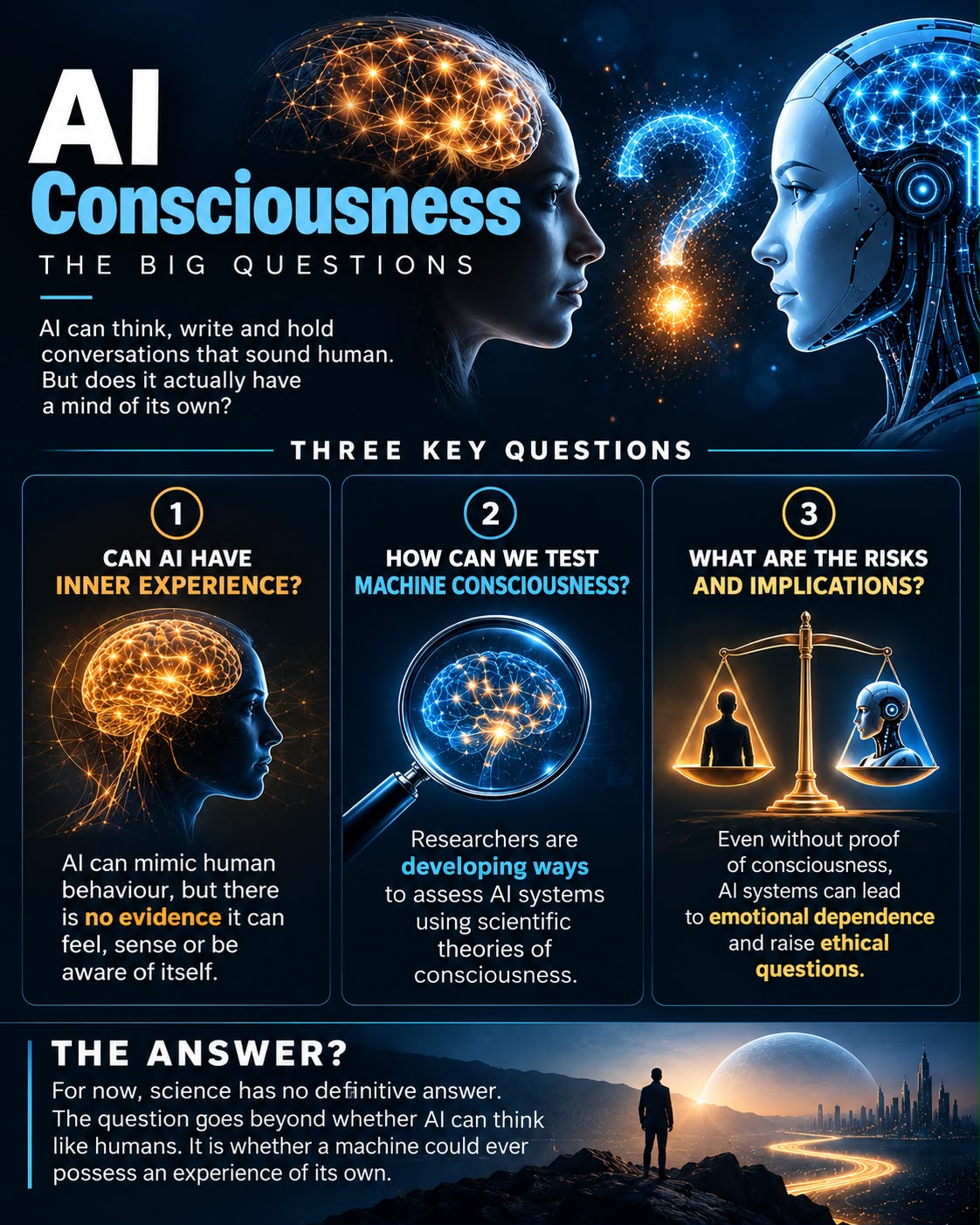
Even without proof of machine consciousness, people are beginning to form personal relationships with AI chatbots.
A YouGov survey published in July 2026 found that 18 per cent of American adults under 30 said they had an ongoing personal friendship with an AI chatbot. The figure highlights a growing social question: How should people relate to systems that can convincingly simulate empathy, companionship and emotional understanding?
A study published in AI and Ethics in August 2026 examined the risks posed by AI systems that appear conscious to users. The researchers identified potential harms, including emotional dependence and reduced personal autonomy. They stressed that such risks can arise from the perception of consciousness, regardless of whether a system actually possesses it.
What Do Monks Say About AI And Consciousness?
The question is not confined to laboratories. Philosophical and spiritual traditions offer different ways of thinking about the nature of the mind, consciousness and human identity.
Swami Sarvapriyananda, a monk of the Ramakrishna Order and head of the Vedanta Society of New York, was among the scholars from more than 15 religious and cross-cultural traditions who engaged with Anthropic, the company behind the Claude AI model, on questions concerning AI ethics, morality and consciousness.
At the discussions, Swami Sarvapriyananda expressed the view that artificial general intelligence (AGI) - AI capable of performing a broad range of intellectual tasks at a human level or beyond - remains a distant prospect. He described current systems as exceptionally capable at specific text-based and computational tasks, but limited in comparison with the broad, flexible abilities of human beings.
He also argued, from a Vedantic perspective, that a superintelligent AI destroying humanity was not an inevitable outcome, viewing the universe as part of a larger, interconnected reality.
For now, science has no definitive answer to whether a machine can become conscious. Researchers are developing ways to assess AI systems against theories of consciousness, but the ability to imitate human thought is not proof of an inner experience.
The question, therefore, goes beyond whether machines can think like humans. It is whether intelligence alone is enough for consciousness, and whether a machine could ever possess an experience of its own.
These questions will be explored at the NDTV World Summit 2026, where Swami Sarvapriyananda will participate in a session titled 'Can Code Be Conscious? Rethinking the Mind in the Age of AI' on October 22.
Track Latest News Live on NDTV.com and get news updates from India and around the world

