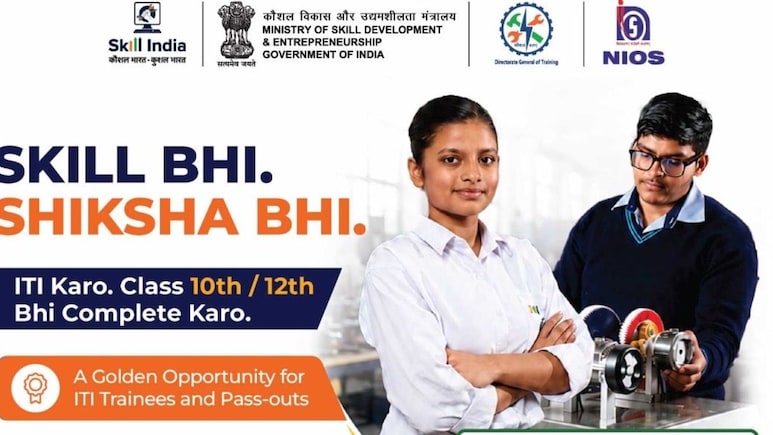

The National Institute of Open Schooling (NIOS), under the Ministry of Education, in collaboration with the Directorate General of Training (DGT), Ministry of Skill Development and Entrepreneurship, has introduced the NIOS-DGT Integrated Academic Equivalency Certification. The initiative allows eligible Industrial Training Institute (ITI) trainees and pass-outs to obtain a Class 10 or Class 12 equivalent certificate while continuing their vocational training.
The programme aims to integrate vocational and academic education by enabling ITI students to earn a nationally recognised academic qualification without enrolling in a separate school.
What Is NIOS-DGT Integrated Academic Equivalency Certification?
The certification is designed for eligible trainees enrolled under the Craftsmen Training Scheme (CTS). Through the Transfer of Credit (ToC) mechanism, ITI trade subjects are recognised by NIOS, reducing the number of additional academic subjects students need to study to obtain Class 10 or Class 12 equivalency.
The initiative aligns with the objectives of the National Education Policy (NEP) 2020, which promotes the integration of vocational and mainstream education.
Eligibility And Subject Requirements
The number of additional NIOS subjects depends on the duration of the ITI course:
- Two-year National Trade Certificate (NTC) trainees: Their ITI trade subjects are credited towards the NIOS certification, and they are required to study only one additional language subject.
- One-year National Trade Certificate (NTC) trainees: Their trade subjects are also credited, but they need to study two additional NIOS subjects-one language and one other academic subject.
- The programme is implemented through NIOS-approved Special Accredited Institutions for Academic and Skill Development (SAIASD) functioning at selected ITIs.
Key Benefits For ITI Students
According to the official details, the integrated certification offers several advantages for trainees and pass-outs, including:
- Opportunity to earn a Class 10 or Class 12 equivalent certificate alongside ITI training.
- No need to attend a separate school for academic equivalency.
- Transfer of Credit for ITI trade subjects, reducing the academic workload.
- Eligibility to pursue higher education, including diploma and degree programmes.
- Eligibility for government jobs where Class 10 or Class 12 qualifications are required.
- Certificates recognised by universities, government departments and employers across India.
- Flexibility through NIOS' on-demand examination system.
How The Initiative Helps Students
The integrated certification enables students to combine skill-based training with formal academic qualifications, improving their educational and career prospects. By earning both vocational and academic credentials simultaneously, ITI trainees can access higher education opportunities, apply for a wider range of government jobs, and strengthen their employability without interrupting their skill training.
Interested candidates can contact their nearest ITI or a NIOS-approved SAIASD study centre for details regarding admission, eligibility, and the application process.
