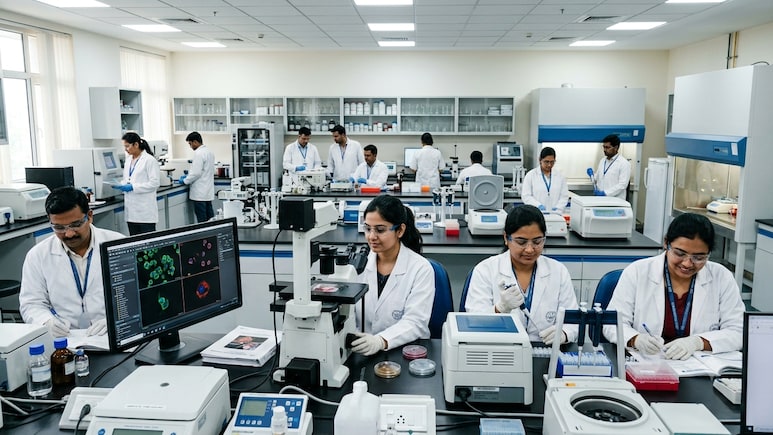

India has steadily improved its global standing in innovation, research output, patent filings, and PhD enrolment over the past decade. Minister of State for Education Sukanta Majumdar, in a written reply in the Rajya Sabha, highlighted the country's key achievements in strengthening its research ecosystem. The minister said India's research ecosystem has gained significant global recognition over the last 10 years, with notable improvements across multiple international indicators.
According to the information shared by the minister:
- Global Innovation Index (GII): India's ranking improved from 81st in 2015 to 38th in 2025.
- Science and Engineering Publications: India climbed from 7th position in 2010 to 3rd globally in 2022, according to the National Science Foundation (NSF), United States.
- Patent Applications: India's ranking improved from 8th globally in 2013 to 6th in 2022, as per the World Intellectual Property Organisation (WIPO).
Science and Engineering PhDs: India ranks 3rd globally in terms of the number of PhDs awarded in Science and Engineering, according to Research and Development Statistics at a Glance 2022-23.
The minister said that, recognising research as a key pillar of quality education, the National Education Policy (NEP) 2020 encourages Higher Education Institutions (HEIs) to strengthen research and innovation by establishing start-up incubation centres, technology development centres, centres for frontier research, promoting stronger industry-academia linkages, and encouraging interdisciplinary research, including in the humanities and social sciences.
He further said that the country's Gross Expenditure on Research and Development (GERD) has consistently increased over the years, more than doubling from Rs 60,196.75 crore in 2010-11 to Rs 1,27,380.96 crore in 2020-21.
The government has also sanctioned Rs 99,494.24 crore over the last five financial years (FY 2020-21 to FY 2025-26) for premier technical institutions, including the Indian Institutes of Technology (IITs), National Institutes of Technology (NITs), Indian Institutes of Information Technology (IIITs), Indian Institutes of Science Education and Research (IISERs), and the Indian Institute of Science (IISc), to support teaching, research, and innovation. Research activities at these institutions broadly cover areas such as healthcare and medtech, advanced computing (including supercomputing, artificial intelligence, and quantum computing), semiconductors, advanced materials, rare earths and critical minerals, space and defence, and the blue economy.
To further strengthen the research ecosystem, the government launched the Prime Minister's Research Fellows (PMRF) Scheme in 2018-19 with a total financial outlay of Rs 1,650 crore. The scheme aims to attract the country's brightest students to pursue high-quality research in premier academic institutions by providing enhanced financial support, including fellowships and research grants. According to the minister, 3,688 scholars have been admitted under the PMRF scheme so far.
The minister also highlighted that the Anusandhan National Research Foundation (ANRF) was established under the ANRF Act, 2023, in February 2024 with an outlay of Rs 50,000 crore. The foundation aims to provide strategic direction for research, innovation, and entrepreneurship in science and technology while encouraging substantial private sector participation in research funding.
Additionally, the government launched the Research Development and Innovation (RDI) Scheme on November 3, 2025, with an outlay of Rs 1 lakh crore to further strengthen India's research and development ecosystem.
Majumdar also said that the University Grants Commission (UGC) implements research fellowship and scholarship schemes such as NET-JRF to support scholars pursuing advanced studies leading to a PhD. Besides UGC schemes, various ministries and organisations also offer fellowships to doctoral researchers. Special fellowships are available for Scheduled Castes (SCs), Scheduled Tribes (STs), Other Backward Classes (OBCs), Persons with Disabilities (PwDs), and Single Girl Child scholars.
He added that PhD scholars are also eligible to participate in research projects funded by various government agencies through universities, enabling them to receive financial assistance for their research leading to the award of a PhD.
