Can't Save Enough For A Home Down Payment? 3 Ways To Build Your Fund
Down payment is only part of the money a buyer needs. Stamp duty, registration, moving expenses and furnishing can add to the upfront cost.
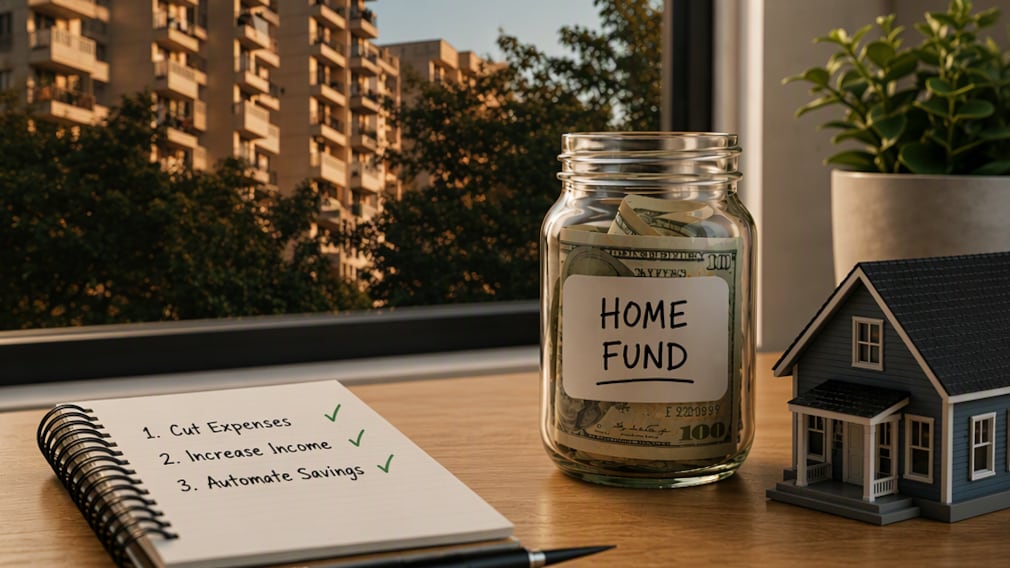
You may be paying Rs 30,000 a month in rent. You may even be comfortable paying Rs 35,000 as a home loan EMI. Yet, buying a house remains out of reach because you cannot put together the money required upfront.
This is the financial dilemma many middle-class homebuyers face. Their monthly income may be enough to service a home loan, but their savings are not enough to secure one.
The problem is that rent consumes a large part of their salary. School fees, groceries, insurance premiums and other household expenses eat into the rest. Whatever remains may be too little to build a sizeable corpus quickly.
And the down payment is only part of the money a buyer needs. Stamp duty, registration, moving expenses and basic furnishing can add significantly to the upfront cost.
So, should a prospective homebuyer simply keep the money in a savings account until the target is reached? Or can investments help bridge the gap?
There are three routes worth examining: recurring deposits, mutual fund systematic investment plans (SIPs), and buying a small plot of land that could eventually be sold to fund the down payment. Each comes with a different balance of risk, return and flexibility.
First, Calculate How Much You Actually Need
Suppose you want to buy a house worth Rs 60 lakh. If the lender finances 80 per cent of the property value, you would need to arrange Rs 12 lakh as a down payment. The remaining Rs 48 lakh could be financed through a home loan, subject to the lender's assessment and eligibility criteria.
But your actual savings target should be higher than Rs 12 lakh. You need to account for transaction costs and retain an emergency fund rather than putting every rupee into the property.
This is where planning becomes important. Instead of waiting for a large sum to accumulate in your bank account, decide how much you need, when you want to buy and how much you can invest every month.
1. Recurring deposits: A predictable route to the down payment
A recurring deposit (RD) can suit someone who wants to build a home-buying fund without exposing it to stock market fluctuations. You deposit a fixed amount every month and earn interest at the rate offered by the bank or post office, subject to the scheme's terms.
Consider someone who invests Rs 20,000 a month for five years. The total contribution would be Rs 12 lakh. At an illustrative annual interest rate of 6.5 per cent, compounded monthly, the maturity amount could be around Rs 14 lakh before tax. The actual amount will depend on the rate, deposit terms and compounding method.
The advantage is predictability. You can estimate how much you will accumulate and plan your home purchase accordingly. You also avoid the risk of a stock market fall just when you need the money. The trade-off is that returns may be lower than those of equities over a long period. Interest income may also be taxable, depending on your tax position.
2. SIPs: Can the stock market help you get there faster?
A systematic investment plan allows you to invest a fixed amount regularly in a mutual fund. For someone whose home purchase is several years away, an equity mutual fund SIP could help build a larger corpus, although returns are not guaranteed.
Take the same example. Investing Rs 20,000 every month for five years means contributing Rs 12 lakh. If the investment earns an illustrative annualised return of 10 per cent, the final value could be around Rs 15.5 lakh, depending on the timing of investments and actual returns.
That is roughly Rs 1.5 lakh more than the illustrative RD outcome. But this is a projection, not a promise. Equity markets can deliver lower returns or even negative returns over a five-year period.
A prospective buyer who chooses the SIP route should therefore match the investment to the purchase timeline and risk appetite. Money needed in the near term should not depend entirely on equities. As the purchase date approaches, shifting the required amount towards safer, more liquid options can help reduce the risk of a sudden market decline disrupting the plan. The lesson is not to chase the highest possible return. It is to accumulate enough money without taking a risk that could delay the purchase.
3. Can buying a small plot help fund your future home?
Another possibility is to buy a small plot, hold it for a few years and sell it to fund the down payment on a home.
Atul Monga, CEO and Co-founder of BASIC Home Loan, told NDTV that buying a land first, and then a home later is feasible, but not without challenges. Suppose you buy a plot for Rs 10 lakh. If purchase-related charges, including stamp duty and registration, add another 7 per cent, your total outlay rises to Rs 10.7 lakh.
Now assume the plot appreciates by 5 per cent annually for five years. Its estimated value would rise to about Rs 12.76 lakh. After an assumed selling expense of 1 per cent, the proceeds would be around Rs 12.63 lakh, before taxes.
Your gain would be approximately Rs 1.93 lakh on the original outlay of Rs 10.7 lakh. That works out to an annualised return of roughly 3.3 per cent, before taxes and inflation.
The apparent appreciation, therefore, does not necessarily translate into a strong investment return. Purchase charges and selling expenses eat into the gains.
What if the plot's value does not rise? If it still sells for Rs 10 lakh after five years, a 1 per cent selling expense would leave you with Rs 9.9 lakh. You would receive less than your original investment.
There is also the question of timing. A plot may take months to sell, especially if buyers are scarce or the property has title, access or infrastructure issues. Unlike an RD, it does not offer a predictable maturity date.
Monga's underlying proposition is worth considering, but land should not be treated as a guaranteed shortcut to home ownership. The investment makes sense only if the location has credible demand, the title is clear, the purchase price is reasonable and you can afford to keep the money locked in for years.

What About Buying Agricultural Land First?
Some prospective homebuyers may consider agricultural land because its purchase price appears more affordable than that of a residential plot.
However, agricultural land is not simply a cheaper version of a residential property. State laws can restrict who may buy it, and rules governing land use and conversion vary. A buyer cannot assume that agricultural land can later be converted into a residential plot or sold easily at a profit.
Before committing money, check the ownership records, encumbrances, access, permitted use and applicable state laws with a qualified property lawyer. Also account for transaction costs, taxes and the possibility that resale demand may be limited.
Most importantly, do not borrow heavily to buy land while continuing to pay rent in the hope that appreciation will eventually finance a house. If the property does not appreciate as expected, the buyer could end up with both a financial liability and a delayed home purchase.
Which Route Should You Choose?
The right choice depends less on which investment promises the highest return and more on when you intend to buy the house.
If you plan to buy within two or three years, protecting the money you have already accumulated may matter more than pursuing aggressive growth. An RD or other suitable low-risk instrument can help you plan around a defined target.
If the purchase is five or more years away, an equity SIP may have a role, provided you can tolerate volatility and gradually reduce risk as the deadline approaches.
A plot of land is a different proposition. It involves concentrated exposure to one asset, substantial transaction costs and uncertainty over when you can sell. It may work for someone with surplus capital and a longer investment horizon, but it is not an ideal substitute for a dedicated down-payment fund for everyone.
There is one more calculation buyers should make: whether the proposed EMI will remain affordable after the purchase. A household that can pay Rs 35,000 in rent today may still face higher costs as a homeowner, including maintenance, property tax and repairs. Spending the entire available surplus on the down payment can leave little room for emergencies.
-
Opinion | Sonia Gandhi Belongs Here, And She Wants Us To Know That

Sonia Gandhi was easily the most misunderstood person in Indian politics. I believe Belonging is her way of telling us who she really was and is, writes Sanjay Jha.
-
4,500 vs 34,000: NASA Scientist Flags Punjab-Haryana Farm Fires Undercount
Dr Hiren Jethva, an aerosol remote sensing scientist associated with Morgan State University and NASA's Goddard Space Flight Centre, stated that his calculations showed 34,000 farm fires in Punjab and Haryana between October 1 and November 9 this year.
-
Analysis | Politics Of Drugs: BJP Looks To Turn Punjab AAP's Biggest Challenge Into Electoral Gains
The BJP is attempting to turn the drug menace into one of its principal political weapons against the AAP government in Punjab, ahead of the assembly election
-
Real Cost Of Moving Out: Low Salary Job In Tier 2 Hometown vs Chasing Big Pay In Metropolitans
The rising cost of urban living is also changing how young couples think about marriage, children and financial independence.
-
Opinion | How Pakistan's Anti-India Obsession Turned Into A $40 Billion Blunder
The country incurred an estimated $40 billion in losses due to trade with India being suspended in 2019, with businesses facing higher sourcing and logistics costs after being forced to import goods from distant markets.
-
BJP Hunts For A Crack. Rahul Gandhi's Allies Could Be His Weak Spot
The government suffers a handicap in the sense that there is little to beat the opponents who have been out of power for long. But this is where the Congress and Rahul Gandhi need to use caution
-
Opinion | A Wounded Trump Could Soon Make The World Pay For His Defeat
The US and the rest of the world should worry more about what Trump might do next to redeem himself.