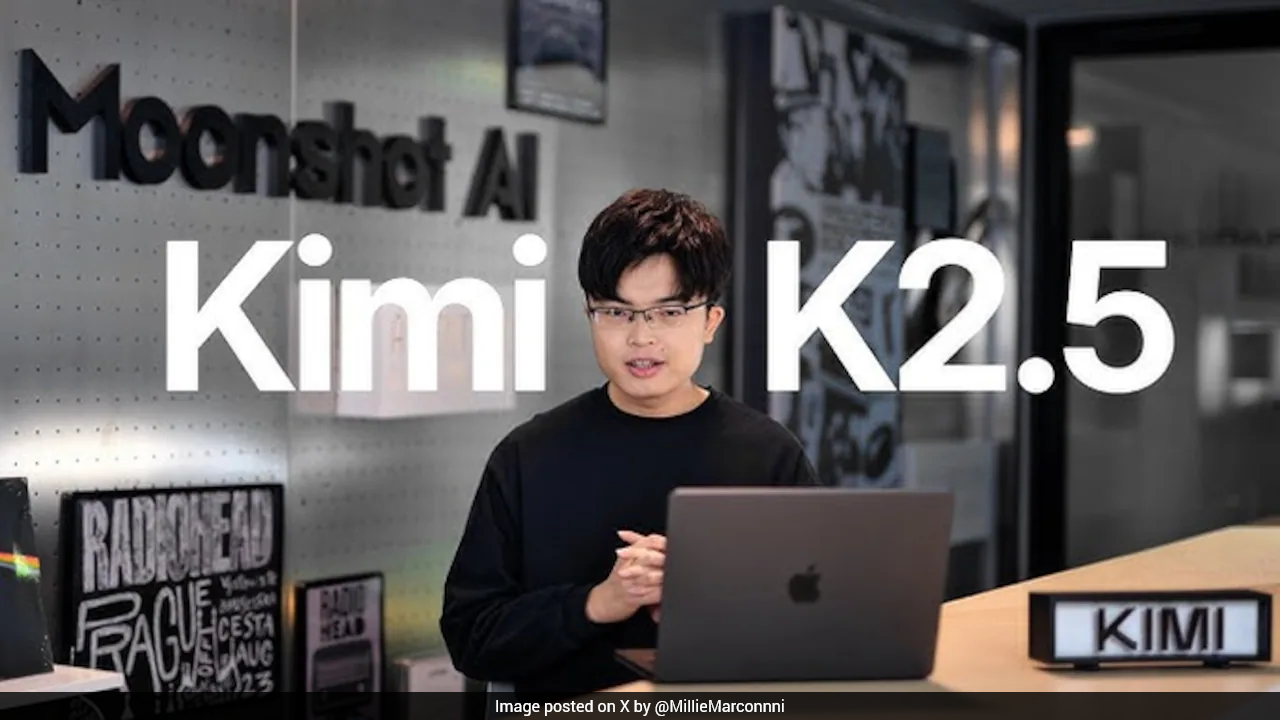
While many Chinese tech talents head to the US, and the bay area in particular, for opportunities, Yang Zhilin chose to return home. After completing his PhD in the US, the 33-year-old went back to China to build his own AI company. Today, Yang is the co-founder and CEO of Moonshot AI, one of China's top artificial intelligence labs.
The company has gained global attention with its Kimi family of AI models, including Kimi K3, which was released in July.
Moonshot's latest private funding round reportedly valued the company at $50 billion. According to a Wall Street Journal report, it has also confidentially submitted an application for an initial public offering in Hong Kong.
From Carnegie Mellon To Moonshot AI
At 17, Yang started intensive programming training and went on to compete in China's National Olympiad in Informatics. Later, he attended Tsinghua University, where he pursued machine-learning research and co-authored several widely cited papers with Professor Tang Jie.
He moved to Carnegie Mellon University in 2015 for his PhD, where he worked under computer scientists Ruslan Salakhutdinov and William Cohen. His research work earned praise from his professors, who noted that he required less guidance and was able to quickly develop his research ideas.
Toward the end of his PhD, Yang decided to return to China and build a startup. His Ph.D. adviser, Salakhutdinov, cautioned against the move, as per the Wall Street Journal.
Bringing Silicon Valley Culture To Beijing
Yang has also brought some of the workplace culture he experienced in the US to Moonshot AI. The Beijing-based company avoids titles and hierarchy, while Yang emphasises "direct communication" as a personal motto.
The company has roughly 300 employees, with offices featuring conference rooms named after musicians and bands such as Led Zeppelin, Metallica, Queen, Prince and Bob Dylan. Employees also sometimes wear slippers at work.
The company's Chinese name translates to "The Dark Side of the Moon," implying Yang's love for rock band Pink Floyd.
Yang's infusion of Western culture in a Chinese startup seems to be working.
Why Did Yang Return to China?
According to the report, Yang made it clear during discussions near the end of his PhD that he wanted to return to China and build a startup. His decision surprised his advisers, particularly Salakhutdinov, who noted, "That's not what I would have done in his shoes."
A fellow Ph.D. candidate recalled that Yang had expressed confidence in his ability to build AI models capable of competing with systems from OpenAI and Google if given sufficient funding and computing resources.
"Hotshot" CEO
William Cohen, a professor of machine learning at Carnegie Mellon who co-advised Yang, told WSJ that he was "sort of like this hotshot from the top school in China" during his Ph.D.
Toward the end of his studies at Carnegie Mellon, Yang interned at Google Brain.
In 2019, he co-authored two research papers with Quoc V. Le, a Google Brain founding member, about machine learning that have over 20,000 citations today.
Now, Moonshot AI is aiming for the sky with an IPO set for early 2027, as per Reuters. The startup aims to raise $3 billion through its IPO.
Track Latest News Live on NDTV.com and get news updates from India and around the world


