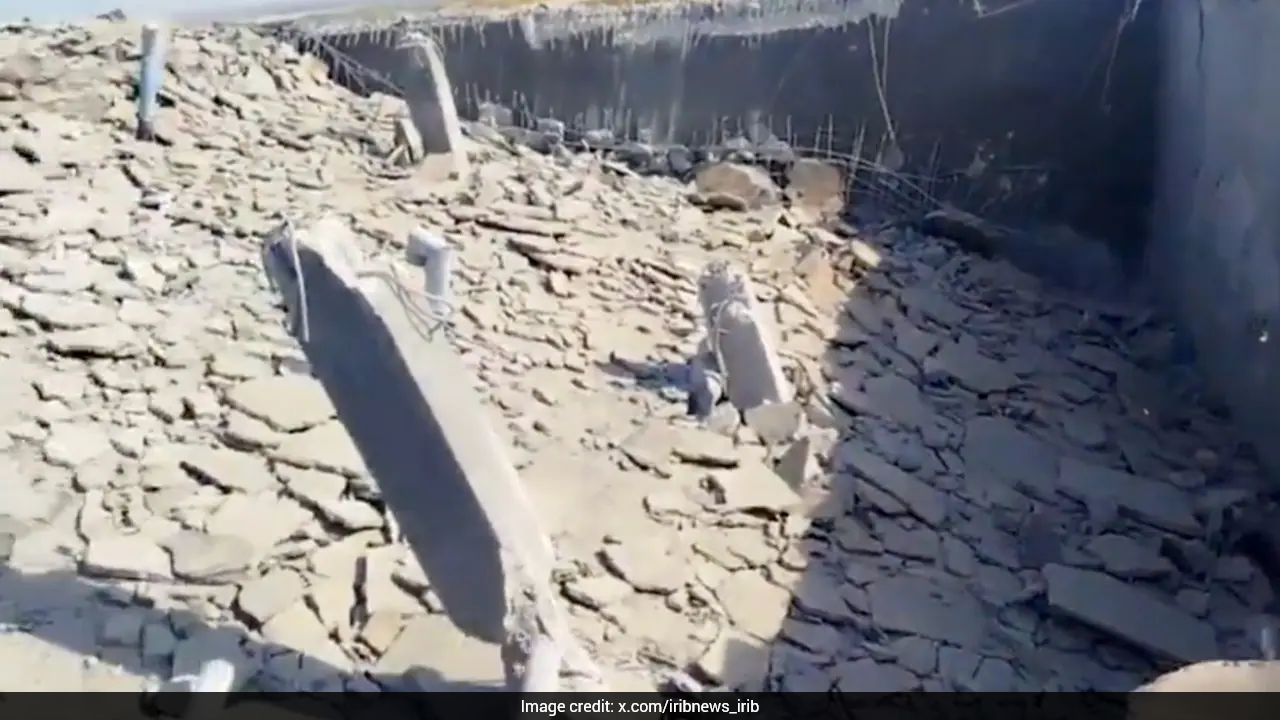
Iran has said that the US' Wednesday strikes hit two key water reservoirs in its southern city of Sirik, briefly cutting off water to thousands of people.
The American forces had carried out late-night strikes on the southern cities of Jask and Sirik and on Qeshm Island in the Strait of Hormuz after claiming that Iran downed a US Army Apache helicopter off the coast of Oman.
Iran's state media, the IRIB, posted a video on X of what it said were damaged drinking water tanks in the Bemani district of Hormozgan's Sirik. It claimed that the two reservoirs - a 500 cubic metre and a 2,000 cubic metre tanks - served about 20,000 homes in the area.
NDTV could not immediately verify the footage.
🎦 Video of the attack by the US army on drinking water tanks in the Bemani district of Sirik County, Hormozgan https://t.co/ME1oPhKxAc pic.twitter.com/NYBuWZxWEJ
— IRIB (Islamic Republic of Iran Broadcasting) (@iribnews_irib) June 10, 2026
"Unfortunately, following this attack, 20,000 residents of the region have lost access to safe drinking water, and with temperatures ranging between 45 and 50 degrees Celsius, conditions have become extremely difficult and critical for local inhabitants," Iran's state television quoted local water company officials as saying.
"The destruction of these reservoirs has created a major problem for the region's water supply network," it added.
It said the area had insufficient groundwater to replace the damaged reservoirs.
The IRIB, in a post on X at around 10:30 IST, said the water supply was "completely restored".
WHO On US Strikes On Iran Water Tanks
World Health Organisation regional director for the Eastern Mediterranean Hanan Balkhy said the loss of safe water increases threats to human health, including the risk of waterborne diseases.
"With temperatures exceeding 45 degrees Celsius, it can cause dehydration and heat-related illnesses, particularly among infants, older persons, pregnant women and people with chronic health conditions. Lack of safe water also compromises infection prevention and control in health facilities, including neonatal, maternity and surgical services," she wrote on X.
Earlier today, strikes on Sirik County, southern #Iran, reportedly destroyed two strategic water tanks, disrupting piped drinking water supplies to villages in the Bemani district and the town of Kuhestak.
— HananBalkhyحنان بلخي (@HananBalkhy) June 10, 2026
The loss of safe water increases threats to human health, including the… pic.twitter.com/Tplrbm7SMo
"Drinking-water installations are indispensable to people's health and survival, and are afforded special protection under international humanitarian law. Water systems, health facilities and other civilian infrastructure must be protected at all times," Balkhy added.
US On Striking Iran
The United States said it had conducted "self-defense strikes" against Iran in response to Tuesday's downing of a US Army Apache helicopter.
The US Central Command (CENTCOM) said the American forces struck Iranian air defense, ground control stations, and surveillance radar sites near the Strait of Hormuz with "precision munitions" from Air Force and Navy fighter jets.
"The operation was a proportional response to recent attacks on U.S. forces and international commercial ships transiting regional waters," it said in a statement.
It was unclear if Washington intentionally struck the water facilities, as deliberately targeting civilian infrastructure could constitute a war crime under international law.
US' New Strikes On Iran
The US launched a new wave of attacks against Iran on Wednesday night, with Tehran saying it will target any ship going through the Strait of Hormuz.
CENTCOM said the US forces began "additional self-defense strikes" at 5:15 pm Washington time, early Thursday in Iran, against multiple Iranian targets, in response to what it called Tehran's "unwarranted and continued aggression."
"CENTCOM forces launched strikes on Iranian military surveillance capabilities, communication systems, and air defense sites across Iran. US Marine Corps, Air Force, and Navy assets fired precision munitions on Iranian targets that posed a threat to US forces and international commercial ships transiting regional waters," it said.
US President Donald Trump had said that Tehran's negotiators were taking too long and "playing us for suckers."
The war began on February 28 when the US and Israel launched joint strikes on Iran. In response, Tehran attacked American bases in the Middle East and launched missiles at Israeli cities. The strikes have threatened an already fragile ceasefire that began April 8.
Track Latest News Live on NDTV.com and get news updates from India and around the world


