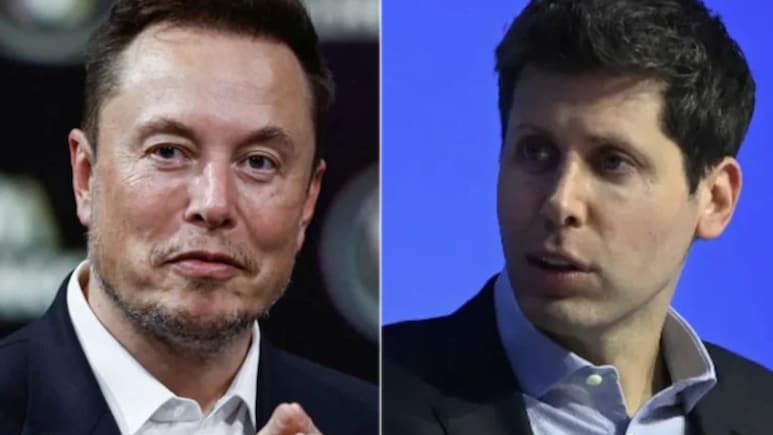
A friendship between Silicon Valley tech rivals Sam Altman and Elon Musk is “less likely”, the OpenAI CEO has said.
In an interview with The Indian Express, Sam Altman was asked which scenario was more improbable: Taiwan Semiconductor Manufacturing Company (TSMC) losing its dominance over global chip manufacturing, or he and the Tesla CEO rekindling their friendship.
“I think Musk and I becoming friends again is less likely,” Altman replied, drawing laughter from the audience.
The TSMC controls about 65 per cent of the global chip foundry market and produces more than 90 per cent of advanced logic chips critical for AI systems.
In March, TSMC announced an additional $100 billion investment in US manufacturing over five years.
The comment comes amid an escalating legal battle between the two tech leaders. Musk, who co-founded OpenAI in 2015 before parting ways with the organisation, has since become one of its most vocal critics.
Musk alleges that Altman and OpenAI abandoned their original nonprofit mission to develop AI for humanity's benefit, transforming it into a profit-driven entity closely tied to Microsoft. A jury trial is scheduled to begin on April 27. Musk is seeking to block OpenAI's transition to a for-profit structure and is reportedly pursuing damages ranging from $79 billion to $134 billion in alleged “wrongful gains.”
AI Solving 11th Grade Maths To Complex Codes
In the event, Altman also spoke on how dramatically AI has evolved in just one year.
“Just a little over a year ago that I was here (India)… AI was just able to do high school math. And this was incredible,” he said. At the time, he recalled, people were astonished that AI could do what “an 11th grader can do.”
“Only a couple years before that, AI couldn't really do any math at all. It couldn't do grade school math. It was struggling with that.”
But the pace of change since then has stunned even seasoned observers.
“By last summer, it was competing at the hardest mathematics competitions we had in the world and doing okay,” Altman said.
He pointed to a recent benchmark called “first proof”, where mathematicians released 10 unsolved research problems. “I believe our latest AI got seven of those problems right,” he said.
“AI has gone from doing okay at high school math to being able to do new research-level mathematics, figure out new knowledge also happening in physics. This is an amazing change in a year.”
“We've gone from AI that could do what we expected a very smart high school student to do, to pushing the edge of human knowledge.”
The transformation is not limited to mathematics. “The other change is that AI has gone from being able to write a little bit of programming to completely changing what it means to be a computer programmer,” Altman said.
“Last time I was here, people were amazed at these sort of autocomplete tools for code. And now, if you type in an idea in something like Codex, you can have an entire application created.”
Sam Altman On What Children Should Study In The AI Age
Altman acknowledged that the most common question he hears socially is about the future of children. “Almost every conversation I have socially is, what should my kids study for the future? What's it going to look like?”
He admitted the difficulty of predicting specific careers. “It's really hard to answer that specifically. If you study history… and look at the primary source material of people that were experiencing the industrial revolution, there was a lot of panic about jobs.”
“There were a lot of predictions about what the new jobs would be. They were sort of shockingly wrong.”
“None of them were like, I'm going to be the CEO of an AI company. Certainly none of them were like, I'm going to be a YouTube influencer.”
Instead of predicting job titles, Altman emphasised foundational skills.
“The skills that will work no matter what: fluency with AI tools, resilience, adaptability, figuring out what people are going to want and how to be useful to them. How to work with other people. These are all very good things to learn.”
Track Latest News Live on NDTV.com and get news updates from India and around the world


