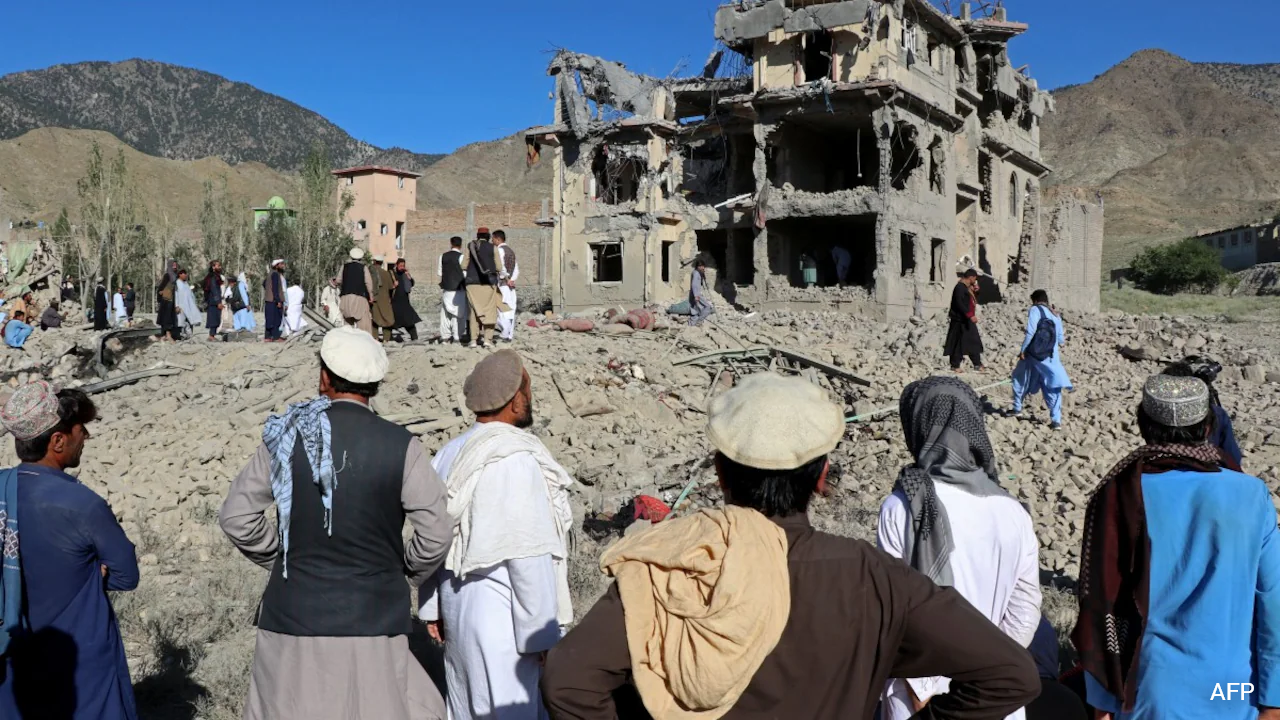
- Pakistan killed at least 35 in double-tap airstrikes near Afghan border targeting alleged terrorists
- Afghanistan condemned strikes, reporting dozens of civilian casualties including women and children
- Pakistan cited recent terrorist attacks inside its borders as justification for cross-border operations
As Pakistan rides high on the success of brokering a truce deal between the United States and Iran to halt the war in the Middle East, the situation back home is bloody. In the 'double tap' attack, Islamabad's forces have killed at least 35 people-- who, according to Pakistan's claim, were terrorists-- in a ground operation along the Afghanistan border.
A "double tap" is a military term used to describe a deliberate second strike on the same location shortly after an initial attack. It is a highly controversial and often condemned tactic because the second strike is deliberately timed to coincide with the arrival of emergency responders, medics, and journalists.
Afghanistan has claimed that Pakistan's attacks resulted in the deaths and injuries of dozens of civilians, including women and children. Authorities in Kabul have also repeatedly denied that their territory harbours terrorists.
The Double-Tap Attack
According to available information, Pakistan Air Force (PAF) jets took off at 12:30 AM (IST), striking homes and mosques across three Afghan districts -- Gyan in Paktika, Chamkani in Paktia, and Marawara in Kunar.
In a display of calculated military brutality, Rawalpindi used a notorious "double-tap" tactic.
At 12:55 AM, just 25 minutes after the first bombardment, when villagers rushed to pull out trapped women and screaming children from the smoking wreckage, Pakistani jets returned and dropped a second wave of bombs on the unarmed rescuers. That deliberate second strike is the main reason the death toll swiftly climbed beyond 35 and hospitals were inundated with more than a hundred casualties.
Why Pakistan is Attacking Afghanistan
Authorities in Pakistan have claimed the strikes on Afghanistan were in response to multiple terrorist attacks across the country, including one in Karachi last week in which three members of the country's paramilitary forces were killed and four others were injured.
In a post on X, Information Minister Attaullah Tarar said the operation was launched in reaction to the recent multiple terrorist incidents inside Pakistan against the people of Khyber Pakhtunkhwa and Balochistan and the Pakistan Rangers (Sindh) Camp, Karachi, and targeted Jamaat-ul-Ahrar, the Tehrik-e-Taliban Pakistan (TTP) splinter group.
"A well-planned intelligence-based ground operation was carried out by security forces along the Pakistan-Afghan border, followed by calibrated strikes in the border region against the hideouts and safe havens of terrorists belonging to Jamaat ul Ahrar and Fitna al Khwarij, killing 29 khwarij (radicals as per Islamic history)," Tarar said.
He added that three targets in Paktia, Paktika and Kunar were destroyed during precision strikes.
What Afghanistan Said
The Taliban government said on Monday the airstrikes in three eastern provinces killed or wounded dozens of civilians.
Spokesman Zabihullah Mujahid condemned the military action, calling it a "cowardly act of aggression".
"We strongly condemn this cowardly act of aggression and consider it a crime and an act of brutality," he said.
Per Taliban authorities, the attack killed more than 35 civilians, including elderly people and children aged 4–9, and left over 100 others critically injured.
'There Were No Terrorists, Only Civilians'
Disturbing hospital footage shows bloodied infants and elderly victims on stretchers. A survivor pulled from the rubble directly refuted Pakistan's claims.
"When the bombing started, there were no TTP militants or military personnel anywhere near this area. Pakistan is lying to the world to justify this slaughter. Every single person affected by this strike is an ordinary local citizen trying to survive," they said.
Another injured resident of Chamkani, who had recently returned from work in Dubai, described the scene: "The airstrike flattened my neighbour Badshah Khan's house. We ran to the rubble to pull out women and children buried underneath. Minutes later, the Pakistan military dropped another bomb right on top of our rescue crowd. Dozens died before my eyes."
The Afghanistan-Pakistan Border Conflict
The strikes are the latest flare-up of violence between the two countries whose relationship has been fraught since 2021, when the Taliban government took power, and follow a weeks-long war that erupted in February. The neighbours agreed to a ceasefire in March, but there have been sporadic attacks since, with Pakistani strikes in June killing 13 people according to Afghan officials.
As Islamabad mediates between the United States and Iran to end their war in the Middle East, Pakistan claims its battle against militancy at home requires its strikes on Afghanistan. Mediation from several countries, including China, has failed to produce a lasting resolution between the neighbours, and the frontier has been largely closed since cross-border violence in October.
Islamabad said its forces use "precise targeting" to aim at terrorist hideouts and weapons stores, especially those of the TTP, which Pakistan accuses of waging a violent campaign against its soil for years.
Afghan authorities have, however, repeatedly denied the country is used by terrorists and claim Pakistani operations have caused several civilian casualties, including a strike at a drug treatment centre in March that the United Nations said killed hundreds.
Pakistan remains widely documented as a sanctuary for global terror networks. Yet when its internal security falters, Islamabad shifts blame to Afghanistan. Since last September, under the pretence of "counter-terrorism", the PAF has repeatedly violated Afghan airspace with cross-border strikes. Rather than targeting militant training sites, Pakistan's ordnance has repeatedly hit Afghan residential neighbourhoods, schools, and local infrastructure. In the past nine months alone, Pakistan's reckless military actions have claimed the lives of roughly 570 innocent Afghan civilians.
Pakistan's Ongoing Fight With Militancy And Its Weaponisation of Rights
In the past week alone, there have been three major developments in Pakistan that highlighted some of the country's deepest domestic challenges, including insurgency and terrorism, and the weaponisation of blasphemy allegations for state repression. Pakistan continues to deflect blame onto neighbouring India and Afghanistan for its problems, without any proof.
Karachi Attack: Last week, terrorists armed with guns and explosives targeted the regional headquarters of the paramilitary Rangers in the southern port city of Karachi, killing three soldiers. Security forces killed three attackers and arrested another assailant, whom the military identified as an Afghan national in wounded condition.
Jamaat-ul-Ahrar, a breakaway faction of the Pakistani Taliban, claimed responsibility for the Karachi attack in a statement Saturday night.
In the aftermath, however, some Pakistani officials tried to link India with the attack. New Delhi rejected the "baseless" allegations and slammed Islamabad for trying to deflect attention from its own internal security failures.
The exchange echoed a familiar pattern where Islamabad blames New Delhi for supporting terrorists acting on its soil, despite countless pieces of evidence proving that the state itself sponsored terrorism for decades.
Sentencing of Baloch Activist: An anti-terrorism court in Balochistan also sentenced Baloch rights activist Mahrang Baloch-- a prominent voice highlighting enforced disappearances and alleged human rights abuses in the province-- to life imprisonment in connection with the death of a paramilitary soldier during a protest in Gwadar in 2024.
Authorities in Pakistan maintain that Baloch's sentencing followed due process. However, rights groups condemned the proceedings, arguing that the trial raises serious concerns about freedom of dissent. Her supporters claim that Islamabad is increasingly criminalising peaceful political mobilisation, especially for leaders like Baloch, who are operating in an environment shaped by militancy.
Geo News Ban: Authorities in Pakistan also took Geo News, one of Pakistan's largest television networks, off air in parts of the country after outrage over remarks made during a programme that some groups alleged were blasphemous.
The temporary action was taken even though Geo News promptly apologised, underscoring the extraordinary power that blasphemy accusations continue to wield in Pakistan.
Track Latest News Live on NDTV.com and get news updates from India and around the world


