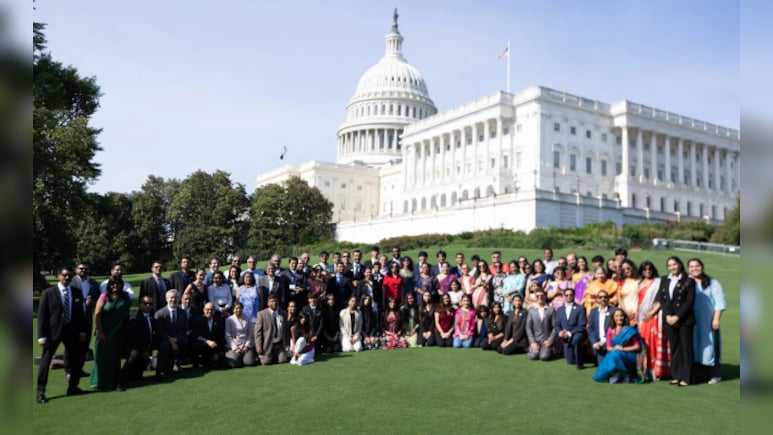
- More than 130 Hindu Americans from 15 states met on Capitol Hill for advocacy discussions
- The event focused on religious freedom, civic engagement, and rising anti-Hindu hate concerns
- Seven members of Congress and 12 staffers participated in bipartisan dialogues with delegates
More than 130 Hindu Americans from 15 states gathered on Capitol Hill this week for the fifth annual Hindu Advocacy Day, combining celebrations of the United States' 250th anniversary with discussions on religious freedom, civic participation and concerns over what organisers described as a rise in anti-Hindu hate and Hinduphobia.
Hosted by the Coalition of Hindus of North America (CoHNA), the event brought together lawmakers, community leaders, students, veterans, researchers and interfaith representatives for a day of dialogue focused on the contributions of Hindu Americans and challenges facing the community. According to the organisers, seven members of Congress and 12 congressional staffers from both Republican and Democratic offices participated in the programme.
The advocacy initiative began before the formal event, with Hindu delegates conducting more than 50 meetings with Senate and House staff while visiting over 120 congressional offices to discuss issues affecting Hindu Americans and strengthen engagement with elected representatives.
Just in time for July 4th🇺🇸. More than 130 Hindu delegates traveled from 15 states across the US, to be part of CoHNA's 5th Hindu Advocacy Day on Capitol Hill as we celebrated America at 250. 🇺🇸🇺🇸
— CoHNA (Coalition of Hindus of North America) (@CoHNAOfficial) July 3, 2026
In a bipartisan display of support, we were joined by 7 Congressional Reps and… pic.twitter.com/KtJMcGzmyB
Speaking at the event, CoHNA President Nikunj Trivedi said the gathering reflected both the diversity of the Hindu American community and its commitment to civic engagement.
"It was a powerful day on Capitol Hill. We came together as Americans, sharing stories, building relationships and singing the national anthem," Trivedi said. He highlighted the varied backgrounds of Hindu Americans, including students, entrepreneurs, healthcare professionals, engineers, veterans and scientists, adding that the anniversary of America's founding offered an opportunity to celebrate shared democratic values while engaging lawmakers.
The event featured testimonies from community members spanning multiple generations and professions. Representatives from Armenian and Jewish organisations joined the discussions, alongside a city council member from Maple Grove, Minnesota, underscoring broader interfaith support.
A youth panel organised by CoHNA's Youth Action Network (CYAN) highlighted student-led advocacy efforts at Rutgers University. Panelists recounted their experiences advocating for greater representation of Hindu perspectives on campus, responding to what they viewed as Hinduphobic events, engaging university administrators and eventually organizing an academic conference focused on Hinduism.
Young speakers also explored the historical connections between Hindu philosophy and early American thinkers, while sharing personal reflections on balancing religious identity with civic participation in the United States.
Military veteran Ruchir Bakshi described how his experiences serving in Afghanistan and Iraq with the US Army were shaped by teachings from the Bhagavad Gita. He said the scripture's emphasis on discipline, integrity and selfless service influenced both his military service and his understanding of civic responsibility while maintaining his Hindu identity.
Several lawmakers from both parties used the occasion to condemn attacks targeting Hindu temples and express support for religious freedom.
Representative Buddy Carter, Republican of Georgia, described freedom of religion as one of America's foundational rights and criticized incidents of temple vandalism. He also acknowledged the role of Hindu Americans in contributing to what he called America's democratic experiment.
Democratic Representative Shri Thanedar of Michigan emphasised the importance of immigrant communities in shaping the country's development and encouraged Hindu Americans to seek recognition for their contributions across science, medicine, academia and public service.
Addressing younger attendees, Democratic Representative Suhas Subramanyam of Virginia encouraged Hindu students and professionals to speak out against discrimination and embrace their religious identity with confidence rather than remaining silent in the face of prejudice.
Other lawmakers also addressed policy issues affecting the community. Representative Zoe Lofgren, Democrat of California, cautioned that caste-related legislation should be approached carefully to avoid unintended discriminatory consequences.
Representative Sanford Bishop, Democrat of Georgia, described Hinduphobia as incompatible with American values while noting Georgia's recognition of anti-Hindu discrimination. Fellow Georgian Representative Brian Jack, a Republican, pointed to his state's actions against anti-Hindu hate as an example of how community advocacy could influence public policy and praised the continued organization of CoHNA's annual advocacy day.
Closing congressional remarks, Representative Rich McCormick, Republican of Georgia, commended Hindu Americans for their educational achievements, entrepreneurial success and emphasis on family values, describing those qualities as reflective of the American Dream.
The programme also included presentations from researchers examining trends related to anti-Hindu rhetoric and public policy.
Dr. Joel Finkelstein, co-director of the Network Contagion Research Institute (NCRI), discussed research examining proposals to incorporate caste into US policymaking. He argued that policymakers should require rigorous evidence before adopting legislative or educational frameworks concerning caste discrimination, citing findings from a recent study.
NCRI researcher Prasiddha Sudhakar presented research examining online narratives surrounding immigration debates and anti-Hindu sentiment. According to her presentation, coordinated social media campaigns and geopolitical influences have contributed to hostility directed toward Hindu religious practices, festivals and temples.
Political strategist and former Capitol Hill staffer Anang Mittal introduced the Citation Integrity Dashboard, which he described as a non-partisan initiative designed to assess the transparency and sourcing of institutional reports concerning Hindu Americans and India. The project aims to encourage greater scrutiny of research methodologies and evidentiary standards in public policy debates.
Concluding the event, CoHNA Director of Government Relations Sudha Jagannathan welcomed the bipartisan participation from lawmakers and said continued civic engagement remained essential for advancing religious freedom and addressing anti-Hindu discrimination.
Founded as a grassroots civil rights and advocacy organisation, CoHNA works to promote awareness of Hinduism in North America while engaging policymakers and the broader public on issues affecting the Hindu American community.
Organisers said the annual advocacy day is intended to strengthen dialogue between lawmakers and Hindu constituents while encouraging greater participation in the democratic process.
Track Latest News Live on NDTV.com and get news updates from India and around the world


