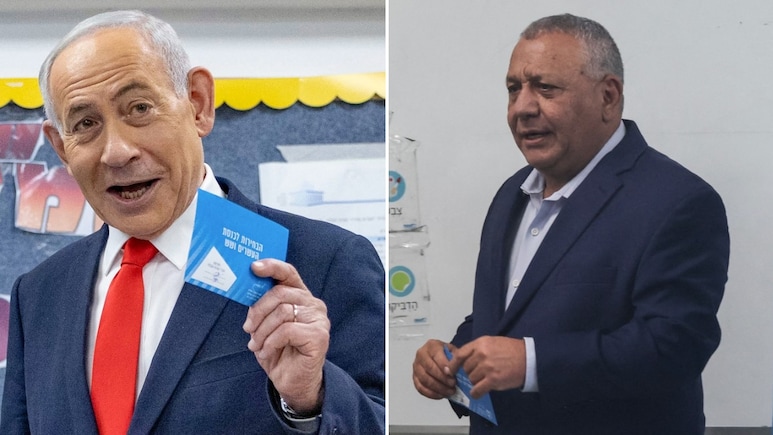
Prime Minister Benjamin Netanyahu's coalition is leading the Israel election against his main rival, former military chief Gadi Eisenkot, but both coalitions appear to have fallen well short of the 61 seats needed for a Knesset majority, according to exit polls. Netanyahu's Likud is leading with approximately 27 per cent of the vote after the first 100,000 ballots were counted, while Eisenkot's "change" bloc held about 17 per cent of the vote, according to the data shared by Israel's Central Election Committee.
Results are seen as voters' disappointment in Netanyahu's alliance with the far-right and anger over draft exemptions for ultra-Orthodox Jews, which appeared to have shrunk his bloc's majority in parliament, jeopardising his return to power.
The revised polls suggest that Netanyahu's Likud Party will be the largest in parliament, with about 27 seats. But the broader bloc of parties led by Netanyahu and the bloc of parties led by his main rival, Gadi Eisenkot, each captured about 51 seats in parliament, the polls suggest. Initial exit polls had indicated Eisenkot's bloc had a slight edge.
Arab-led parties won the remaining 18 seats, the exit polls suggested.
Final results are expected over the next 48 hours, but it would set the stage for weeks of political jockeying before a prime minister is declared -- or another round of elections is called. No single party has ever won an outright majority in the country's 120-seat parliament, forcing political leaders to forge coalitions. Minority governments are also possible, but they must rely on support or cooperation from parties outside the government to pass legislation.
Netanyahu's Address
In his first address to the nation after the polling, Netanyahu promised to form a new government after a close election, saying no leader should rule through the backing of Israeli Arabs, whose parties posted strong gains. FOLLOW LIVE UPDATES
"We must put in place a strong government of the right," Netanyahu told cheering supporters.
"The Jewish and Zionist majority must unite," Netanyahu said. "It is out of the question to have a government that is backed by Arab parties."
The speech was short by Netanyahu's standards, and he did not directly claim victory, only noting that his Likud was projected to be the largest single party.
Israeli Arab parties posted strong gains and could allow the opposition to take power, although Netanyahu's main rival, Eisenkot, has said he will not form a government with the minority group.
In his speech, Eisenkot said the exit polls show a "lack of confidence" in Netanyahu, and he vowed to form a new government. Speaking to upbeat supporters at a Tel Aviv arena, Eisenkot also issued a veiled warning to Netanyahu over his threats to launch a new war on Iran, which could scramble efforts to form a coalition.
"Netanyahu, don't you dare use Israel's security for your political needs," Eisenkot said.
After turnout of nearly 78 per cent, the highest since 1999, Eisenkot said it would be a mistake to hold a second election and vowed to work "swiftly" to form a government.
"The public has voted for change," Eisenkot said. "A worthy leader would accept the people's vote of no confidence and announce his retirement from political life today."
Arab voters also celebrated the exit polls while supporters of far-right parties aligned with Netanyahu expressed disappointment.
Possible Scenarios to Form Government
The easiest path to form the government would involve Netanyahu's main rival, Eisenkot, partnering with Arab-led parties, but that could prove politically difficult and potentially alienate other opposition factions.
Itamar Ben Gvir, a far-right firebrand who, according to exit polls, did not gain as much as expected, warned Netanyahu against another option -- a unity government with Eisenkot.
"It would be a terrible mistake," said Ben Gvir, a champion of extremist settlers in the West Bank and expulsion of Palestinians.
Hebrew University of Jerusalem political scientist Gideon Rahat said Ben Gvir had succeeded in mobilising votes -- of Israeli Arabs.
But he said, "Even if Netanyahu lost, that doesn't mean Eisenkot won."
Key Israeli Arab leader Mansour Abbas said he believed the right had "suffered a major loss" and was open to working with Eisenkot.
Eisenkot, however, has said he would not govern with Israeli Arab lawmakers -- a scenario that Netanyahu had warned his voters could be a consequence of an opposition victory.
But Arab lawmakers could give Eisenkot support in parliamentary votes to maintain a minority government without joining a coalition. If not, Israel could head to new elections.
During the period of uncertainty, Netanyahu would remain as a caretaker prime minister with the power to restart the war with Iran.
Like all surveys, exit polls are subject to potential error. Preliminary results are expected in the coming hours. Final results are expected in the coming days and may vary from the exit polls.
Track Latest News Live on NDTV.com and get news updates from India and around the world


