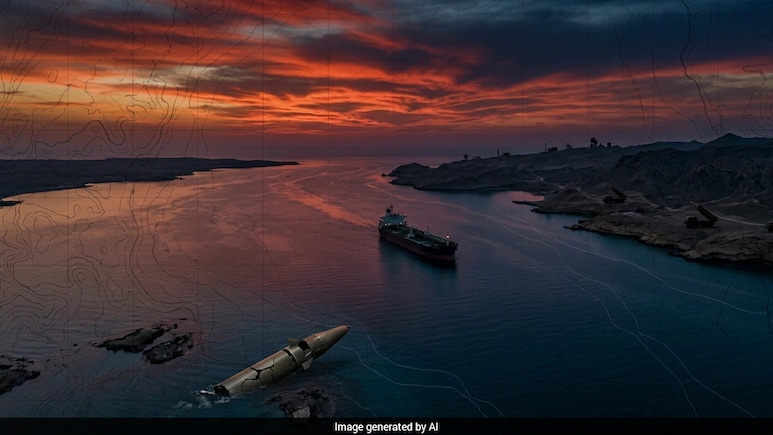
- Countries in the Gulf are speeding up plans to bypass the Strait of Hormuz for oil exports
- Iran plans to charge tolls on ships using the Strait of Hormuz, aiming to generate billions in revenue
- Iraq and Saudi Arabia are developing pipelines to reduce reliance on the Strait of Hormuz for oil shipments
Countries across the Persian Gulf are speeding up plans to move oil without relying on the Strait of Hormuz after repeated attacks on ships and disruptions linked to Iran.
The goal is simple, to reduce dependence on one of the world's busiest oil routes and limit Tehran's ability to influence global energy supplies. Before the conflict, around one-fifth of the world's oil passed through the strait.
Iran has already announced plans to charge tolls for ships using the waterway, a move that could generate tens of billions of dollars. In some cases, it has also been accused of demanding millions of dollars from oil tankers for safe passage.
New Pipelines Take Shape
The United Arab Emirates and Iraq have already started building major pipeline projects that would move oil around the Strait of Hormuz. Saudi Arabia is also exploring a similar expansion, while the UAE is planning a new port to reduce its dependence on the waterway.
According to Goldman Sachs analyst Alexandra Paulus, enough pipeline capacity could be ready by the end of 2027 to divert nearly 45 per cent of the Gulf's pre-war oil exports away from the strait.
The bank also estimates that by the end of 2028, as much as 7.3 million barrels of oil could flow through alternative routes each day, making around 60 per cent of Gulf oil exports independent of the Strait of Hormuz.
UAE Pushes Ahead
The UAE's West-East Pipeline project is now about halfway complete. Crown Prince Sheikh Khaled bin Mohamed bin Zayed has directed officials to finish the project by 2027.
Once operational, the 252-mile pipeline will run alongside the existing Fujairah pipeline and double the UAE's land export capacity to 3.6 million barrels per day.
Abu Dhabi National Oil Company chief Sultan Al Jaber said recent events had reinforced the country's long-term strategy.
"Right now, too much of the world's energy still moves through too few choke points. That is exactly why the UAE made the decision more than a decade ago to invest in infrastructure that bypasses the Strait of Hormuz," he said.
Iraq And Saudi Arabia Join The Shift
Iraq has also launched work on the 435-mile Basra-Haditha pipeline, which will eventually connect with Jordan, Syria and Turkey.
The project is expected to transport 2.5 million barrels of oil every day. Iraqi Prime Minister Mohammed Shia al-Sudani has described it as an important step to protect the country's exports from regional instability.
Construction began in May with about $1.5 billion set aside for the project, although officials have not announced when it will be completed.
Saudi Arabia, meanwhile, is reportedly studying plans to increase the capacity of its crude oil pipeline to the Red Sea to 9 million barrels per day, with discussions still in the early stages.
A New Port To Cut Dependence
Beyond pipelines, the UAE is also planning a major new port and container terminal on the Arabian Sea side of the Strait of Hormuz.
The proposed facility would offer another route for goods entering the region without passing through the strait and could eventually compete with Dubai's Jebel Ali port.
Even with billions being invested in alternative routes, experts say the Strait of Hormuz will remain critical.
An estimated 7 to 9 million barrels of oil and refined products will still depend on the waterway every day. Some of the new export routes also rely on stability in the Red Sea, where Iran-backed Houthi rebels in Yemen have recently threatened attacks near the Bab el-Mandeb Strait.
That means while Gulf countries are trying to weaken Iran's influence over regional oil exports, they are unlikely to eliminate it completely.
Track Latest News Live on NDTV.com and get news updates from India and around the world


