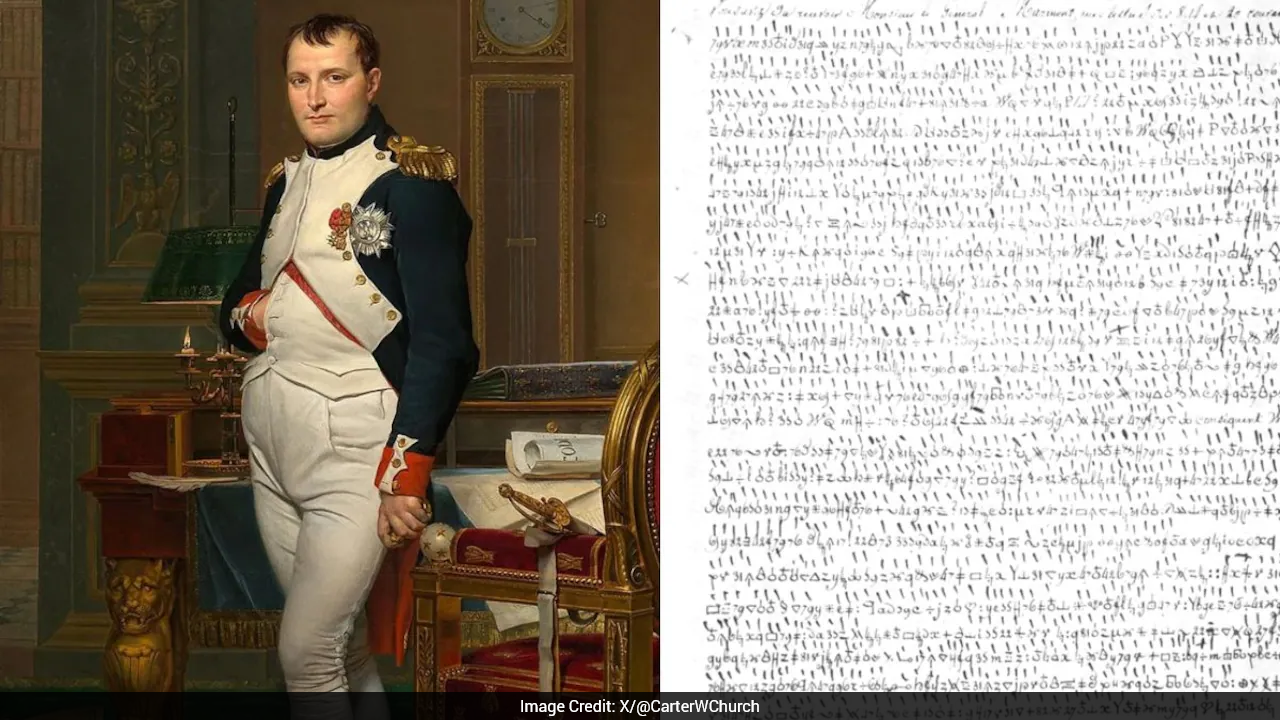
A mysterious letter written by French emperor Napoleon Bonaparte has been decoded for the first time after 217 years using artificial intelligence (AI). The letter was sent to Auguste de Marmont by Napoleon's stepson, Eugene, the Viceroy of Italy, in 1809. The contents of the letter, however, had remained a mystery with historians unable to decipher it. The first line is written in French, but the subsequent 24 lines consist of two-digit numbers, stray letters and invented symbols.
Carter Church, an AI engineer at cybersecurity company SentinelOne, used OpenAI's GPT-6 Astra system to decrypt the code and transcribe the message. After spending six hours, the advanced version of the AI system that powers ChatGPT figured that the letter contains details of French and Austrian troop movements on the eve of war between France and the Habsburg Empire.
"I used GPT–6 Astra to break an unsolved cipher to one of Napoleon's generals that had gone unread for 217 years. What makes this impressive isn't actually the codebreaking, but that Astra completed the entire multi–modal workflow in approximately 6 hours from a single image and goal," Carter explained in a social media post.
Church explained that just from one prompt, Astra transcribed 1,300 hand-drawn signs, found a partial key unconnected to the letter and cracked the rest of the letter using its own 'simulated-annealing solver'.
"It's a war briefing sent two weeks before Austria invaded. It also fills a gap: Napoleon's actual order in his 1865 memoir breaks off mid-sentence: Marmont mustn't be held back by "a handful of..." This letter contains the remainder, intact: "a gathering of rabble,'" he added.
Church said he had never attempted to decode a cipher before but decided to give it a go after seeing an AI model decode a 1941 German army message.
I used GPT-6 Astra to break an unsolved cipher to one of Napoleon's generals that had gone unread for 217 years.
— Carter Church (@CarterWChurch) September 30, 2026
What makes this impressive isn't actually the codebreaking, but that Astra completed the entire multi-modal workflow in ~6 hours from a single image and goal.
1/6🧵 pic.twitter.com/vyiGKOsrHq
Also Read | French Yoga Trainer Lists 11 Things Europeans Can Learn From India
Napoleon Bonaparte
Napoleon gained prominence in the French Army during the French Revolutionary Wars. He led military campaigns in Italy and Egypt and seized control of the French Republic before crowning himself Emperor of the French in 1804.
However, after the disastrous failure of the invasion of Russia in 1812, most of Europe turned against Napoleon. He was defeated and exiled to the Mediterranean island of Elba in April 1814. Despite the setback, he made a triumphant return to France the following year, beginning the period of his second reign known as the Hundred Days. He was soon defeated once again at the Battle of Waterloo in 1815, after which he was exiled for a final time to the island of St. Helena in the South Atlantic, where he died on May 5, 1821.
Track Latest News Live on NDTV.com and get news updates from India and around the world


