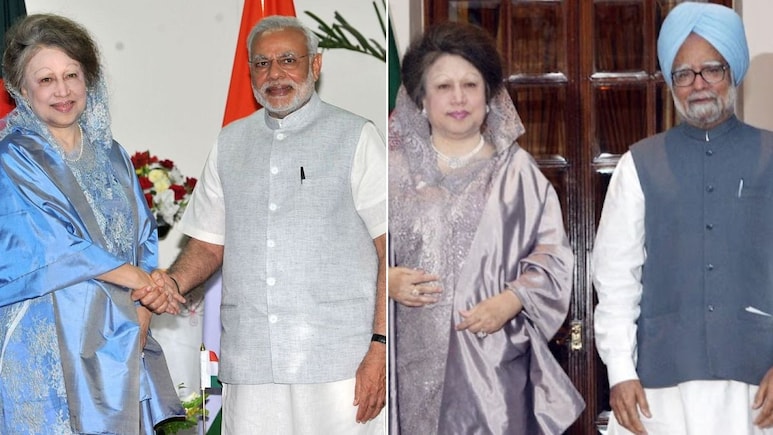
- Former Bangladesh PM Khaleda Zia died after a prolonged illness at age 80
- She served two terms as PM and led the Bangladesh Nationalist Party
- Zia opposed India's transit rights and prioritised Bangladeshi sovereignty
Former Bangladesh Prime Minister Khaleda Zia – seen as a leading contender in next year's general election – died after a prolonged illness early Tuesday. Zia, 80, was being treated for infections in her heart and lungs, and was also suffering from pneumonia, national dailies said.
Begum Khaleda Zia was the first woman to become Prime Minister of Bangladesh; she served two full terms a decade apart – from 1991 to 1996 and 2001 to 2006, and was Chairperson of the Bangladesh Nationalist Party. She is also credited with the replacement of the country's presidential system with a parliamentary one – via a referendum in 1991 - so administrarive power rests with the prime minister.
Zia was one of two women to dominate Bangladeshi politics over the past three decades
The other is Awami League boss Sheikh Hasina, a five-time Prime Minister whose government was overthrown in August 2024 amid violent protests over a jobs quota system.
Zia and Hasina – who is now in exile in India and faces a death sentence if she returns home – differed in their approach to foreign policy, specifically when it came to the India question.
While the latter is widely seen as a friendly face, Zia maintained an overall cautious, even adversarial in some respects, position in her early years, underscored by prioritising Bangladeshi sovereignty.
An example of this is her sustained opposition to overland transit and connectivity links with India, both as PM and as Leader of the Opposition, a post she held twice from 1996 to 2014.
As Prime Minister, Khaleda Zia refused India transit rights across Bangladeshi territory to the northeastern states, arguing it infringed on her country's security and sovereignty. She also argued Indian trucks' toll-free use of Bangladeshi roads was akin to 'slavery'.
She also opposed renewal of the 1972 Indo-Bangladesh Friendship Treaty, which many saw as strategically important from a military perspective, arguing, again, it had 'shackled' her country.
Positioning her BNP as a 'protector of Bangladesh's interests', Zia is seen as having framed policies as 'defence against Indian domination'; at a Dhaka rally in 2018, for example, when Hasina was Prime Minister and she the LoP, Zia railed against Hasina for exempting India from paying transit duties and said, "We will resist the move to turn Bangladesh into a state of India."
But Zia's focus wasn't so much on the denial of transit rights as it was tying it to concrete gains for her country. A 2014 report by Bangladeshi newspaper Dhaka Tribune, for example, quoted her as saying transit permission must be balanced by the signing of the Teesta water accord.
READ | Khaleda Zia, Bangladesh's 1st Woman PM, Had An India Connection
By linking transit permits to unresolved security and water concerns, her stance was seen as converting demands for regional integration into a bargaining chip to limit Indian influence.
There was also criticism of India's Farakka Barrage that has been operational since 1975 to divert water from the Ganges into the Hooghly, via a feeder canal. The barrage not only reduces silt and helps navigability in and around Kolkata Port, it also provides the city with fresh water.
Zia, though, argued the structure deprived Bangladesh of Ganges water; in fact, in 2007 she accused India of having deliberately opened sluice gates to worsen floods in her country.
The confrontational stance extended beyond transit and infrastructure.
In 2002 she actively pursued defence deals with China while snubbing India. A deal signed that year made Beijing Dhaka's primary supplier for tanks, frigates, and other military equipment.
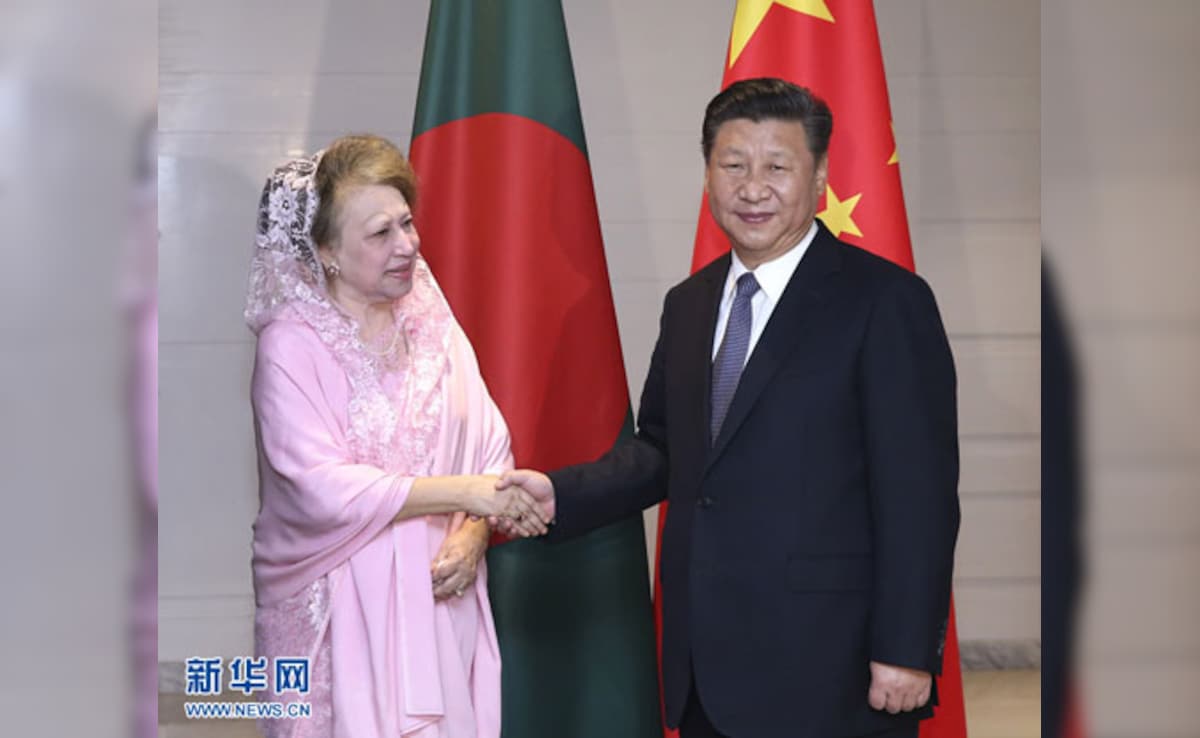
Zia meets Xi Jinping in Beijing. Photo: Ministry of Foreign Affairs, People's Republic of China
The narrative, again, was to 'guard against Indian overreach'.
India's response was guided by the perception of a direct strategic threat, particularly Zia's China arms move, and Delhi stepped up diplomatic pressure, including a counter-offensive that involved accusing her BNP government of sheltering separatists and terrorists operating in the northeastern states.
Zia had earlier publicly referred to separatist groups – like ULFA and NSCN – as 'freedom fighters' and drew parallels to Bangladesh's own independence struggle.
But her anti-India stance was not without pragmatic considerations.
The 1992 Tin Bigha Corridor lease, which gives Dhaka perpetual access to Dahagram-Angarpota – an enclave but located 200 metres inside Indian territory – is an example.
Dahagram-Angarpota is the only one of its kind left between the two countries.
That pragmatism was also evident in 2006, when she visited India as Prime Minister and signed a revised trade agreement and a new anti-drug smuggling accord with India.
However, Zia's relationship with India – often far more strained than Sheikh Hasina's ties with Delhi – evolved post-2012, after a visit to Delhi to meet then-Prime Minister Manmohan Singh.
Among the headline points from that visit was a pledge that future BNP governments would act against terrorist groups operating from Bangladeshi soil to attack Indian targets. The visit, at India's invitation, was widely seen as a strategic pivot in BNP policies before the 2014 election.
That outreach extended to meetings with Prime Minister Narendra Modi post-2014.
In fact, PM Modi met Zia in Dhaka in June 2015, during his visit to Bangladesh. The meeting was unusual - not just because Zia was then Leader of the Opposition - but also because it underlined the BNP's intent to engage with Delhi and Delhi's desire to broaden ties with Dhaka beyond Hasina.
But the tension never fully went away. Between 2016 and 2024 there were instances in which Zia's anti-India rhetoric - accusing Delhi of backing authoritarianism and highlighting unresolved issues like border killing - was in sharp focus, particularly against the friendlier position of Hasina's Awami League.
However, there was a notable thaw after August 2024 - when Sheikh Hasina was deposed, with the BNP signalling 'equal and respectful' ties and breaking with Islamic political group Jamaat-e-Islami.
And, as her health deteriorated, PM Modi said on X, "... deeply concerned to learn about the health of Begum Khaleda Zia, who has contributed to Bangladesh's public life for many years."
That prompted BNP praise for a 'gesture of goodwill'.
Deeply saddened to learn about the passing away of former Prime Minister and BNP Chairperson Begum Khaleda Zia in Dhaka.
— Narendra Modi (@narendramodi) December 30, 2025
Our sincerest condolences to her family and all the people of Bangladesh. May the Almighty grant her family the fortitude to bear this tragic loss.
As the… pic.twitter.com/BLg6K52vak
And, when her death was confirmed, the PM expressed sorrow, writing on X, "As the first woman PM of Bangladesh, her important contributions towards the development of Bangladesh, as well as India-Bangladesh relations, will be remembered. I recall my warm meeting with her in Dhaka in 2015..."
NDTV is now available on WhatsApp channels. Click on the link to get all the latest updates from NDTV on your chat.
Track Latest News Live on NDTV.com and get news updates from India and around the world


